The question of whether AI in healthcare should be adopted already has a clear answer. But that acceptance reveals a whole new layer of questions and at its core it is: What does it cost to implement AI in healthcare?
For decision-makers, this is often a bigger concern—bigger than identifying new ways to integrate AI into their clinical workflows. You might be a healthtech startup founder evaluating a healthcare app development initiative. Or perhaps you’re part of the IT leadership team at a major healthcare organization. Or maybe you’re part of the IT leadership team at a healthcare organization. In either case, you’re likely looking for a quote to get things started. But that controlled estimate almost always inflates. Why? It’s due to hidden complexities such as fragmented data, compliance requirements, and legacy system dependencies.
The challenge is that healthcare AI budgets rarely stop at development costs. Data readiness, EHR integration, compliance validation, infrastructure, and ongoing system maintenance all contribute to the final investment. Underestimating any of these factors can lead to delays, scope changes, and a higher total cost of ownership than initially planned.
If you’re evaluating vendors or planning a 2026 budget that accounts for the cost of implementing AI in healthcare, this blog breaks down real cost drivers and helps you build a budget that remains realistic as implementation moves forward.
Key Takeaways:
- Budgets under $50K are limited to administrative automation. Anything touching clinical workflows moves beyond that quickly
- Most production systems land between $150K and $1M once integration and compliance are accounted for
- Total cost of ownership usually reaches 3-6x of the initial build cost over time
- Data readiness and EHR integration influence budget more than the AI model itself
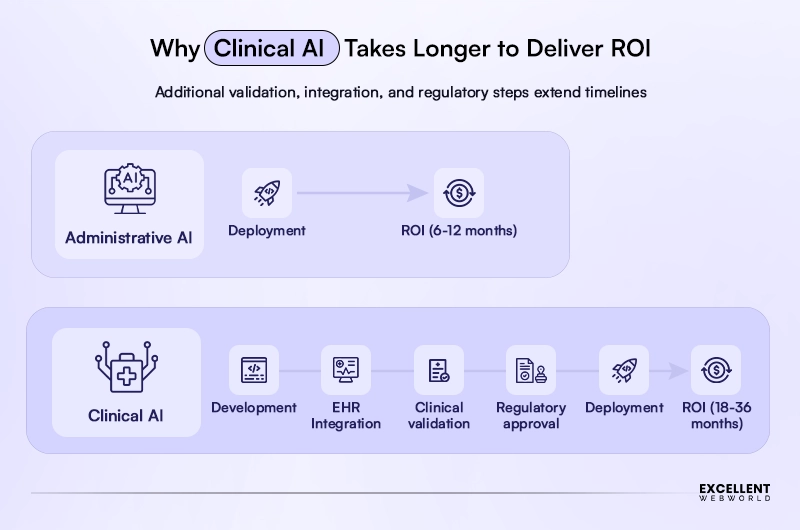
- Administrative AI shows ROI within 6-12 months. Clinical systems take longer due to validation and compliance
- If data and integration are not scoped early, budgets tend to expand after the project starts
What Does Healthcare AI Implementation Cost Actually?
Across most instances, you’ll come across a surface-level range of $40K-$100K. These numbers reflect build cost, not what it takes to make the AI system work inside a real healthcare environment.
When we scope projects, especially for custom AI development, we help the decision-makers map the cost ranges to the type of system being built first. The table below follows the same approach.
| Requirement | Cost Range | Timeline | Key Cost Driver | Use Case Fit |
|---|---|---|---|---|
| Patient chatbots & scheduling automation | $10,000 – $50,000 | 4-8 weeks | Integration with existing systems + NLP model & HIPAA hosting | Admin automation for multi-location clinics handling high patient query volume |
| Clinical documentation & workflow automation | $50,000 – $150,000 | 2-4 months | Data structuring, EHR integration and model tuning | Documentation and coding automation across hospital departments to reduce physician admin load |
| Diagnostic AI (imaging, computer vision) | $100,000 – $500,000+ | 4-8 months | Data labelling, DICOM/PACS integration and FDA regulatory requirements | Radiology and pathology workflows requiring high diagnostic accuracy and regulatory validation |
| Predictive analytics & clinical decision support | $200,000 – $1 million+ | 6-12 months | Data pipeline readiness, MLOps and system integration | Risk stratification and care optimization embedded into clinical decision workflows |
| Enterprise-wide AI deployment | $1 million – $5 million + | 6-18 months | Cross-system integration and compliance | Full-scale digital health transformation across departments with deep EHR integration and compliance layers |
“Healthcare organizations often budget based on the cost of building the AI solution itself. In our experience, the real cost profile emerges when the system needs to integrate with clinical workflows, connect to multiple data sources, and meet regulatory requirements. That’s typically where projects move into a higher cost tier than originally anticipated.”
 CTO, Excellent Webworld
6 Factors Affecting The Cost of AI Implementation in Healthcare
When we break down AI budgets for healthcare teams, instead of landing on a single number, we advise them to carefully review the layers that push the cost up. The idea here is to see past the initial build cost and consider the total cost of ownership (TCO). Based on projects we’ve delivered, that estimate often rises to 3-6 times the initial development cost once you account for infrastructure, compliance, and operations.
1. Solution Complexity and Use Case
The first thing we look at when estimating healthcare AI costs isn’t the technology itself but the role the system is expected to play.
Administrative AI systems tend to be the most cost-effective category of healthcare AI implementations. This includes many generative AI healthcare applications focused on patient communication as well as documentation support and admin assistance. For instance, the cost of developing an AI chatbot used by patients for routine questions or to automate appointments generally falls within the $10,000 to $50,000 range. But as AI moves closer to the clinical decision-making workflows, the cost moves with it too. Systems built for documentation, diagnosis, risk prediction, or treatment decisions can now cost anywhere between $200,000 and $1M.
What drives that jump isn’t necessarily a more sophisticated model. It’s the additional burden of validation, oversight, and accountability. The closer an AI system gets to influencing patient outcomes, the more organizations have to invest in proving that it performs safely and reliably.
Agentic AI pushes this even further. Instead of responding to requests, these systems can execute actions across workflows, which introduces new requirements around orchestration, monitoring, and failure management. As a result, agentic healthcare AI initiatives usually start in the $300K to 1M+ range before large-scale deployment even begins.
2. Data Readiness and Preparation
One of the most common assumptions in healthcare AI projects is that existing data is ready for AI. In reality, patient records are often spread across EHRs, imaging systems, billing platforms, and third-party tools, with varying levels of quality and consistency. That creates a challenge long before model development even begins as the data has to be cleaned, standardized, mapped, and validated before it can be used reliably. Depending on the state of the data, preparation alone can account for 20-60% of the total project budget.
We’ve even seen situations where teams felt ready to begin model development, only to discover that patient records from different systems used entirely different naming conventions and data structures. So even though nothing was technically broken, the data simply wasn’t consistent enough for the AI system to interpret reliably.
Counterintuitively, more data doesn’t always mean more work. We’ve seen smaller datasets become the bigger budget problem simply because the information was scattered across too many systems and formats.
The interesting part is that many healthcare organizations already have enough data to support AI initiatives. The challenge isn’t finding it. It’s turning years of disconnected records into something an AI system can actually work with.
3. Infrastructure: Cloud vs On-Premises
Unlike data preparation or integration, infrastructure doesn’t really feel like the biggest budget concern for the cost of implementing AI in healthcare. Initial costs can begin around $10,000 and exceed $100,000+, but the more important question is how those costs behave over time.
Cloud deployments make it easier to get systems running quickly and avoid large upfront investments. That’s one reason they’re often preferred during early implementation. The tradeoff becomes visible later in the form of:
- Compute usage
- Model retraining
- Real-time processing requirements
- High-volume data workloads
On-premises environments flip that equation. More of the spending happens before deployment through investments in hardware, security, and maintenance, but organizations gain greater control over infrastructure and long-term operating costs.
4. EHR/EMR Integration Complexity
If there’s one line item that surprises healthcare teams repeatedly, it’s integration. Costs can easily add $20,000 to $100,000+ to the overall implementation budget. On paper, that can look like a secondary expense compared to model development but speaking from experience, it’s often one of the main reasons budgets and timelines start drifting away from their original estimates.
Part of the challenge lies in the environment the AI system is expected to operate within. Patient data may sit across multiple EHRs, imaging platforms, billing systems, and legacy applications each with its own standards, workflows, limitations, and varying levels of FHIR interoperability. The work goes beyond simply connecting systems though. Organizations exploring large-scale AI integration often discover that the challenge lies less in the model itself and more in how that model interacts with existing software ecosystems. Information has to move reliably, appear where clinicians expect it, and fit naturally into existing workflows.
That’s why similar AI solutions can carry very different implementation costs. The model may remain largely unchanged, while the integration effort varies significantly from one healthcare organization to another.
5. Regulatory Compliance Pathway
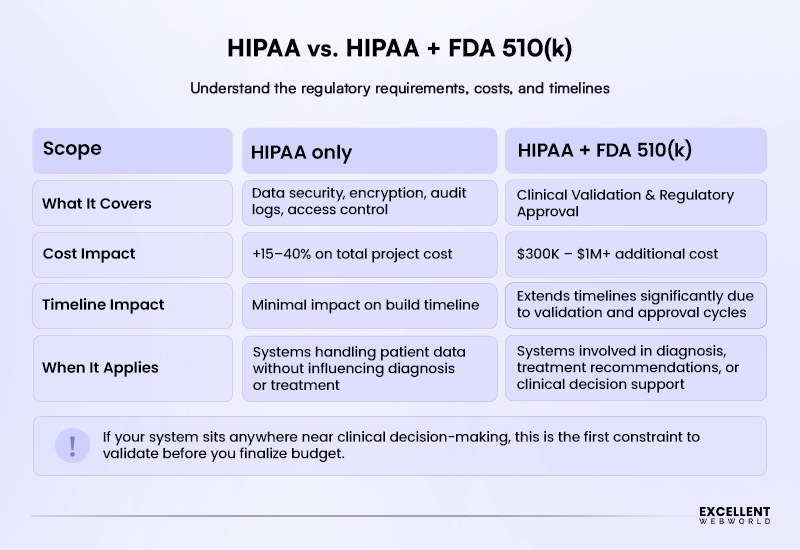
Unlike infrastructure choices or team structures, compliance isn’t something you can scale back to save budget. Regardless of the use case, requirements around data security, auditability, validation, and governance become part of the implementation scope, making compliance a significant contributor to both cost and timelines.
What makes this factor particularly important is that compliance requirements don’t scale linearly. A minor change in how an AI system is used can move it into an entirely different regulatory category with a very different budget profile.
- If the system handles patient data, and this operates under a HIPAA-only scope, compliance adds 15-40% to the total project cost.
- Once a solution qualifies as Software as a Medical Device (SaMD) and requires FDA 510(k) clearance, additional costs associated with clinical validation, testing protocols, documentation, and regulatory submission can push budgets into the $300,000 to $1M+ range.
6. Team model: in-house vs outsourced
How you build the system changes both cost and speed. In-house teams give you control but require hiring and ramp-up. External teams vary by geography and experience.
- US-based AI development teams cost more but align closely with regulatory and clinical requirements.
- India-based AI development teams can reduce development cost by 2-3X, especially for well-scoped implementations.
| Factor | US-Based Teams | India-Based Teams |
|---|---|---|
| Cost Range | Higher baseline cost across development and integration | Typically 2-3x lower for similar scope |
| Healthcare Experience | Strong alignment with regulatory and clinical workflows | Varies by vendor; requires validation of healthcare-specific experience |
| Communication & Coordination | Easier alignment with internal teams | Requires tighter coordination, especially across time zones |
| Speed of Execution | Stable, predictable timeline | Can be faster for well-scoped builds, slower if requirements are unclear |
| Best Fit | Complex clinical systems, FDA-bound projects, high regulatory exposure | Cost-sensitive builds, well-defined scopes, admin and mid-complexity systems |
These factors don’t operate in isolation. They stack, much like what you see in a broader software development cost breakdowns, where infrastructure, integration, and long-term maintenance reshape the initial estimate.
Hidden Costs of AI That Most Healthcare Organizations Miss
Before you sign a statement of work, there are a few budget conversations we make a point of having. Not because these costs are unusual, but because they tend to sit outside the initial estimates and surface later in the project.
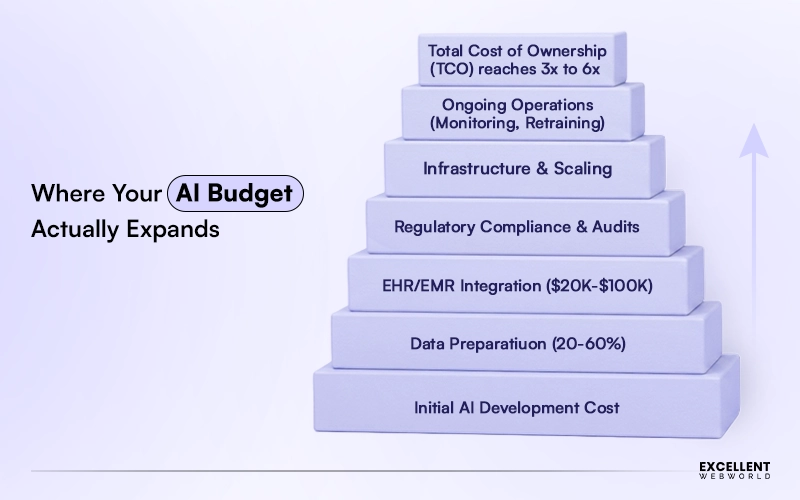
We remind the leadership teams that the build is merely the starting point. Getting the system to work inside a healthcare environment is where costs actually expand, especially when you consider how healthcare software modernization transforms clinical operations at scale.
“The model you launch won’t be the model you’re running a year from now.”
Clinical terminology evolves, treatment protocols change, and new data enters the system, which may lead to performance drifts if left unchecked.
That’s why monitoring, validation, and retraining often become recurring costs even when the original budget only accounts for development.
For a closer look at how these systems perform across clinical settings, see our guide on AI in healthcare examples.
“Compliance has a habit of sticking around long after deployment.”
It’s easy to view it as a milestone on the path to launch. In reality, annual HIPAA audits, security assessments, and governance activities continue long after the system goes live, often adding $20,000-$200,000 in recurring operational costs.
Regulatory requirements also have a tendency to evolve alongside the system. A deployment that begins with a relatively straightforward compliance scope may require additional oversight, documentation, or governance measures as usage expands.
“Sometimes the technology works exactly as intended and adoption is still slow.”
For large healthcare organizations, getting clinicians and staff to trust a new system can require significant investment in training, workflow redesign, and adoption programs. For a 500-bed hospital, that effort can add $300,000-$600,000 to the total cost of ownership.
“Not every AI project begins with data that’s ready for training.”
In some cases, the real work starts with creating the dataset itself. For example, radiology images may need annotation from specialists. Similarly, clinical notes may require categorization by coding experts.
Before development begins, data labelling alone can add $50,000-$250,000 to the budget.
“A successful pilot can create a whole new budgeting complication.”
It sounds backwards, but we’ve seen successful pilots create more budget pressure than unsuccessful ones. The moment leadership decides to scale beyond a single department, new integrations, governance controls, support processes, and infrastructure requirements start entering the picture. What looked like a contained implementation can quickly become an organization-wide initiative with a very different cost structure.
Off-the-Shelf vs Custom Healthcare AI: The Cost Decision Framework
Now, let’s understand the different development and deployment strategies for implementing AI in healthcare. While each of these approaches has its cost range and timeline, ultimately, it’s your end goal that determines what works best for your system.
| Approach | Cost Range | Timeline | Best For |
|---|---|---|---|
| Off-the-Shelf | $20K–$50K + licensing | 2-8 weeks | Admin automation, scheduling, basic patient interactions |
| Hybrid | $50K–$300K | 2-4 months | Early-stage teams needing quick assistance in clinical documentation, prior auth, and coding |
| Custom-build | $300K-5M+ | 6-18 months | Diagnostic AI, decision support systems, deep EHR integration, FDA-bound systems |
When to Choose Off-the-Shelf vs Hybrid vs Custom AI in Healthcare
(A) Off-the-Shelf AI Solutions
- A strong fit if you’re implementing an AI chatbot for appointment scheduling or patient query handling.
- Built for predictable, administrative workflows where speed matters more than customization.
- Helps reduce manual workload without introducing the complexity of a custom build.
- Usually the quickest way to get from idea to deployment.
(B) Hybrid AI Approach
- Makes sense when you need more flexibility than an off-the-shelf product can offer, but don’t want to build everything from scratch.
- Commonly used for patient engagement platforms and internal workflow automation. Prior authorization workflows are another common starting point, particularly when organizations want faster operational gains without committing to a fully custom build.
- Works well when partial EHR integration is required.
- Lets you move faster by using existing components while customizing the parts that actually affect your operations.
- Often the choice for teams looking to validate ROI before committing to a larger investment.
(C) Custom AI Healthcare Solutions
- Usually becomes necessary when the AI system is expected to support or influence clinical decisions.
- A better fit for Clinical Decision Support Systems (CDSS), diagnostic tools, and other clinical-grade applications.
- Gives you greater control over data, validation processes, and model behaviour.
- Often required when deep EHR integration, HIPAA requirements, or FDA 510(k) pathways enter the picture.
- The goal here isn’t faster deployment. It’s clinical accuracy, compliance, and long-term ownership of the system.
From how we’ve seen this play out across projects, the path is usually clear:
- Start with off-the-shelf or hybrid when the focus is on automation and operational efficiency. These approaches come with proven vendors, faster timelines, and acceptable accuracy for admin workflows
- Go for custom-built AI when the system is expected to make or influence clinical decisions. This requires deep EHR integration, FDA clearance in many cases, and controlled models trained on your own patient data, especially when outputs impact diagnosis, prognosis, or treatment decisions
How to Calculate ROI of AI in Healthcare: A Practical Framework
While implementing AI in healthcare has countless isolated benefits, the correct way to evaluate ROI is by tying the system as a whole to measurable financial impact across workflows, not a single outcome.
If you’re putting forward an AI initiative, this is the model that usually gets reviewed internally by finance, operations, and leadership before approval.
At a basic level, this is the structure most teams use:
× 100
What matters is how you define net financial benefit. This is usually the part that gets reviewed when budgets are questioned internally.
If the impact is not tied to measurable outcomes across workflows, the numbers don’t hold during approval.
Let’s apply the formula using a simple example:
Imagine a healthcare organization invests $1 million in an AI-powered clinical documentation and patient engagement platform.
Over the following year, the system:
- Saves $3 million in physician time
- Generated $1.2 million through readmission reduction
- Recovers $1.4 million through coding optimization
This creates a net financial benefit of $5.6 million.
Applying the formula:
× 100
ROI = 460%
Similar ROI calculations are often used when evaluating broader AI development cost projections before implementation begins.
Note: Of course, very few organizations see value distributed this neatly in practice. The example simply illustrates how multiple operational improvements combine into a single ROI calculation.
So where does the ROI actually come from? How does AI reduce costs in healthcare at the workflow level?
Not from the model itself. And not from accuracy metrics sitting on a dashboard.
Once the AI system starts interacting with your healthcare workflows, ROI shows up in very specific and measurable areas.
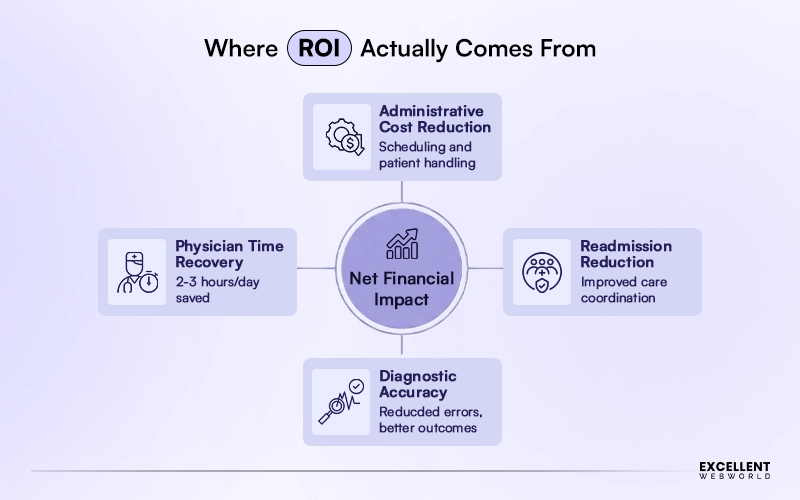
- The first one is administrative cost. This is usually where teams see movement fastest. Scheduling, documentation, and patient communication are repetitive systems. Once automation kicks in, the dependency on admin staff and external support drops almost immediately.
- Then there’s physician time. Oddly enough, this is often where the biggest value sits and where the initial ROI calculations tend to be the most conservative. AI-assisted documentation alone can give back 2-3 hours per physician, per day. When you translate that into actual numbers, it lands somewhere between $50K and $150K per physician annually. That isn’t theoretical ROI. It’s practical, recovered capacity.
- Readmissions are different. Their benefits don’t show up as immediate savings, but they directly impact revenue. In value-based care models, higher readmission rates lead to reduced reimbursements. AI systems that improve risk prediction or care coordination for readmission reduction don’t require large gains. Even small reductions help avoid those cuts. At scale, that becomes a consistent financial lever.
- Diagnostic accuracy drives the highest long-term ROI. But it’s less visible upfront. The value comes from what gets avoided: missed diagnoses, delayed treatments, unnecessary procedures. Over time, that’s where the greatest cost recovery happens, especially in high-volume systems.
ROI Timeline Differences: Administrative Automation vs Clinical AI
| Use Case | Average ROI Timeline | Where ROI Comes From | What Delays ROI |
|---|---|---|---|
| Administrative AI | 6-12 months | Reduced admin costs, faster patient handling, staff time savings | Minimal; mostly adoption and workflow alignment |
| Clinical AI (CDSS, diagnostics) | 18-36 months | Diagnostic accuracy, readmission reduction, physician productivity | Validation cycles, EHR integration, regulatory approval |
Mapping ROI To Real Implementations
In one implementation, our team at Excellent WebWorld developed an AI-powered virtual health assistant for a hospital network in the U.S. to handle patient interactions and scheduling.
The impact showed up quickly at the operational level. Administrative workload dropped and patient interactions were handled faster without increasing team size. As the system integrated with EHR workflows, the ROI became measurable.
- Achieved 90% accuracy in EHR data standardization, improving reliability of patient records
- Reduced diagnostic inaccuracies by 70%, supporting more consistent clinical decision-making
- Lowered total cost of ownership by 50% through automation and operational efficiency gains
- Reduced administrative workload and improved patient response times with 24/7 availability across channels
This is how ROI builds in most healthcare AI systems. It starts with operational efficiency, then compounds as the system becomes part of clinical and administrative workflows.
On paper, the budget looks stable at this stage.
The pressure builds when the system has to connect to real workflows, real data, and compliance requirements. That’s the part most proposals don’t fully account for.
How Our Phased AI Implementation Model for Healthcare Works At Excellent WebWorld
If you’ve worked through the cost of implementing AI in healthcare and the ROI layers, the next decision is how to move forward without losing control of the budget midway through execution.
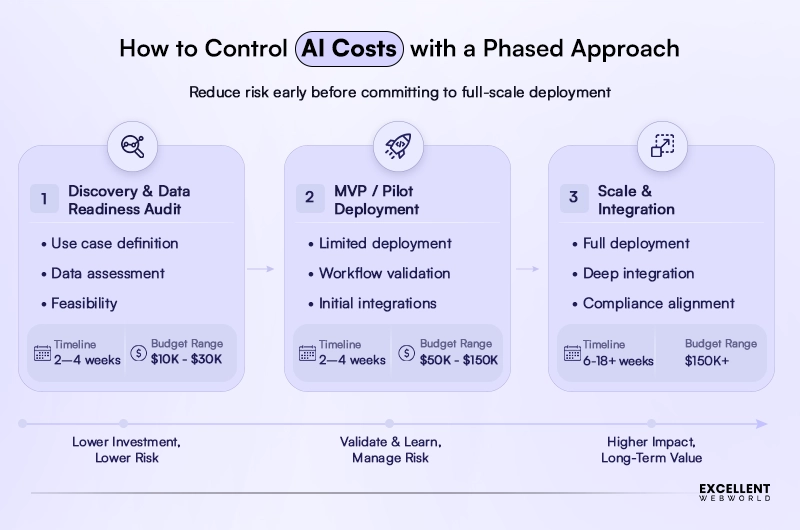
The way we handle this at Excellent WebWorld is by isolating risk early, before full-scale development begins.
| Phase | Scope | Timeline | Budget Range |
|---|---|---|---|
| Phase 1: Discovery & Data Readiness Audit | Use case definition, data assessment, feasibility, validation, integration mapping | 4-6 weeks | $15,000 – $30,000 |
| Phase 2: MVP/Pilot Deployment | Focused AI model development, limited-scope deployment, workflow validation, initial integrations | 8-12 weeks | $50,000 – $150,000 |
| Phase 3: Scale & Integration | Full system deployment, deep EHR integration, performance optimization, compliance alignment | 3-6 months | $150,000 – $500,000+ |
Our dedicated AI development services at Excellent WebWorld start by removing the unknowns. That usually means validating data quality, integration constraints, and regulatory exposure before any major investment is locked in.
Most healthcare teams we work with begin at Phase 1 exactly for that reason. It gives them a clear picture of what the system will actually cost before moving into development.
If you’re budgeting for AI implementation in healthcare in 2026, the bigger risk isn’t overpaying upfront. The nuances lie in committing to a number that doesn’t hold once integration, data readiness, and compliance come into scope.
The teams that stay on budget are the ones that validate these layers early, before moving into full-scale development.
This is usually where we start at Excellent WebWorld. The discovery phase is where the actual cost becomes clear before any major investment is locked in.
Frequently Asked Questions
The cost of implementing AI in healthcare ranges from $40,000 to $500,000+ depending on the use case, level of integration, and regulatory requirements. Administrative systems sit on the lower end, while clinical AI systems involving EHR integration and FDA pathways move towards the higher range.
What are often called hidden costs are usually indirect cost drivers that don’t appear in initial estimates. These include data preparation (20-60% of project budget), EHR integration ($20K-$100K+), compliance audits ($20K-$200K annually) and workforce training ($300K-$600K for large hospitals).
ROI timelines depend on the type of system being implemented. Administrative AI solutions tend to show returns within 6-12 months through cost reduction and time savings. Clinical AI systems, such as diagnostic tools or decision support, usually take 18-36 months due to validation, integration, and regulatory requirements.
Buying off-the-shelf AI is cheaper upfront and works well for administrative use cases like scheduling or patient communication. However, custom-built AI becomes necessary when systems require deep EHR integration, clinical decision-making, or regulatory approval.
HIPAA compliance usually adds 15-40% to the total cost of AI implementation in healthcare. This includes secure data handling, encryption, audit logging, and access controls. If the system also requires FDA 510(k) clearance as a medical device, costs increase further. Compliance is not a one-time expense and continues post-deployment.
Post-deployment costs include model retraining, infrastructure, monitoring, and compliance updates. Most teams should plan for 15-25% of the initial development cost annually for maintenance.
Smaller providers can start with off-the-shelf or hybrid AI solutions in the $20K-$50K range for administrative automation. As needs evolve, they can move toward more customized solutions. This phased approach helps control costs while building toward more advanced use cases.

Article By


Paresh Sagar is the CEO of Excellent Webworld. He firmly believes in using technology to solve challenges. His dedication and attention to detail make him an expert in helping startups in different industries digitalize their businesses globally.