- Banks treating fintech APIs as optional aren’t just falling behind on technology; they’re losing real revenue to competitors who can ship new features in weeks.
- Embedded finance and AI-driven personalization turn API investment into a direct revenue driver.
- Every AI capability in modern banking – fraud detection, credit scoring, real-time risk checks – depends entirely on live data that only APIs can deliver.
- Legacy core systems don’t need to be replaced to modernize; APIs let banks layer new capability on top, cutting both cost and risk.
- The strongest fintech API use cases now span banking, payments, digital wallets, lending, BNPL, and insurance, rather than a single isolated department.
- The right API provider, not the biggest brand name, determines whether an integration ships on time or stalls for months.
- The next shift in fintech APIs is to build for AI agents as primary users, not just to design around human-facing apps.
Banks blame their core banking system for stalled digital transformation, but in my experience advising on integration strategy, the real blocker is hesitation to commit.
C-level executives spend months comparing fintech API use cases on paper, without ever narrowing down to the one that actually fits their architecture and compliance needs. That indecision has a cost, and it’s a measurable one.
McKinsey’s survey report estimates that banks skipping AI-led integrations miss $200–340 billion annually in AI-driven banking productivity gains, none of which would be possible without API-connected banking data. Gartner’s 2026 CIO survey report confirms this: 55% of banks deployed Generative AI in 2025, and 26% more plan to by 2026; all built on API infrastructure.
Over the last 15+ years, I’ve helped many banks navigate this situation. Based on this hands-on experience of handling various fintech projects, I’ve written this blog to help you break down:
Fintech API use cases & where it delivers maximum ROI, create a robust security & compliance posture, and choose the right fintech app development company that can help you achieve your objectives.
What are Fintech APIs?
A fintech API is a connector that enables your core banking system to communicate with lending platforms, payment processors, and AI tools without disrupting existing infrastructure. Most banks aren’t short on ambition; they’re stuck with legacy systems that can’t accommodate anything new, and that gap is what has pushed fintech APIs from “nice to have” to the backbone of digital finance. Today, real-time payments, fraud detection, Open Banking, and embedded finance all run on some form of fintech API integration working quietly in the background.
What are the Best Use Cases of APIs in Fintech?
Over the years, I’ve worked with plenty of fintech institutions. From that experience, I can definitely say I’ve seen plenty of fintech companies build detailed integration plans that never reach the production stage. The ones that succeeded had one thing in common: they focused on real-world fintech API use cases running in production, and not on theory.
Here are some of the best fintech API use cases for 2026:
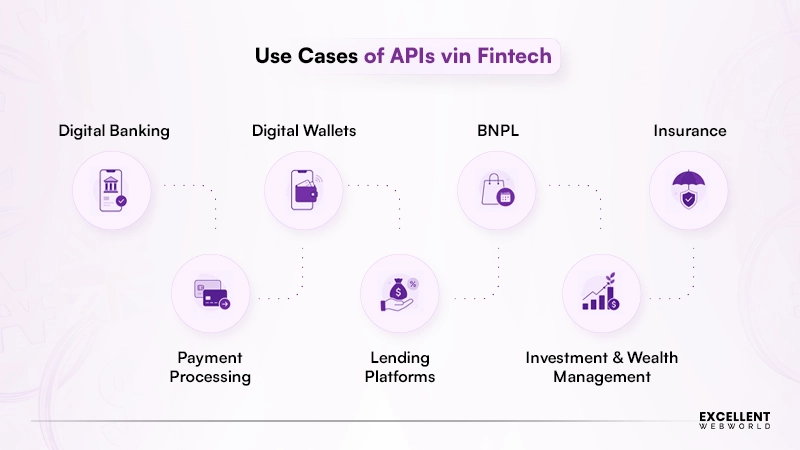
1. Digital Banking Runs on Borrowed Infrastructure, Not a New License
With the help of APIs, neobanks, one of the most prominent digital banking types, launch full-fledged banking products without even owning a core banking system. With APIs in fintech, neobank app development now takes a few months rather than years, as the infrastructure and licensing shift to the partner bank rather than the neobank owner.
Chime runs entirely on this model, as it provides paycheck access, savings, and check-writing services through partner bank APIs. According to the American Bankers Association, 54% of U.S consumers use digital banking services. This clearly shows that API-driven digital banking is the need of the hour, and banks that don’t adopt this trend will lose out on customers.
2. Payment Processing Now Runs on Milliseconds, Not Overnight Batches
Real-time payments APIs allow money to move between accounts instantly, rather than waiting for next-day settlement. Stripe’s payment gateway infrastructure is a prime example, powering checkout flows for a major chunk of US eCommerce websites and making that speed the new normal rather than a premium feature.
3. Digital Wallets Combine Three APIs Into One Product
A digital wallet API combines identity verification, card issuance, and payment processing into a single layer, reducing build time for such apps. Cash App and Venmo both run on this type of API stack rather than customized infrastructure, and as a result, they can scale up much faster than some legacy fintech applications.
4. Lending Platforms Now Score Risk With AI, Not Static Rules
Fintech APIs provide lenders with live income and transaction data rather than static paperwork, and that data feeds into AI models that deliver real-time credit scoring. Upstart runs exactly on this type of approach, and in the near future, you’ll see AI in fintech, especially AI-driven credit scoring, becoming the norm.
5. BNPL Depends Entirely on Three APIs Working Together
BNPL app development depends on three major APIs – checkout, credit scoring, and repayment tracking – to integrate into one consolidated workflow. Missing any of these three components can stall a BNPL (Buy Now, Pay Later) launch midway, underscoring the importance of fintech APIs in BNPL. Affirm’s checkout financing is the perfect example of this as it embeds installment options directly into a retailer’s existing purchase flow.
6. Investment & Wealth Management Can’t Tolerate a Second of Lag
APIs that stream live market data and portfolio positions in real time are pillars of wealth management software development. A small delay in this type of application can directly cost the customer money. Robinhood’s brokerage system is a great example of this category as it uses fintech APIs to avoid even a few seconds of data lag that could result in a missed trade.
7. Insurance Claims Now Get Scored the Moment They’re Filed
Insurance mobile app development is not what it was a few years ago. Earlier, claim processing took days and days of manual review before the customer saw a payout. To resolve that delay, insurers have now pushed toward automated claim scoring, made possible by a fraud detection API that provides real-time scoring and verification of the claim the moment it’s filed by the customer, instead of flagging it for manual review. Lemonade’s claims process runs entirely on this type of automated review system, providing faster claim processing.
In summary, standalone financial apps are disappearing, giving way to embedded finance use cases. On the other hand, there’s also a reverse trend in which banks are opening up their data and services to third-party providers, which is driving open finance use cases across the industry.
What Type of Fintech API Actually Solves Your Business Problem?
Every fintech API solves a different problem, and you need to identify the fintech API that aligns with your use case. From my experience, I’ve seen many fintech teams waste months building expensive custom APIs, instead of opting for readily available APIs that save time and money. To address this issue and help you understand the importance of banking APIs in fintech, I’ve created the following table to make decision-making easier for your business.
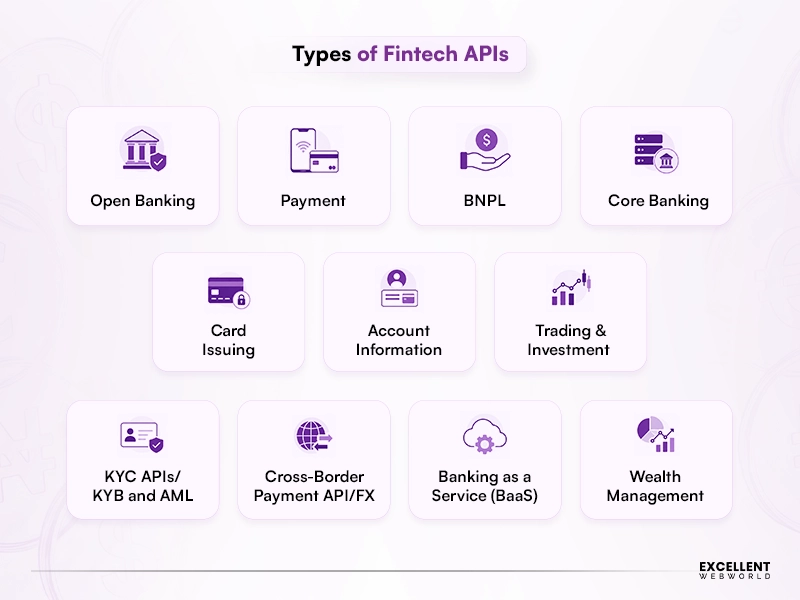
| API Type | Core Function | Who Uses It | Business Pain Point Solved | Real-World Examples |
|---|---|---|---|---|
| Open Banking APIs | Shares account data securely with third parties | Digital banks, fintech partners | Replaces manual data exports with real-time account access | Plaid, MX, Finicity |
| Payment APIs | Processes transactions and transfers in real time | Retail banks, PSPs | Cuts checkout steps through direct payment gateway integration services | Stripe, Adyen, Fiserv |
| Banking-as-a-Service (BaaS) API | Lets non-banks offer accounts, cards, and payments | Fintechs, digital-first banks | Removes the need for a banking license before launch | Synctera, Unit, Treasury Prime |
| KYC APIs/KYB and AML APIs | AI-driven identity verification and risk scoring | All regulated institutions | Cuts onboarding time from days to seconds per applicant | Persona, Alloy, Trulioo |
| Lending APIs/BNPL API | Powers instant, AI-assisted credit decisions | Lenders, NBFCs, retailers | Replaces manual underwriting queues with instant approval | Affirm, Klarna, Upstart |
| Wealth Management API | Connects investment and trading data in real time | Wealth platforms, banks | Removes data lag between trade execution and portfolio view | Plaid Investments, SigFig, Apex Fintech |
| Core Banking APIs | Connects legacy cores to modern digital layers | Mid-size to large banks | Adds new capability without touching the core system | Mambu, Thought Machine, Temenos |
| Card Issuing API | Issues virtual and physical cards programmatically | Fintechs, BaaS platforms | Shortens mobile banking app development timelines for card products | Marqeta, Lithic, Highnote |
| Cross-Border Payment API/FX API | Settles international transfers with live FX rates | Payment service providers | Removes manual FX rate lookups and delays | Wise, Airwallex, Currencycloud |
| Account Information API | Aggregates balances and transaction history | Budgeting apps, lenders | Consolidates fragmented account data into one view | Plaid, Yodlee, Akoya |
| Trading and Investment API | Executes trades and streams market data | Brokerages, wealth platforms | Removes latency between market data and trade execution | Alpaca, Tradier, DriveWealth |
What are the Top Benefits of APIs in Fintech?
People think that API investment is only relevant for the tech team. However, that’s not true at all. I’ve advised plenty of fintech businesses, and based on that experience, I’ve seen the return on investment on the business side in terms of speed to market, risk, and revenue. Here are the key benefits of APIs in fintech:
- New revenue streams without building a new product line: With an API in play, you can integrate a third-party lender’s or insurer’s product directly into your existing financial app. So you can keep customers in your app instead of referring them elsewhere, opening up new revenue streams. That’s what embedded finance looks like. According to Markets and Markets, embedded finance will become a $251.9 billion entity by 2029, with banks looking to capture this revenue.
- Fraud gets caught before the loss: APIs can deliver transaction data to a fraud detection model the moment a transaction occurs. That’s why fraud scoring can happen in real time through live feeds. API-driven automation in banking now detects fraud before money moves from one account to another, preventing financial losses that used to occur.
- Personalized offers that convert into actual sales: APIs can connect your mobile app, website, and branch systems into one consolidated customer experience, instead of three separate apps. According to a McKinsey study, a single consolidated view helps banks double digital sales and triple cross-sell sales, made possible by the best fintech APIs.
- New product launches in months: APIs let you reuse KYC, payment, and card infrastructure across new features instead of building from scratch. That’s an advantage of implementing an API-first fintech strategy, which is exactly why you see a lot of fintech partners creating a digital wallet and launching it in months instead of years.
- Launch a fintech without becoming the bank: APIs enable fintech institutions to call and use a partner bank’s licensed infrastructure instead of building their own core banking system. With that borrowed infrastructure, someone can start a fintech company in months today, rather than spending years on regulatory approval before writing a single line of code.
- The app finally matches what customers expect: APIs enable fraud detection, instant transfers, and real-time balance checks, all available in various apps. This real-time capability is what separates legacy bank apps from the best mobile payment apps on the market.
Top 8 Reasons Why Fintech APIs Are So Important Today
Banks that treat API support for fintech as optional are losing a massive amount of revenue to competitors who can ship new features in weeks rather than months. I’ve advised many banking teams through this shift, and based on this experience, I can say that whichever bank integrates faster will surge ahead in the fintech industry.
Here are the 8 reasons that make fintech APIs so important in the modern era:
- Helps you retain customers who’ve already gone digital: According to Juniper Research, more than 50% of the global population will start using digital banking services by the end of 2026. So, if your bank is still running those disconnected legacy systems, there’s every chance that you will lose out on a major chunk of your customer base. And if you want to retain customers, you need to digitize your services, and that’s where fintech APIs play a major role.
- Digital transformation initiatives have moved from the IT backlog to the boardroom: According to Deloitte’s industry report on digital banking, 26% of CIOs have named digitization their top strategic priority, and those initiatives depend on a reliable integration layer. That layer is built on fintech APIs.
- Legacy systems don’t need to be rebuilt for modernization: With API integrations for fintech in the picture, you can modernize your legacy banking systems on top of existing infrastructure without disrupting the existing workflows or rebuilding from scratch. It also reduces both implementation costs and operational risk.
- AI tools actually work as promised in the documentation: Any AI-powered capabilities only function well when they’re fed with current and real-time data, and fintech APIs exactly do that. Without fintech APIs in place, AI ends up operating on outdated information, which means customers keep repeating the same issue across departments.
- Compliance is simpler if integrations are standardized: Point-to-point connections between systems are where auditors most often raise the flag; there’s often a risk of a security loophole. Instead, if you use a standard fintech API layer, it will unify all the integrations into a single system, which makes it easier for compliance teams to monitor, and there’s less chance of queries from the auditor side.
- Close partnerships in weeks, not quarters: If the bank and fintech partner use the same standardized integrations, connecting their systems takes a few weeks rather than months. That’s where the role of API in the fintech industry comes into play, as it should provide standardized formats that enable partnership deals to close in a few weeks rather than quarters.
- Stop stretching your engineering team: An in-house engineering team for banks can’t handle a full integration workload as they have other priority tasks related to business operations and management. That’s why banks nowadays outsource software development services from a reputed tech partner, which helps them build an API layer. So, fintech APIs can also reduce the load on your in-house engineering team.
- APIs are where the money is flowing: According to Grand View Research, the open banking market will reach $135.17 billion by 2030. This growth is directly tied to fintech APIs, as banks that use them are driving capital, innovation, and competitive advantage. So, staying up to date with the latest fintech trends is the need of the hour for financial institutions.
How do Fintech APIs Work? Step-by-Step
Most financial institutions that I’ve worked with treat API integration as a task their engineering team will figure out mid-project, without knowing the actual sequence of how an API works. That is the primary reason integration timelines are delayed by months.
Here’s a step-by-step guide of how a fintech API works in the modern era:
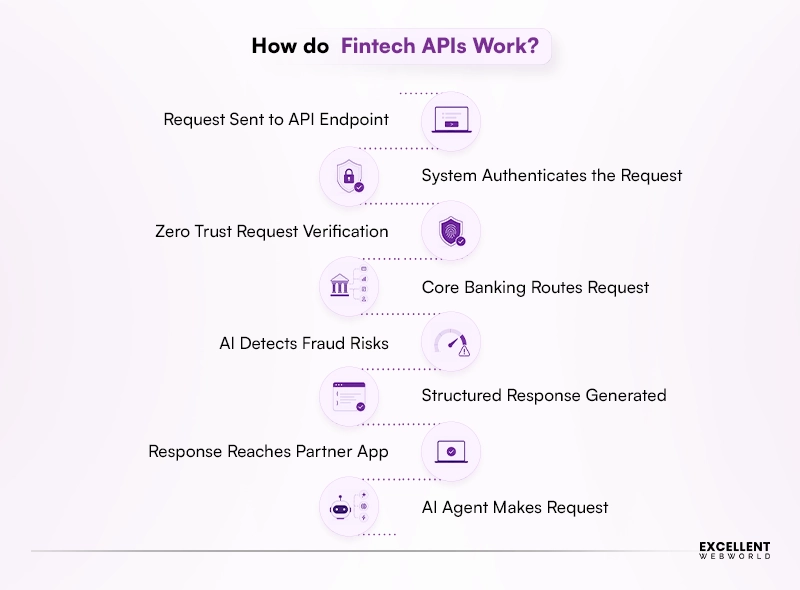
Step 1: A Request is Sent to a Specific API Endpoint
First, an app or the partner platform sends a request to the API endpoint for financial data. That could be related to a payment instruction, balance check, or transaction history. Before this request is formed, no further process can take place, and this is where most delays in the integration process happen.
Step 3: The Request is Verified Under a Zero Trust Model
API authentication in fintech has changed the most. Earlier, banks used to whitelist trusted partners and let their requests pass through freely. That approach has been exploited a lot by hackers, which is why the verification process has changed today. Today, with the zero-trust model, each request is treated as unfamiliar by default and re-verified each time, regardless of who the partner claims to be.
Step 4: The Core Banking System Routes the Call
Once the request passes verification, it moves to the core banking system. The core banking system then redirects it to the correct service, whether fund transfer, balance retrieval, or identity verification, without giving access to unrelated systems in the process. The same routing logic enables an online payment API to process transactions instantly, making the fintech API architecture flexible enough to add new features with ease.
Step 5: AI-Driven Fraud Detection Scores the Transaction
Here, the transaction passes through fraud detection, which now runs on multiple AI models to provide a risk score rather than relying on a single model. If the risk score is very high, it triggers extra verification rather than an automatic block.
This layered approach was created for these reasons. According to a survey report by SQ Magazine, financial institutions incur $4 billion in losses annually from API-related fraud, and attack traffic has increased by 600% in recent years. Given this criticality, fintech API security protocols have become standard, not optional, to tighten your security posture.
Step 6: A Structured Response is Returned
Once the transaction clears the fraud-checking stage, the system returns the data requested in the initial step. The same mechanism also powers balance checks, real-time fraud alerts, and the mobile banking trends customers now expect as a default rather than an add-on.
Step 7: The Response Reaches the Requesting App or Partner System
The partner platform receives the responses, and either displays them to customers or triggers the next action, such as confirming a payment or updating the account balance in real time.
Step 8: The Caller Is an AI Agent, Not a Human App
This is where the sequence looks pretty different from what it may have looked like a couple of years ago. In 2026, plenty of API requests will come from AI agents and LLMs querying financial systems. This clearly means that APIs in fintech are now being built to serve AI agents rather than customer-facing interfaces. So, banks need to plan for scalability and monitoring by keeping AI agents at the center.
Cloud solutions and services provide the infrastructure and elastic scaling that let each step handle real-time load. Data engineering services build the pipelines that ingest, transform, and structure the data as it moves through each step above. Skip either layer, and the sequence breaks long before it reaches the fraud check or the response.
What does Fintech API Security & Compliance Actually Require in 2026?
Based on my experience collaborating with various financial institutions as a technology partner, I can assure you that most fintech API compliance failures don’t stem from financial institutions’ ignorance. They come because compliance is added after the API is built.
Each compliance standard has a distinct risk profile for fintech products; therefore, treating them all equally in a single generic list is not sufficient. Here’s how each compliance standard works:
| Standard/Area | What It Covers | Who Needs It | Business Risk If Ignored | Role of AI in 2026 |
|---|---|---|---|---|
| Data Security | Every banking API encrypts data in transit and at rest. | All regulated institutions. | A single exposed endpoint can leak account data from thousands of users in a single incident. | AI-driven anomaly detection now flags unusual access patterns encryption alone would miss. |
| Authentication | Verifying every request via OAuth 2.0 and token-based checks, rather than static passwords, is central to serious fintech API development. | Every institution exposing customer data through an API. | Weak authentication remains one of the leading causes of API breaches across the industry. | AI-based risk scoring adds a real-time layer on top of static token checks. |
| PCI DSS | The security standard any institution must meet before touching card data, shaping how payment gateway development happens. | Institutions processing card transactions. | Losing certification halts payment processing for every merchant relying on that infrastructure. | AI continuously monitors transaction patterns rather than relying on periodic manual audits. |
| GDPR | Data handling rules that any bank must plan for when hiring a mobile app development company to build an app serving customers in the EU. | Banks serving international or cross-border customers. | Non-compliance risks direct fines and blocked access to EU customer data. | AI helps automate data classification and consent tracking across large customer datasets. |
| PSD2 | A strong customer authentication mandate that any founder looking to create a money lending app for international audiences has to design around from day one. | Fintechs expanding into EU markets. | Retrofitting this after launch costs significantly more than building it in from the start. | AI strengthens fraud checks layered on top of mandatory two-factor authentication. |
What are the Biggest Challenges and Risks of APIs in Fintech?
APIs can solve most of your burning issues. However, they can also create challenges. I’ve seen plenty of financial institutions unaware of the risks and challenges that come with APIs until their fintech app reaches production.
Here are seven of the most common challenges/risks that I’ve found while working with clients and possible fixes based on years of experience in providing fintech solutions:
1. Legacy Systems Don’t Connect Cleanly
Legacy system integration challenges are one of the first roadblocks for most financial institutions. The reason behind that is that old systems weren’t designed to accommodate modern APIs. So, if you try to force a direct connection, it may work fine in testing, but when it deals with real transaction volume, the system collapses immediately.
My Recommendation: Always build a middleware layer between the legacy system and the new fintech API. It will help you isolate old-system failures while protecting the new layer, saving a lot of time and effort.
2. Compliance Gets Messy When It’s an Afterthought
Fintech API compliance can be hard to achieve when security and legal teams join the conversation post-development or midway through development. Because of this timing gap, auditors continue to raise compliance questions that are difficult to resolve retrospectively.
My Recommendation: Follow a compliance-first development approach when designing any fintech API from day one, and don’t bring that into the picture post-development.
3. Your Uptime Depends on Your Weakest Vendor
If you’re using plenty of APIs for your fintech ecosystem, then you also need to deal with third-party API risk. That means one partner’s outage or issue becomes your issue as well, regardless of how robust your infrastructure is. Fintech institutions don’t account for this dependency during the planning stage and face the consequences.
My Recommendation: Always keep a fallback provider ready for any mission-critical projects. Also, use AI-powered monitoring that alerts you about a partner’s degrading performance as early as possible, so you can take necessary action to avoid an outage.
4. Traffic Spikes Break Systems Nobody Prepared
API rate limiting is for protecting your infrastructure during peak load. However, if you use a single fixed threshold for your system, it may block genuine customers during peak times or allow attackers to access your fintech ecosystem. So, striking a proper balance between these two approaches is a real challenge for fintech institutions.
My Recommendation: Use AI-driven throttling that dynamically adjusts the API rate limit based on real-time traffic, rather than relying on a single static rule.
5. Downtime Costs More Than Most Teams Expect
You need to give extra importance to API downtime/reliability issues when you are building real-time products like stock tracking app development, where even a few seconds of lag can cost the customer plenty of money and also a lifetime of bad user experience that they won’t come to your application or platform in their lifetime.
My Recommendation: Start treating uptime as a revenue metric and not just an engineering milestone. If you take this perspective, you’ll invest heavily in building a robust infrastructure.
6. Fraud Hides in Ordinary-Looking Requests
Every single endpoint in your ecosystem is a potential entry point for attackers. Now, if you alone opt for periodic audits, you’ll miss out on what’s actually happening in real time between the two scheduled review cycles. Because of this gap, fraud can go unnoticed for weeks.
My Recommendation: Opt for continuous, AI-assisted monitoring rather than scheduled audits held quarterly or annually. It will help you catch and resolve any issue as early as possible.
How to Choose the Right Fintech API Provider
Choosing the right technology provider is not only a procurement decision. It’s a choice that determines whether you build a fintech app that launches on time or the project drags on. The wrong provider can cost months of rework. Here’s how you can pick the right fintech API provider:
1. Know Your Use Case First
Before analyzing and comparing various vendors, clearly map your use case, whether it’s payments, lending, insurance, or creating a stablecoin. Once you know your use case, narrowing down vendors that align with it and your specific requirements becomes easier. Otherwise, you’ll have to go through a long list of vendors, wasting time and effort.
2. Compare Providers, Not Brand Names
Once your use case becomes clear, you should evaluate various providers against your specific needs rather than their market reputation. A Plaid vs Stripe API comparison is the perfect example of why this step matters. Both are reputable payment gateway providers, but the choice between them depends on specific requirements and use cases. Similarly, don’t opt for a bigger brand just because of its market reputation; check whether it aligns with your specific use case, and only then make the final call.
3. Check the Docs Before the Demo
Before finalizing the provider or committing to a contract, check the quality of their API documentation. If the documentation is confusing and misleading, it’s an early warning of weak engineering support you’ll receive at the later stages. Many provider offer a fancy sales demo, but documentation is one place where they can’t fake their capabilities. So, based on documentation, you will be able to judge the quality of service provider.
4. Get the Uptime Promise in Writing
Deployment is the phase where an API uptime SLA commitment is tested against real-world scenarios, not what was just promised on a sales call. So, study the SLA very carefully, as it will tell you about the financial and reputational risk you’re willing to accept the moment anything goes wrong. So, you can’t leave that commitment to verbal assurance; make sure the service provider backs it up with a written contract.
5. Let AI Reveal What a Demo Never Will
Sales pitches always show that the service provider is the best in the business. However, with AI-driven monitoring, you can see how a provider works under peak load, providing details such as latency and degradation signals.
Based on this real-time analysis, you can separate the best fintech API providers from the ordinary ones that buckle down under peak load. Whether you’re building the best NFC payment apps or core banking infrastructure, always choose the provider that delivers peak performance under real-time load and maintains higher uptime.
How to Integrate Fintech APIs: Implementation Checklist
Most integration failures I’ve seen aren’t due to coding mistakes but to fintech institutions failing to follow the integration checklist rigorously. A proper fintech API integration checklist can help you catch this gap early, before it becomes a big issue and delays your product launch. Here’s a sequence that actually works:
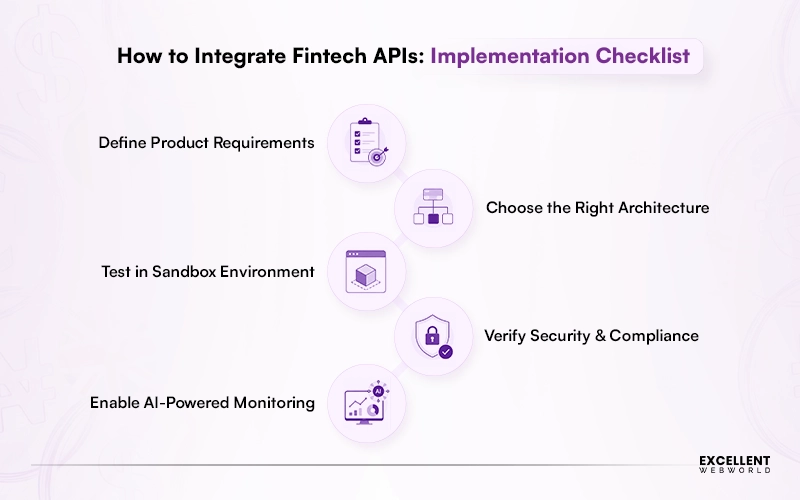
1. Define the Product Before You Touch a Single API
Before writing even a single line of code, you should be aware of what you’re building, whether it’s core banking infrastructure, creating an NFT marketplace, or starting a crowdfunding website. Most fintech institutions skip this step. As a result, they end up integrating APIs that are of no use to them, only to have to rebuild them from scratch, which costs time and money.
2. Pick Your Architecture Based on How Data Should Move
Once the use case is clear for your API integration, you should compare REST APIs vs. webhooks. It will shape your entire integration strategy. REST APIs are good when your app needs to request data on demand, while webhooks are good for updates, like payments issued in real time. Decide this as early as possible, as delaying it would force you to miss real-time events or incur unnecessary polling costs, both of which are expensive to fix.
3. Test in the Sandbox Like It’s Already Live
API sandbox testing is where most integration challenges appear before they reach a real customer. That’s why you need to give this step ample time. According to Gartner’s 2026 infrastructure report, only 28% of enterprise AI projects deliver ROI on time, and one reason for project failure is skipping these types of validation steps.
4. Verify Security and Compliance Before Going Live
Make sure the authentication, compliance, and encryption requirements are built in from the initial phase, not just on a roadmap slide, before deployment. Many fintech institutions rush through or skip this step, and it becomes one of the most expensive errors when an audit or a breach forces you to resolve it.
5. Let AI Monitor What Manual Checks Will Always Miss
Once your fintech product goes live, you need to implement AI-driven monitoring across your ecosystem to detect unusual activity and performance degradation in real time, before customers notice anything. Many banks treat this as optional and, as a result, experience major outages that force them to perform this validation step.
What does the Future Hold for Fintech APIs?
The future of fintech APIs is not about adding more APIs. It’s more about building smarter APIs that can serve AI agents as efficiently as they serve human apps. This paradigm shift is reshaping the “integration” strategy for banks and major financial institutions.
Here’s what future trends of fintech APIs will look like:
- AI agents are becoming primary API consumers, not just customer apps. Originally, APIs were built on the assumption that a human would tap a screen to trigger a request. That same assumption no longer holds with the rise of AI agents. AI agents now query banking APIs directly to initiate transfers, evaluate lending decisions, or check balances. Deloitte’s 2026 banking outlook report confirms this shift, stating that AI agents, or autonomous agents, represent the next major driver for the fintech industry.
- Agent-native protocols are emerging faster than most banks have planned for: Standards like the Model Context Protocol enable AI systems to call financial APIs directly, using a machine-readable structure rather than a human-facing interface. Most banking and financial institutions’ infrastructure roadmaps still don’t account for this type of shift. Still, in the near future, you will see this trend become mainstream, and banks should start preparing for it.
- Real-time settlement is becoming the baseline expectation, not a premium feature: If you’re still offering next-day transfers, customers will see it as a sign of outdated infrastructure rather than normal banking.
- Embedded finance keeps replacing the standalone financial app: Current fintech API examples worldwide show a consistent pattern: financial features are moving into non-financial platforms rather than remaining standalone banking apps. So, embedded finance is the way forward for fintech.
AI-Driven Credit Scoring Turns Fragmented Car Finance Into One Unified Platform
Maridady Motors was operating five different vehicle finance products: SACCO savings, asset finance, lay-by, Flexi-pay and hire purchase, through paper-based contracts and spreadsheets. We replaced this fragmented experience with a consolidated, AI-powered automotive finance platform that uses M-Pesa transaction data to generate a structured credit profile, giving loan officers a reliable way to assess income for self-employed borrowers who don’t have a regular paycheck.
- Runs all five finance models through one shared client profile instead of five disconnected systems.
- Uses AI to parse M-Pesa statements and score creditworthiness without manual review.
- Pulls real-time CRB Africa credit checks directly into the approval workflow.
- Cut underwriting time by 2.1x and lifted loan approvals by 38%.

Why Choose an Excellent Webworld for Fintech API Development?
Most fintech projects don’t fail because of a bad idea; they fail because the tech partner building those projects didn’t have the necessary experience of shipping a lending engine or payment rails under regulatory scrutiny. Over the years, I’ve watched this gap sink solid products.
That’s the gap I aim to close for enterprise banking and financial institutions with the experience of:
- 100+ fintech platforms delivered, across payments, lending, neobanking, and wealthtech
- 65+ core banking modernizations, done without disrupting live operations
- 120+ payment and banking API integrations, the exact kind of work covered throughout this blog
- #1 Clutch ranking in fintech, with active deployments across 40+ countries
This track record matters because my team and I have already resolved every major fintech challenge for leading institutions worldwide.
Every platform I build is compliance-first from day one:
- PCI DSS, SOC 2 Type II, and ISO 27001 compliance built in before launch
- PSD2 compliance covered for any institution expanding into EU markets
- 99.99% uptime SLA written into the contract, not promised on a sales call
So, ready to modernize your banking infrastructure the right way? Then, connect with our fintech experts today and let’s devise your fintech API roadmap together.
Frequently Asked Questions
Open Banking APIs are a particular type of fintech API that allow banks to securely share customer data with authorized third parties, such as lenders or budgeting apps. On the other hand, fintech APIs are an umbrella term that covers everything from payments and lending to wealth management and KYC. In short, every Open Banking API is a fintech API, but not all fintech APIs, such as fraud detection or payment processing, are Open Banking APIs.
Digital banking relies mostly on four major fintech APIs: (a.) Open Banking APIs for sharing account data securely, (b.) payment APIs that handle payment transfers and transactions in real-time, (c.) KYC & AML APIs that verify identity during onboarding, and (d.) core banking APIs that connect new digital features with existing infrastructure.
First, define your exact use case before comparing vendors. Then, evaluate providers against your specific requirements. After that, check the quality of their documentation to see whether they can provide good support if a problem arises. Lastly, get uptime SLA commitments in writing instead of relying on verbal promises.
If your fintech platform handles card data, you need to comply with the PCI DSS standard. For broader data security, you need to align with ISO 27001 and SOC 2 Type II standards; GDPR governs the data handling for EU customers, and PSD2 ensures strong authentication for any institution operating in EU markets. The final combination of applicable security standards depends on your target region, customer base, and specific product type.
Oh, YES. It’s not necessary to rebuild the whole legacy system from scratch. With APIs, you can layer new digital capabilities onto existing infrastructure via middleware. It helps you isolate old-system failures from new features. So, the banks can modernize gradually without disrupting daily operations or taking unnecessary risks.
Banking-as-a-Service (BaaS) allows non-banking fintech companies to provide payment, account, and card features to customers by calling APIs that are connected to a licensed bank’s infrastructure. So, basically, it enables non-banking fintech institutions to operate without owning a banking license or building a core banking system, which cuts both time and cost.
REST APIs are most useful when an app needs to request specific data on demand, such as checking transaction history or account balance. On the other hand, GraphQL APIs are useful when your app is requesting multiple types of data in a single call. So, GraphQL provides a lot of flexibility, but most fintech products still rely on REST APIs due to their robust security posture and simplicity of operations.
There can’t be a one-size-fits-all approach to determining the cost of fintech API integration. A basic-level integration for an early-stage startup, such as a KYC flow or a single payment method, would cost between $40,000 and $80,000. On the other hand, enterprise-grade projects that involve integrating multiple APIs, like AI-driven fraud detection and cross-border compliance, cost between $150,000 and $500,000 or more.
Fintech APIs allow non-financial platforms such as software companies, ride-sharing apps, or retailers to provide banking, payment, or lending features directly inside their app experience. It allows businesses to retain customers and earn additional revenue from financial services without having to build, license, or maintain them, while still meeting compliance requirements.
With fintech APIs, you can feed live transactions and identity data directly into KYC verification and AI-driven fraud detection systems. This enables real-time fraud scoring and identity verification as soon as a transaction occurs or during new onboarding.
Oh, YES. Fintech APIs can handle cross-border transactions, and with FX APIs, you can handle currency conversions and international settlement automatically, using the continuously updated exchange rates. Companies don’t need to manually check FX rates, which enables them to expand internationally at scale without building their own currency infrastructure.
If you standardize fintech APIs, you can unify scattered integrations into a single, easier-to-monitor system than multiple individual ones. With this kind of system in place, compliance teams can track all activity easily and respond to any queries from the audit team in real time.
AI Agents becoming the primary consumers of fintech APIs, rather than consumer-facing applications, will be the most influential future trend reshaping the fintech industry. In addition, real-time payment settlement will become the new normal, embedded finance will expand, and fraud detection will become predictive and AI-driven instead of periodic and manual.
You should always work with an experienced fintech app development company to integrate APIs, as they have a deep understanding of compliance requirements, security standards, and common integration challenges that may arise in fintech projects. Collaborating with an experienced tech partner reduces the risk of costly mistakes, shortens your time-to-launch, and ensures your fintech platform is architected to meet the latest needs.

Article By

