A production line cannot wait 3 seconds for the cloud to tell it that a machine is failing. At the same time, an autonomous vehicle cannot upload a camera frame or wait for a response & then decide what to brake. And a cardiac wearable should not need a round trip to a distant server prior to recognizing a potentially dangerous rhythm.
That is where Edge AI is totally changing the architecture of intelligent systems, and it’s important for you to understand Edge AI use cases pertaining to your relevant industry to make the most of it.
Instead of sending every signal to a centralized cloud system, Edge AI processes data where it is generated, such as on a camera sensor, vehicle, wearable, smartphone, industrial machine, or nearby edge server. This generally enables faster decision-making, lower bandwidth consumption, and greater resilience where connectivity is limited & tighter control over sensitive datasets.
That is why edge AI in industry is shifting from experimental deployments to practical production usage across manufacturing, healthcare, retail, logistics, automotive, energy & beyond.
The real question is no longer just whether AI can solve a problem; it is about “Where should AI make the decision?”
When milliseconds matter, connectivity is quite uncertain & sensitive data should be close to the source, the answer may be the edge.
What Is Edge AI Really About?
Edge AI is a set of practices for running AI inference systems on a local device or nearby computing infrastructure rather than just sending data to a centralized cloud space. It could be a camera, an industrial controller setup, any wearable, vehicle computer, smartphone, gateway, robot, or any embedded processor.
Generally, it can be said that a model is trained using a centralized cloud or data center infrastructure, and then it is optimized for edge hardware utilizing techniques like quantization, pruning, or knowledge distillation.
And, once it is deployed, the model can process incoming data locally & produce a prediction or decision without much waiting for a cloud round trip.
It can be represented as a pathway;
- “Device
- Cloud
- AI Model
- Decision
- Device”
- “Device
- Edge AI Model
- Decision”
to
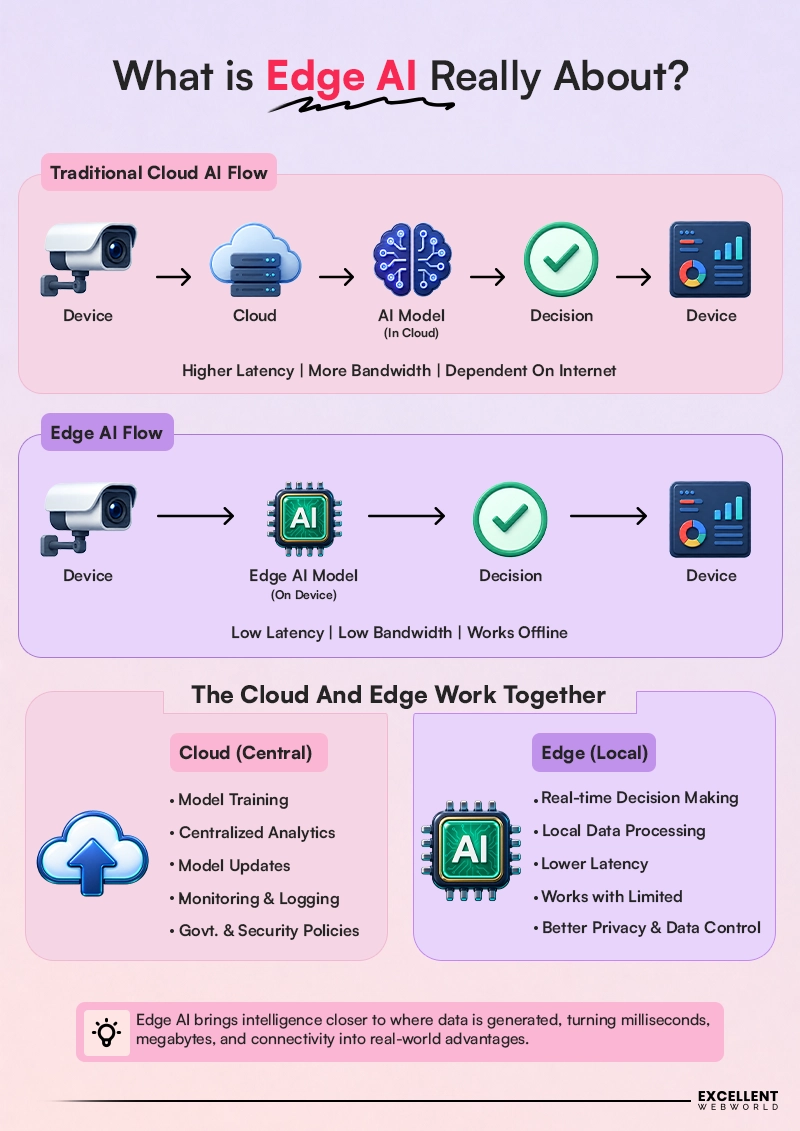
The cloud still has an important role in terms of training processes, centralized analytics, model management, monitoring & also in terms of standard governance. The difference is that the edge takes responsibility for decision-making & local processing, which actually provides a measurable advantage. That makes edge AI in real-world applications particularly significant where milliseconds, megabytes, and network connection really matter.
Edge AI vs Cloud AI
The debate around Edge AI vs Cloud AI is not about selecting one over the other. Cloud AI generally excels at large-scale training processes and complex analytics, making it a strong fit for cloud services & solutions development, while, on the other hand, Edge AI brings inference much closer to the datasets for providing faster & more reliable decision-making.
| Factor | Cloud AI | Edge AI |
|---|---|---|
| Inference location | Centralized cloud/data center | Device or nearby edge server |
| Latency | Network-dependent | Millisecond-level response |
| Connectivity | Requires stable internet | Can work offline/intermittently |
| Data privacy | Data may leave the device | Data can stay local |
| Compute | Highly scalable | Hardware-constrained |
| Best for | Training, analytics, complex workloads | Real-time, sensitive, bandwidth-heavy tasks |
I would say that both edge AI vs cloud AI are practically important. While the cloud manages the intelligence that actually benefits from centralized scale, edge AI is able to handle the intelligence along with the benefits of physical proximity.
Why Edge AI Use Cases Are Scaling So Fast?
There are several forces that are converging to make local AI increasingly practical. Here are the key driving factors that are mainly accelerating the adoption of edge AI use cases across real-world enterprise applications.
| Driver | Why It Matters |
|---|---|
| Latency | Milliseconds actually matter for safety & real-time systems, where cloud round trips can introduce too much delay. Gartner identifies latency as a fundamental driver for edge computing, especially for the applications that need faster & deterministic responses. |
| Bandwidth & Cost | While streaming raw videos or sensor datasets continuously can become quite expensive at scale, edge processing can reduce that burden by processing data closer to the source, thus reducing the bandwidth costs as highlighted by Gartner’s edge infrastructure research. |
| Privacy & Compliance | Sensitive information, such as patient vitals & data, in-home video, and transactions can be processed closer to its source. KPMG’s research on edge AI in healthcare shows how this specific approach tends to reduce the unnecessary movement of sensitive datasets. |
| Reliability | Edge AI systems can continue to operate through limited connectivity, which is particularly useful for distributed industrial spaces. Deloitte’s research on predictive technologies highlights the shift in manufacturing. |
| Data Growth | As enterprise datasets are generated & processed outside traditional data centers & cloud space, distributed processing becomes more important. Gartner’s edge computing analysis offers context for broader shift. |
Overall, all these factors explain why enterprises are shifting intelligence closer to where data is generated. The result is a growing range of common edge AI use cases that are designed to make real-time decisions faster & efficiently, with less reliance on the cloud.
What Are the Most Common Edge AI Use Cases?
Before looking at specific industries, there are several patterns that appear quite frequently across today’s AI edge use cases.
| Use Case | What Runs at the Edge |
|---|---|
| Edge AI in smart cameras and security | Object, intrusion, activity, and anomaly detection |
| Edge AI in voice assistants | Wake-word and selected speech processing |
| Edge AI in autonomous vehicles and drones | Obstacle detection, navigation, and scene understanding |
| Edge AI in predictive maintenance | Local anomaly detection from machine sensors |
| Edge AI in retail analytics | Shelf monitoring, footfall, and checkout intelligence |
| Edge AI in healthcare wearables | ECG, heart-rate, fall, and activity analysis |
| Edge AI in smart homes | Motion, sound, temperature, and anomaly detection |
| Edge AI in agriculture | Crop, soil, and livestock monitoring |
| Edge AI in manufacturing and robotics | Visual inspection and local decision-making |
| Edge AI in mobile devices | Biometrics, translation, imaging, and personalization |
| Edge AI in smart traffic | Traffic detection and adaptive signal control |
| Edge AI in telecom | Local network and application processing |
| Edge AI in environmental monitoring | Air, water, weather, and pollution alerts |
These applications actually share the same architectural principle, but the business value generally changes significantly from one industry to another. That is where edge AI in industry becomes quite interesting.
Edge AI Use Cases by Industry
Edge AI in Healthcare
Healthcare is considered as one of the most strongest edge AI use cases, as many clinical decisions can’t wait for a cloud round trip. Wearables are actually able to track heart rate, ECG, glucose levels, & also movement locally, thus triggering fall or cardiac alerts on a real-time basis.
There are also portable diagnostic tools that are associated with the healthcare system that can process images closer to the point of care, while remote monitoring systems can function in low-connectivity environments. As because the patient data is quite sensitive, local inference can able to reduce unnecessary data movement while improving privacy & security at the point of care in the healthcare system. Developing a HIPAA-compliant system across remote monitoring, EHR integration, and connected care is also part of our AI in healthcare app development expertise.
| Edge AI in Healthcare Use Case | Business Impact |
|---|---|
| Wearable ECG & fall detection | Real-time alerts without cloud latency |
| Point-of-care imaging | Faster diagnostic support at the bedside |
| Remote patient monitoring | Reliable operation in low-connectivity settings |
| On-device health analytics | Reduces unnecessary PHI transmission |
Edge AI in Manufacturing
This seems to be a mature space for edge AI in industry. Vibration, temperature, acoustic & machine vision sensors can coordinate the AI models locally to detect anomalies prior to any equipment failure.
With Deloitte’s Smart Factory research, it has been observed that by utilizing historical & real-time datasets, there can be improvements in uptime, quality & safety while enabling predictive capabilities across the connected manufacturing space. Edge computer vision generally identifies defects directly on the production lines, while the worker safety models actually detect hazards without continuously streaming to the cloud. And connecting these insights with proper planning & operational systems can actually strengthen the value of a modern ERP software development strategy.
A similar focus on real-time manufacturing intelligence can be seen in our production testing system for Amazon Ring, which combines automated hardware validation, optical testing, and real-time MES traceability to support faster and more reliable manufacturing operations.
| Edge AI in Manufacturing Use Case | Business Impact |
|---|---|
| Predictive maintenance | Detects equipment degradation before failure |
| Computer vision inspection | Identifies defects in real time |
| Worker safety monitoring | Detects hazards and PPE compliance locally |
| Edge-to-ERP integration | Connects machine insights with planning and operations |
Edge AI in Automotive
In the case of automotive, it is said to be the most natural fit for edge AI use cases, as it is related to safety-critical decisions that must be made within a few milliseconds. This basically includes object detection systems, lane recognition, collision avoidance & driver monitoring, which actually depend on local inference rather than waiting too long for cloud responses. In terms of the cabin systems, this is basically able to detect drowsiness conditions or any distraction locally, while the vehicles can also pre-process the telematics & sensor datasets prior to synchronizing useful information within the centralized platforms.
| Edge AI in Automotive Use Case | Business Impact |
|---|---|
| Object & lane detection | Enables faster collision-avoidance decisions |
| Driver monitoring | Detects drowsiness and distraction locally |
| Collision detection | Supports immediate safety responses |
| Fleet telematics | Reduces bandwidth through local data processing |
Edge AI in Retail
Retailers are using edge AI in real world applications to make physical stores much more responsive without continuously offering high-resolution video to the cloud only. The cameras and sensors associated help monitor shelves, customer movement, checkout activities, & also potential transaction anomalies locally.
This actually enables real-time inventory visibility, checkout-free experiences, and faster decision-making abilities while reducing the bandwidth requirements. Retailers connecting these capabilities associated with the digital ecosystem can utilize ecommerce app development services to unify the online and offline customer experiences.
| Edge AI in Retail Use Case | Business Impact |
|---|---|
| Shelf & inventory monitoring | POS fraud detection |
| Checkout-free stores | Enables faster, frictionless checkout |
| Shopper analytics | Delivers immediate in-store insights |
| POS fraud detection | Flags suspicious activity at the transaction point |
Edge AI in Agriculture
Agricultural processes mainly operate in locations where there is unreliable connectivity, thus making local intelligence particularly valuable. The involvement of drones, cameras, and ground sensors helps in analyzing crop health, soil conditions, moisture levels & pest activity directly in the field. AI edge models can then support irrigation & fertilizer decisions without any dependency on cloud connectivity. This same approach can power autonomous agricultural machinery & livestock tracking systems.
| Edge AI in Agriculture Use Case | Business Impact |
|---|---|
| Crop health monitoring | Enables faster field-level decisions |
| Soil & moisture analysis | Supports smarter irrigation |
| Autonomous machinery | Operates without constant connectivity |
| Livestock monitoring | Enables local health and activity detection |
Edge AI in Logistics and Supply Chain
In logistics operations, there is a dependency on rapid decisions across warehouses, vehicles, & distribution centers. Warehouse robots that are associated in this space utilize local sensor fusion & AI for the navigation process, obstacle detection & path planning without waiting for any centralized instructions.
Additionally, the smart cameras basically inspect packages for damage locally, while the fleet systems can process vehicle & route datasets prior to synchronizing relevant information to the cloud. As businesses add intelligent information on top of these signals, the edge AI use cases can actually work alongside AI agent use cases in logistics, which tends to support faster routing processes, sourcing, & operational decisions.
| Edge AI in Logistics & Supply Chain Use Case | Business Impact |
|---|---|
| Warehouse robotics | Enables local navigation and path planning |
| Package inspection | Detects damage without cloud processing |
| Fleet monitoring | Supports real-time vehicle intelligence |
| Dynamic routing | Enables faster response to changing conditions |
Edge AI in Energy and Utilities
In the energy sector, infrastructure generates a large volume of sensor data across the grids, turbine systems, pipelines, and also in terms of remote sensing assets. Edge AI helps analyze the information locally to detect faults, equipment degradation, or even abnormal operating conditions prior to a major failure. Drones are able to process images during power line & solar farm inspection conditions, thus reducing the need for large dataset transmission for centralized evaluation.
| Edge AI in Energy & Utilities Use Case | Business Impact |
|---|---|
| Grid fault detection | Enables faster responses to disruptions |
| Turbine monitoring | Predicts equipment problems earlier |
| Drone infrastructure inspection | Speeds up visual analysis |
| Pipeline monitoring | Detects anomalies before failures escalate |
Edge AI in Smart Cities and Public Sector
Smart cities totally depend on distributed systems that actually need to react on a real-time basis. With the help of edge AI, there can be proper traffic feed analysis as per the signal timings, incident detection by public safety cameras, & optimize lighting or even waste collection based on live conditions. Processing datasets closer to where they are generated can help reduce bandwidth requirements & also limit unnecessary movement of sensitive information. For broader compliance-focused engineering, see our government & public sector engineering expertise.
| Edge AI in Smart Cities & Public Sector Use Case | Business Impact |
|---|---|
| Adaptive traffic signals | Reduces congestion in real time |
| Public safety monitoring | Enables faster incident detection |
| Smart lighting | Responds dynamically to local conditions |
| Smart waste management | Optimizes collection and reduces waste |
Edge AI in Financial Services
In terms of financial services, there is a combination of local processing along with centralized analytics for the operations. The biometric authentication system at ATMs, POS terminals, and financial devices generally runs in local verification mode, while associated with edge AI fraud detection & screening, there is proper flagging of suspicious activities. With the edge AI approach, there is a reduction of unnecessary data movement in the environment, aligned with strict security & compliance requirements. These are the considerations that we followed in our work as a fintech app development company.
| Edge AI in Financial Services Use Case | Business Impact |
|---|---|
| Biometric authentication | Faster and more private verification |
| POS fraud detection | Flags anomalies at the transaction point |
| ATM intelligence | Enables local identity and activity analysis |
| Transaction screening | Supports faster first-level fraud detection |
Edge AI in Telecom
Telecom is one such industry that is aligned with the evolution of edge AI trends, especially in terms of 5G networks pushing computing closer to connected devices. Processing workloads at or near the base stations can reduce the latency rate for the applications like in AR/VR, connected vehicles, and also in terms of the industrial automation. However, edge AI is also able to analyze network traffic on a local basis to detect congestion & also optimizing the resource allocation prior to sending any data insights to the centralized system.
| Edge AI in Telecom Use Case | Business Impact |
|---|---|
| 5G edge processing | Enables low-latency connected applications |
| Network traffic analysis | Supports real-time optimization |
| Base-station intelligence | Reduces processing delays |
| Connected-device management | Enables faster local responses |
Edge AI in Consumer Electronics and Smart Homes
Many of the daily used devices are already using edge AI in real world applications. Starting from the smartphone’s face recognition, image enhancement, translation, & also the latest AI-driven functionalities that are directly connected to the device. Smart cameras, thermostats, lighting systems, & also voice assistant systems can process motion, sound, temperature, and wake-word signals locally in a similar way before sending them to the cloud. This kind of connected device model concept is closely related to our work as an IoT development company, where we basically combine embedded intelligence & cloud connectivity.
| Edge AI in Consumer Electronics and Smart Homes Use Case | Business Impact |
|---|---|
| On-device biometrics | Enables fast, private authentication |
| Smart home anomaly detection | Responds instantly to unusual activity |
| Voice assistant wake-word detection | Reduces unnecessary cloud requests |
| On-device camera AI | Processes images without constant uploads |
Edge AI in Environmental Monitoring
The environmental aspect is the most strongest use case example in terms of edge AI use cases where decisions need to be made without centralized infrastructure. The distributed sensors help in analyzing the air quality, water conditions, and also the pollution levels, thus serving the environment properly. When the threshold is crossed, systems can trigger alerts on an immediate basis rather than waiting for data to travel to a central platform.
| Edge AI in Environment Monitoring Use Case | Business Impact |
|---|---|
| Air-quality monitoring | Enables real-time pollution alerts |
| Water-quality sensing | Detects contamination earlier |
| Flood monitoring | Supports faster local warnings |
| Distributed environmental sensing | Works across remote, low-connectivity areas |
Implementation Approaches: What Amazon, Gartner, and Deloitte Recommend
The strongest AI edge use cases follow a hybrid architectural setup rather than just replacing the cloud systems entirely. The models are actually trained centrally, then deployed to edge devices for real-time inference, and synchronized back to the cloud system for monitoring, taking updates, and also for managing fleet operations.
AWS IoT Greengrass demonstrates this kind of approach by generally allowing teams to properly train models with SageMaker & then deploy them to factory gateways, industrial PCs, and also to other edge devices while maintaining centralized control. Similarly, the “train in the cloud, deploy at the edge” approach is also reflected in the research process across Gartner, KPMG, and Deloitte.
And the next step is where edge AI in real world applications becomes even more valuable. And instead of stopping at an alert, edge-driven insights can feed an agentic AI layer that automatically reorders inventory, reroutes shipment processes, or escalates maintenance requests, thus transforming local intelligence into real-time business action outputs.
Challenges to Consider When Implementing Edge AI
Even the strongest edge AI use cases need more than an accurate model. Enterprise deployments often include complications like hardware limitations, security & device management, and seamless integration with existing business processes.
| Challenge | What It Means in Practice |
|---|---|
| Hardware constraints | Models must be optimized to fit device memory and power budgets. |
| Fleet management | Updating AI models across thousands of distributed devices is operationally complex. |
| Security | Physically accessible edge devices expand the attack surface compared to centralized infrastructure. |
| Model drift | Local models need continuous retraining as real-world conditions change. |
| Integration | Edge insights must flow into ERP, CRM, and analytics platforms to create business value. |
I would say that the last challenge is often where the project actually stalls. An edge model may accurately identify an anomaly, but it creates some limited value if the insight never reaches the systems that can act on it.
Additionally, connecting the sensor to the decision pipeline with planning, maintenance, and reporting becomes much of a data-engineering challenge, as an AI system has. And, once the foundation is placed, RPA and workflow automation can actually turn an edge-generated alert into a maintenance ticket, purchase orders, or even scheduling updates automatically.
Build Your Edge AI Solution with Excellent Webworld
So, it can be said that the most successful edge AI use cases actually start with a clearly defined and high-impact business problem, whether it is predictive maintenance, a connected healthcare device, a retail pilot system, or any kind of logistics work process, and that also scales only after the architecture proves its value on the production line.
At Excellent Webworld, we help businesses build edge AI in industry by combining on-device intelligence with cloud infrastructure, IoT connectivity, enterprise integrations, and AI-powered automation. Whether you are developing connected hardware, deploying some real-time inference, or integrating edge insights into your ERP, CRM, or operational systems, we build scalable solutions that align with your business goals & technical requirements.
- Edge AI use cases enable faster, real-time decisions by processing data closer to where it is generated.
- Edge AI vs cloud AI is not an either-or choice; hybrid architectures often deliver the strongest results.
- Edge AI in industry is transforming manufacturing, healthcare, retail, automotive, logistics, and more.
- Privacy, latency, bandwidth, and reliability are major drivers behind edge AI in real world applications.
- Successful deployments typically train in the cloud and infer at the edge.
- Security, hardware constraints, model drift, and integration remain key implementation challenges.
- The latest edge AI trends are moving toward autonomous actions through AI agents and workflow automation.
Frequently Asked Questions

Article By

