DoctorNow: AI-Powered Telehealth Platform for UK Private GPs
One platform for the patient app, the clinician workspace, practice operations, a governed AI layer, integrations and security, designed around UK GDPR, CQC and NHS standards.
Excellent Webworld designed and built it from scratch for DoctorNow, the private GP practice in Beaconsfield and Thame, Buckinghamshire and Oxfordshire.
23 years
DoctorNow has run private GP care since 2003
06
Product layers, one platform
Good
CQC rating on all five key questions (2023 report)
UK-first
UK GDPR, CQC, MHRA and NHS standards by design
DoctorNow case study at a glance
The short version, for readers who need the answer first.
Client
DoctorNow (Doctor Now Limited, trading as DoctorNow and The Beaconsfield Clinic): a CQC-registered private GP and specialist practice in Beaconsfield, Buckinghamshire, and Thame, Oxfordshire.
What we built
An AI-powered telehealth and practice-management platform in six layers: patient experience, clinician workspace, practice management, AI intelligence, integration, and security and governance.
Market and regulation
United Kingdom. Designed for UK GDPR and the Data Protection Act 2018, CQC regulation, GMC guidance, MHRA software rules, NHS clinical safety standards DCB0129 and DCB0160, and NHS DTAC.
Core stack
Flutter patient app; React, Next.js and TypeScript clinician and admin web; Python and FastAPI APIs; PostgreSQL; Redis and Celery; managed WebRTC video; HL7 FHIR-compatible interfaces; AWS or Azure in a UK region.
AI capabilities
AI medical scribe, patient communication agent, AI scheduling, clinical decision support, practice intelligence copilot and remote patient monitoring, each with a defined autonomy level and clinician approval where it matters.
Delivery
Phase 1 clinical MVP in 12 to 16 weeks, phase 2 practice automation in 8 to 12 further weeks, phase 3 advanced AI in 12 to 20 further weeks, with an 11 to 17 person blended team.
Design principle
The model proposes; the application enforces. AI output is a draft until a responsible clinician approves it, and autonomous clinical action is disabled by default.
Last updated
14 October 2026. Research drawn from doctornow.org, the CQC register and the DoctorNow Private GP App Store and Google Play listings.
Who is DoctorNow?
DoctorNow started in 2003 on a simple belief: care works better when people feel heard. It offers 30-minute GP appointments, home visits, video consultations and after-hours care, with on-site specialist consultants at The Beaconsfield Clinic. Patients can pay as they go or join as members.
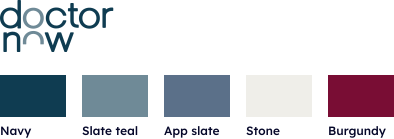
Screens use DoctorNow’s navy and burgundy, and the slate-and-stone look of the live DoctorNow Private GP app, with Hanken Grotesk and a serif display face.
What DoctorNow offers
VIP from £80.25 a month (£918.00 a year), VIP Homecare from £222.75 a month (£2,609.00 a year) with up to four GP and twelve nurse home visits, and VIPi at £368 a year for insured patients. Members get priority access, repeat prescriptions, medication reviews and specialist referral support.
What DoctorNow has achieved
Established
Founded in Beaconsfield and now 23 years in practice, with 15 GPs and 3 practice nurses on the public team page.
Regulated and rated
Rated Good for Safe, Effective, Caring, Responsive and Well-led on the Care Quality Commission register (report published 30 June 2023).
Second clinic opened
DoctorNow Thame opened at The Threshing Barn, Mill Road, and was added to the app within three months.
Secure results
DoctorNow members can securely receive test results and referral letters directly in the app.
Press and public links
Our research found no third-party press coverage or awards. The public record is the regulator’s register, DoctorNow’s own publications and the two app listings.
Care Quality Commission profile
Rating and regulated activities
Spring 2026 newsletter: Connected
Thame opening, AI note-taking, secure results
DoctorNow app page
Book, repeat prescriptions, results
App Store: DoctorNow Private GP
iPhone app, version 2.0
Google Play: DoctorNow Private GP
Android app
DoctorNow on LinkedIn
Company updates
A UK private practice needed more than a video-call app
DoctorNow’s patients already used a members’ app to book visits, order repeat prescriptions and receive results. The next step was a platform that also supports the clinician and the practice behind each visit, in a regulated setting where a wrong note or a leaked record has real consequences.
So we built six connected layers on one canonical data model, with AI placed inside strict clinical and legal guardrails.
Time with the patient
Clinicians lose consultation time to notes, letters and admin. The platform drafts notes and summaries so doctors can focus on the conversation.
One record, not many
Booking, notes, prescriptions and billing live in separate domains that stay consistent, so cancelling a visit never erases a clinical record.
Regulated by default
CQC, UK GDPR, GMC and MHRA expectations shape the design from day one, not as a final checklist.
AI that stays in its lane
Every AI feature has an autonomy level, a permission scope and an audit trail, and clinicians approve anything that touches care.
Six layers, one design language
A closer look at each layer, drawn in DoctorNow’s own brand.
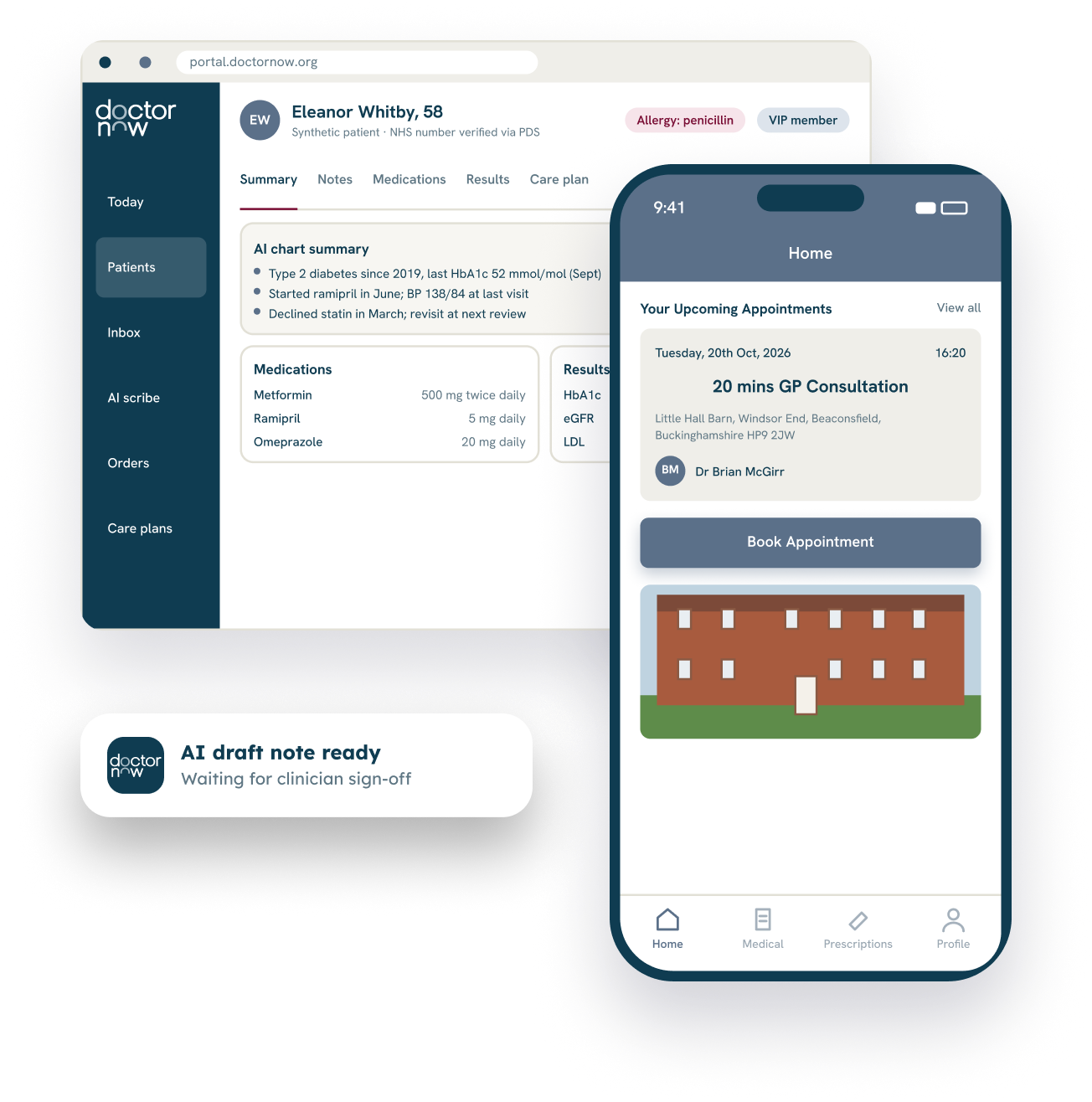
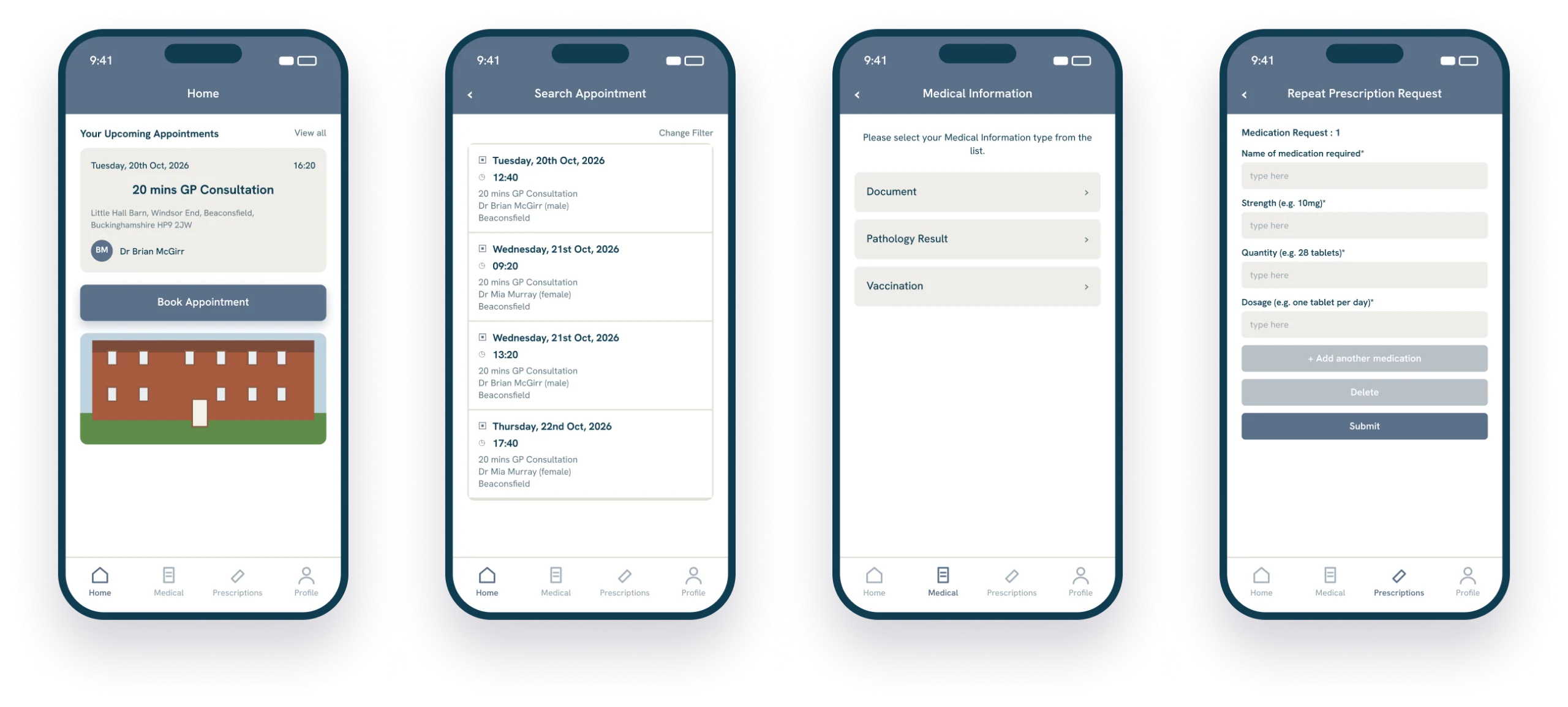
Patients book and manage appointments, join consultations, see results and documents, request repeat prescriptions, pay, and control their consent, from the DoctorNow app or the web portal.
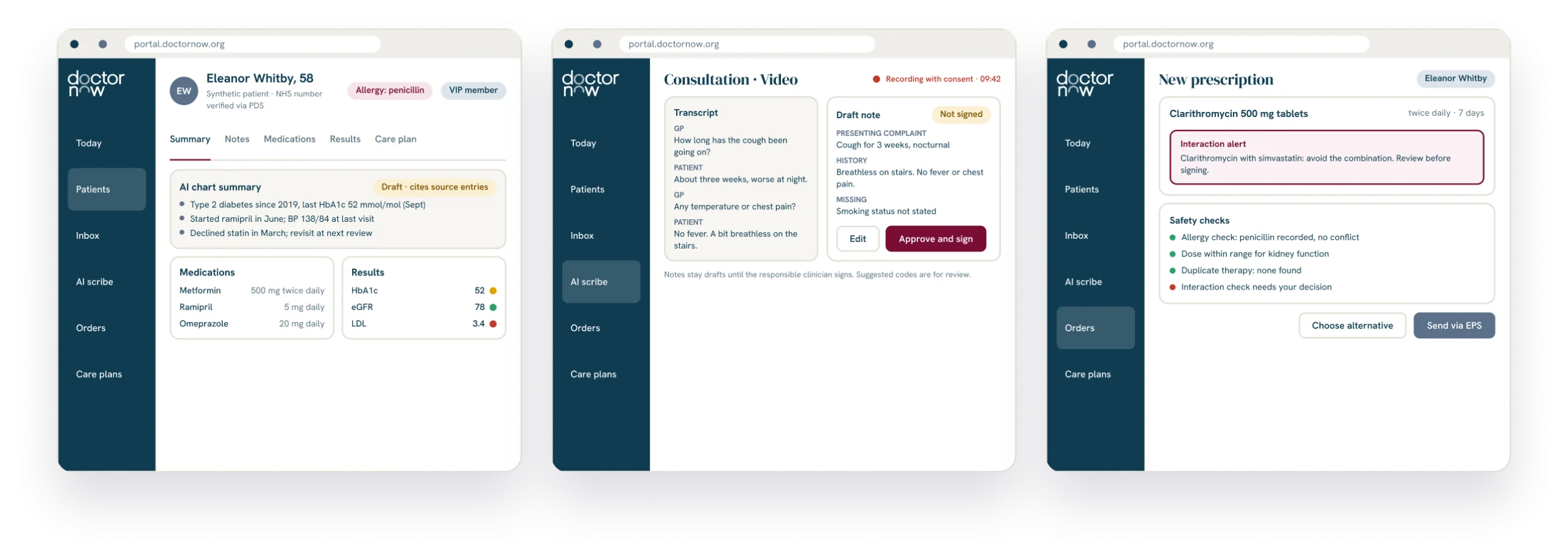
A chart that shows the right history, a consultation view with an AI scribe that drafts the note, and e-prescribing with allergy and interaction checks. Nothing is final until the clinician signs.
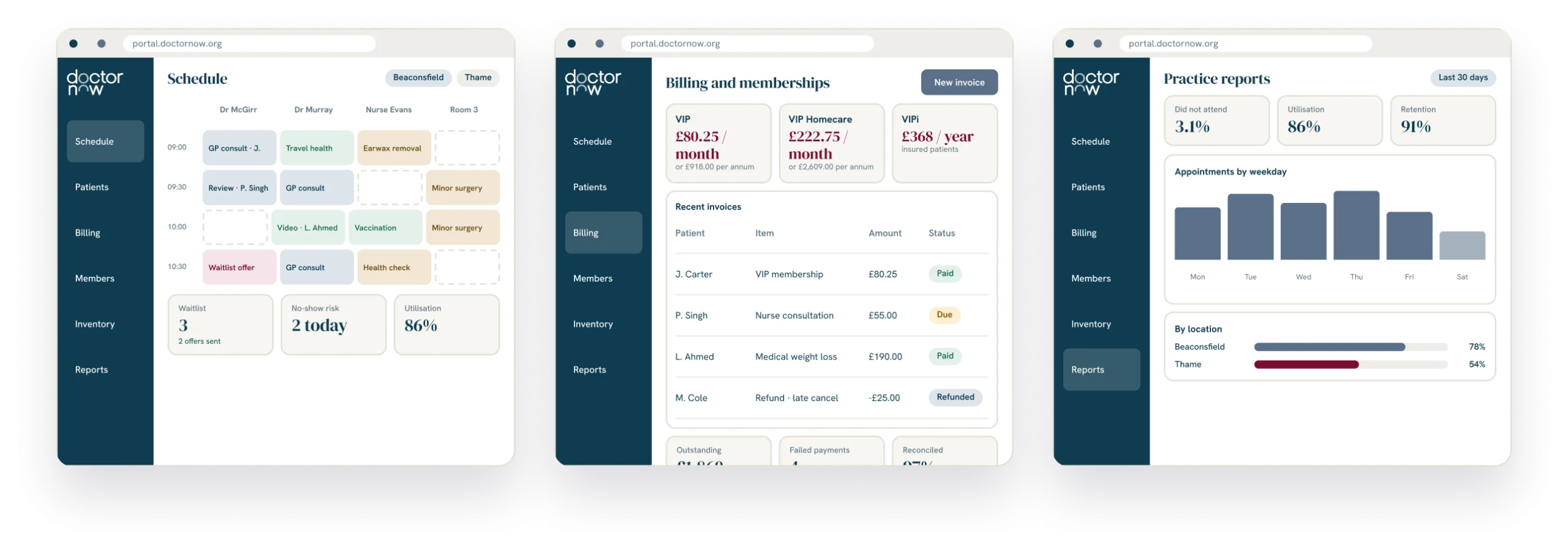
Scheduling across two clinics, rooms and staff, membership billing and invoices, inventory and reporting, with waitlists and no-show handling built in.
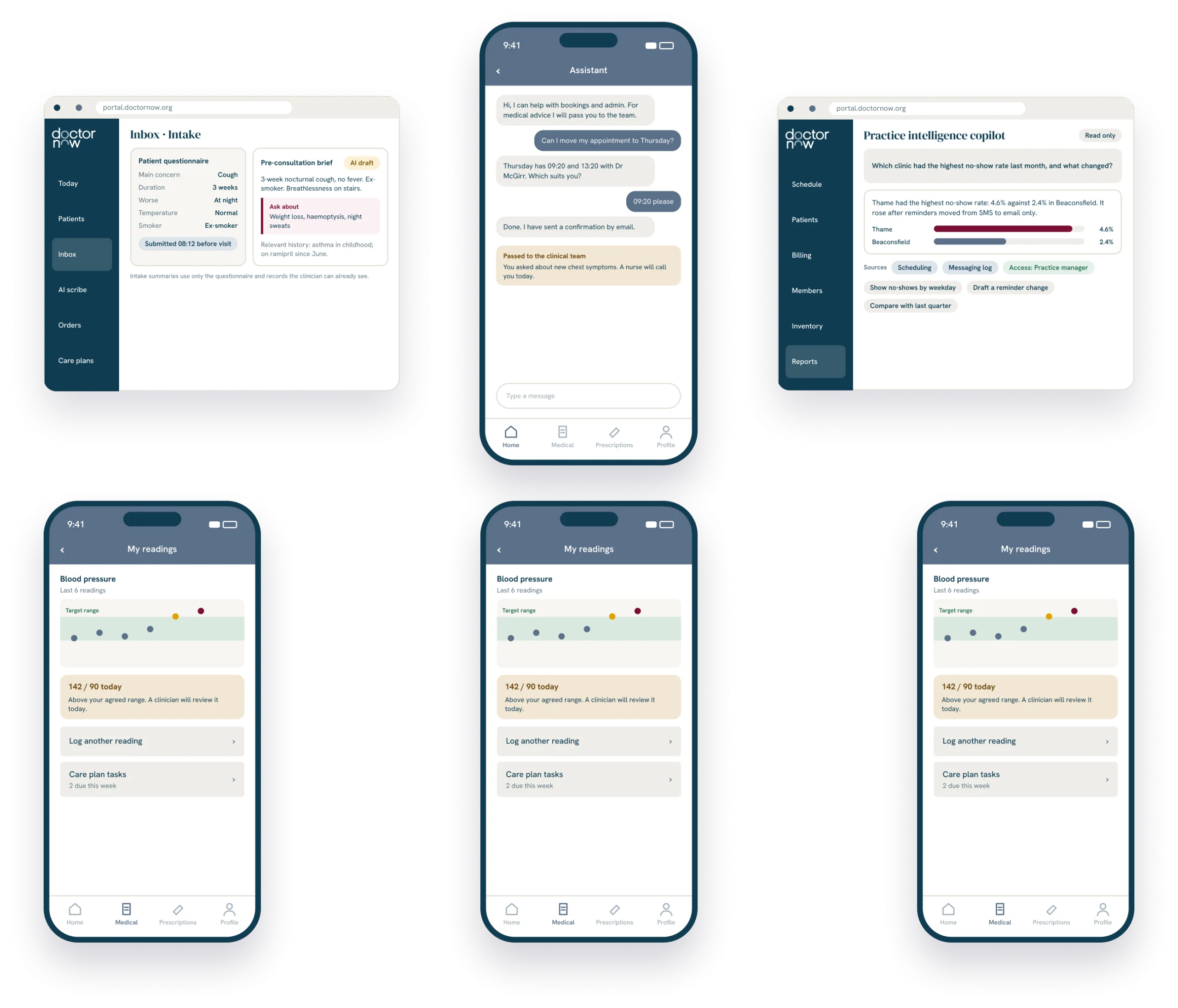
Intake summaries, a patient communication agent, a practice copilot and remote monitoring, all behind one model gateway with scoped access, clinician approval and a full audit trail.
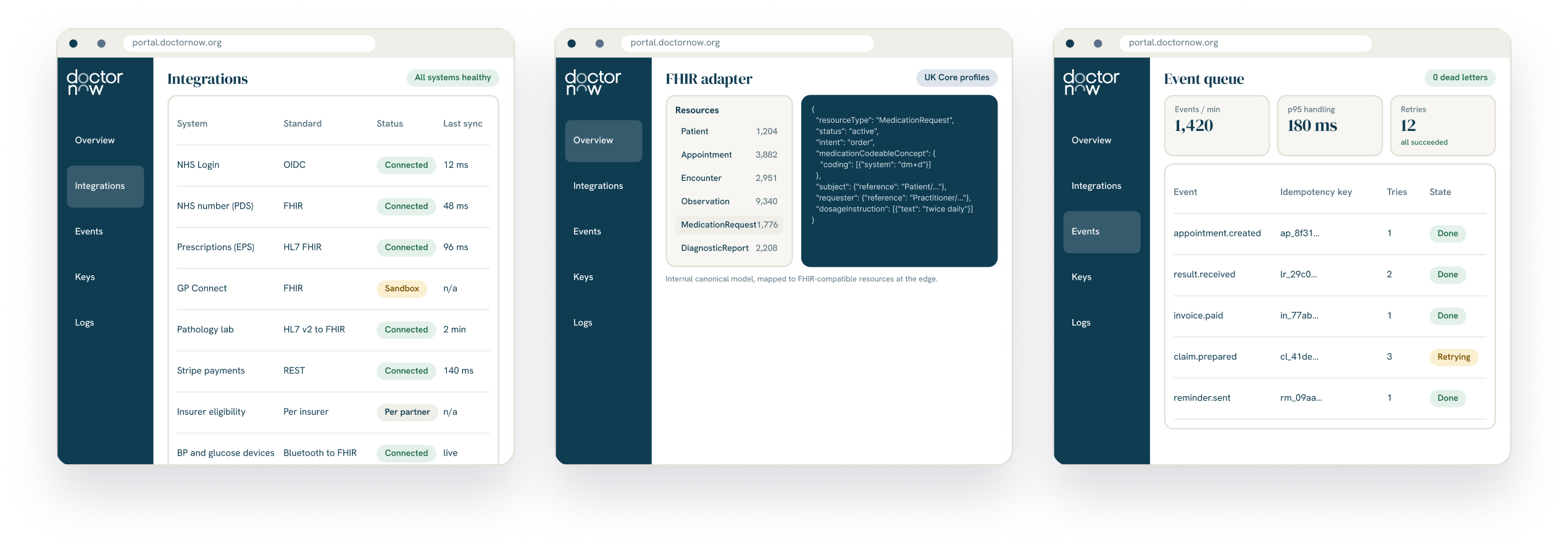
A canonical internal model with FHIR-compatible interfaces to NHS services, labs, pharmacies, payments and devices, run through idempotent, observable event queues.
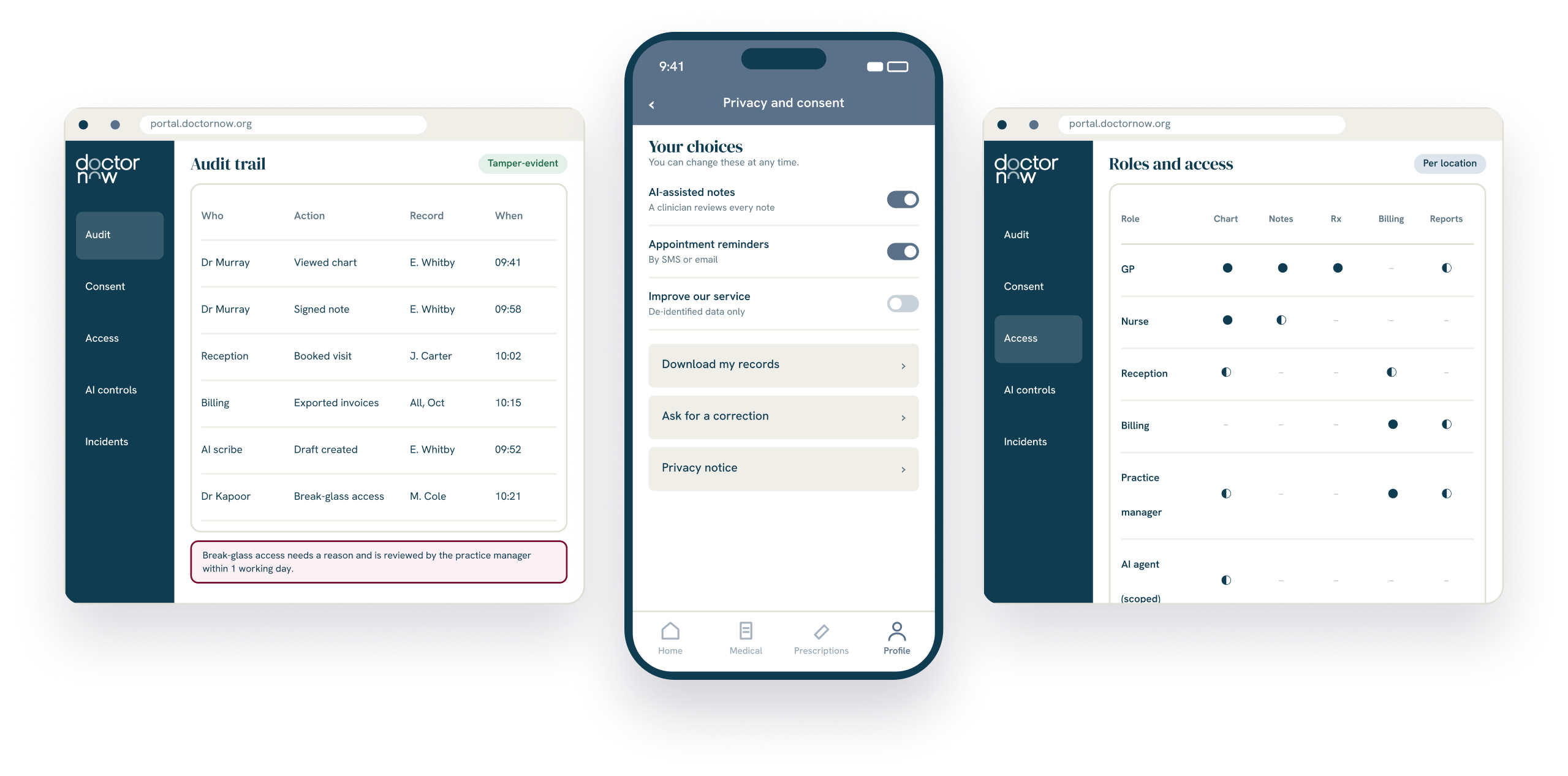
Identity, role-based access, consent, tamper-evident audit trails, encryption and AI governance, visible to staff and patients alike.
How is the DoctorNow platform architected?
A modular, API-first, multi-tenant SaaS platform: one shared identity layer, one canonical clinical data model, a secure integration framework and a separately governed AI runtime.
every channel reads and writes the same order
API gateway, identity and tenant context
AI never reaches the database or tools except through the gateway
Model gateway: the model proposes, the application enforces
canonical internal model, FHIR-compatible interfaces at the edge
Decisions, and what we rejected
Modular monolith with asynchronous workers.
Rejected: a large Kubernetes microservices fleet on day one, because product, clinical workflow and regulatory readiness are tighter constraints than compute scale.
A canonical internal data model with FHIR-compatible interfaces.
Rejected: forcing every internal workflow into a one-to-one FHIR mapping, which slows change and leaks external quirks inward.
Deterministic software for availability, billing, access control and workflow states.
Rejected: asking a language model to decide anything that must be exactly right, repeatable and auditable.
Managed WebRTC video through a vendor SDK.
Rejected: building video infrastructure before there is a clear business case.
A task-specific AI runtime behind a model gateway.
Rejected: one general-purpose model wired to every system, which breaks least-privilege access and makes evaluation impossible.
Autonomy levels 1 to 4 only; level 5 disabled.
Rejected: autonomous diagnosis or treatment changes, which need separate safety, regulatory and clinical justification.
Which AI capabilities does DoctorNow use, and how are they controlled?
Six priority capabilities run on a governed AI runtime. Each has an autonomy level, a guardrail and a measure of success. A prompt is never an authorisation mechanism.
| Capability | What it does | Autonomy level | Guardrail | How it is measured |
|---|---|---|---|---|
| AI medical scribe | Transcribes the consultation, separates speakers and drafts a structured note and patient summary. | Level 1 · Assist | Draft until the clinician reviews and signs; no invented clinical facts; consent captured first. | Clinician correction time and clinically significant error rate, not transcription accuracy alone. |
| Patient communication agent | Answers approved administrative questions, sends reminders and routes clinical questions to staff. | Level 3 · Bounded | No unsupported medical advice; clinical queries are handed to a person with context. | Call volume, hand-off accuracy and complaints. |
| AI scheduling | Matches requests to clinicians, resolves conflicts and offers alternatives. | Level 3 · Bounded | The server-side scheduling engine verifies availability; AI never writes to the calendar directly. | Booking conversion, waitlist fill rate and double-booking incidents (target zero). |
| Clinical decision support | Flags interactions and surfaces evidence-linked options for the clinician. | Level 4 · Decision support | Evidence-linked, shown as a recommendation, always the clinician’s decision; MHRA status assessed per feature. | Alert acceptance, override reasons and false-alert rate. |
| Practice intelligence copilot | Answers questions about no-shows, overdue invoices and trends in plain language. | Level 1 · Assist | Read-only, row-level permissions, query validation and visible sources. | Answer accuracy against a reference set and time to insight. |
| Remote patient monitoring | Tracks patient-reported readings and care-plan tasks and flags warning signals. | Level 2 · Prepare | Escalation rules route to the right clinical team; AI never changes treatment. | Time to review for flagged readings and missed-escalation rate. |
The autonomy ladder
Assist
Suggestions and summaries, such as a draft note.
Prepare
Create a pending action, such as a referral or claim.
Bounded execution
Authorised, reversible tasks, such as an approved reminder.
Decision support
Evidence-linked recommendations for clinician review.
Decision support
Evidence-linked recommendations for clinician review.
Autonomous Care
Disabled by default; needs separate safety and regulatory case.
The AI request path
Trigger and route
A consultation starts, a form arrives, a result lands or an appointment changes. The task router checks the user, patient context and permitted tools.
Run and validate
A specialised pipeline performs speech processing, authorised retrieval or bounded orchestration. Validation checks schema, grounding, missing data, permissions and risk class.
Draft, approve, log
Output becomes a draft, a pending action or a recommendation. Model version, sources and approvals are logged for quality monitoring.
How does the platform meet UK healthcare and data requirements?
Compliance is a design input, not a launch task. This table shows the design basis for the United Kingdom. It is not legal advice and does not state that DoctorNow holds any certification.
| Requirement | Why it applies | How the platform is designed to meet it |
|---|---|---|
| UK GDPR and Data Protection Act 2018 | Health data is special category data. The practice remains the controller and the platform acts as processor. | A documented lawful basis and Article 9 condition, a data protection impact assessment before launch, a records of processing log, data subject rights (access, correction, export, deletion where lawful) in the app, and ICO registration for the controller. |
| Data (Use and Access) Act 2025 | Amends UK GDPR, including rules on automated decision-making. | No solely automated decisions with legal or similarly significant effect; human review on every clinical output. [confirm commencement and guidance with counsel] |
| CQC regulation | DoctorNow is registered as an independent doctor service, and remote care falls under good-governance and safe-care regulations. | Audit trails, incident and complaint workflows, clinician identity checks and quality dashboards that support CQC evidence, with the CQC registration shown to patients. |
| GMC guidance | Good medical practice, remote consultations and prescribing guidance bind each clinician. | Identity checks, consent for remote consultation, safe-prescribing checks, clear records, and the responsible clinician signing every note and prescription. |
| MHRA: software as a medical device | Software with a medical purpose can be a regulated medical device under the UK Medical Devices Regulations 2002. | An intended-purpose assessment per AI feature, with UKCA or CE marking and a post-market surveillance plan where a feature qualifies. NHS England guidance treats ambient scribes with summarising or coding functions as likely devices. [confirm classification with a regulatory specialist] |
| Clinical risk management: DCB0129 and DCB0160 | NHS standards for manufacturers and for deploying organisations. | A named Clinical Safety Officer, a hazard log, a clinical safety case and clinical review of every release that changes patient-facing or clinician-facing behaviour. |
| NHS DTAC | The Digital Technology Assessment Criteria cover clinical safety, data protection, technical security, interoperability and usability. | Evidence packs for each section, so the platform can pass NHS-style due diligence if DoctorNow later serves NHS patients or partners. |
| NHS Data Security and Protection Toolkit, Cyber Essentials Plus, ISO/IEC 27001 | Assurance routes for organisations that access NHS patient data or want independent security assurance. | Annual DSPT submission, Cyber Essentials Plus, an ISO/IEC 27001-aligned controls set, and independent penetration testing before go-live. [confirm which certifications DoctorNow will hold] |
| NHS interoperability: NHS Login, PDS, GP Connect, EPS | The standard UK routes for identity, NHS numbers, record access and electronic prescribing. | FHIR-compatible adapters for each, SNOMED CT and dm+d terminology, and staged onboarding with each service owner. |
| Data residency and AI vendors | Where data sits and who can process it matters under UK GDPR. | UK-region hosting (AWS London or Azure UK South), data processing agreements, UK transfer mechanisms (IDTA or UK Addendum) for any processing outside the UK, vendor retention limits, and no training on patient data. |
| Retention and records | Clinical records follow the NHS Records Management Code of Practice. | Retention schedules, legal holds, correction and export tooling, and secure deletion at end of period. |
| Accessibility and consumer rules | Equality Act 2010 duties, plus PECR for electronic marketing and consumer-law fee transparency. | WCAG 2.2 AA on web interfaces, consent-led reminders and marketing, and transparent fees and cancellation terms in the booking flow. |
What protects patient data and AI behaviour?
Eight control areas apply across all six layers, with owners and tests, not just policies.
Identity
MFA for privileged users, secure sessions and controlled account recovery.
Authorisation
Least privilege, organisation and location isolation, break-glass access with audit, and record-level checks.
Encryption
TLS in transit, encryption at rest and managed key rotation.
Auditability
Tamper-resistant logs of access and changes to sensitive records and privileged operations.
Consent
Traceable consent for care, communications, recording and AI processing.
AI data governance
Vendor data-use review, retention limits, redaction and no model training on patient data.
Video security
Access-controlled rooms, session tokens, and recording off by default.
Resilience
Encrypted backups, tested recovery, incident response and defined recovery objectives.
What does it run on?
Patient mobile
Flutter, one codebase for iOS and Android with native integrations where needed.
Clinician and admin web
React, Next.js and TypeScript for complex forms, scheduling and dashboards.
Backend APIs
Python and FastAPI with typed contracts and a direct path to the AI services.
Data
PostgreSQL, Redis and Celery, encrypted object storage, pgvector for retrieval.
Video and realtime
WebRTC through a managed video SDK.
AI
Python AI layer, model gateway, speech-to-text, structured output, tool calling and evaluations.
Cloud and DevOps
AWS or Azure in a UK region, Docker, Terraform and CI/CD with approvals and rollback.
Observability and testing
OpenTelemetry without sensitive data in logs; Pytest, frontend unit, API contract and end-to-end tests.
How was the work phased and staffed?
Three phases, each ending in something clinicians can use. Durations are planning estimates and assume stable scope and timely decisions; e-prescribing, NHS onboarding and clinical validation can extend them.
12 to 16 weeks
Patient registration and profiles, doctor onboarding and schedules, booking and reminders, secure video, basic records, notes and prescriptions, payments and invoices, an admin dashboard, the AI scribe with clinician approval, and role-based access, audit and backups.
8 to 12 further weeks
Multi-location and staff management, advanced scheduling and waitlists, lab, pharmacy and external record integrations, AI intake and chart summaries, automated communications, billing reconciliation, and operational analytics.
12 to 20 further weeks
Longitudinal record summarisation, clinical retrieval and decision support, remote patient monitoring, risk-stratified follow-up, advanced revenue-cycle automation, specialty workflows, and AI quality monitoring dashboards.
Team: 11 to 17 full-time equivalents
| Role | Allocation |
|---|---|
| Solution architect and CTO | 1 |
| Product manager or business analyst | 1 |
| UI and UX designer | 1 |
| Backend engineers | 2 to 3 |
| Web frontend engineers | 1 to 2 |
| Mobile engineers | 1 to 2 |
| AI and ML engineers | 1 to 2 |
| QA automation engineers | 1 to 2 |
| DevOps and cloud engineer | 1 |
| Clinical advisor or medical informatics specialist | Part-time or dedicated |
| Security and compliance specialist | Part-time or dedicated |
Kept out of the MVP on purpose
- Autonomous diagnosis or treatment decisions
- In-house video infrastructure when a managed provider exists
- A custom foundation model trained on medical records
- A large microservices fleet before scale requires it
- Complex insurance clearinghouse integrations before the market is confirmed
- Every specialty workflow at launch
What does “done” mean?
Availability
99.9% service level target for core APIs, with explicit measurement and exclusions.
API performance
p95 below 300 ms for ordinary reads, excluding external integrations and heavy reports.
Data integrity
Transactional consistency and idempotent retries for bookings, records and payments.
Security
Threat modelling, vulnerability management, tenant isolation tests and independent penetration testing.
Disaster recovery
Defined and tested recovery time and recovery point objectives.
Accessibility
WCAG 2.2 AA for applicable web interfaces.
Observability
Correlated logs, metrics, traces and audit events without exposing health data.
AI quality
Note accuracy, omissions, hallucinations, latency, cost and accent performance, with clinician correction time as the key safety
What were the results?
Placeholder figures against design targets, to be replaced with measured pilot data before publication.
Clinician time spent on each consultation note
Design target: −30%
AI draft notes signed with minor edits only
Design target: 85%
Core API availability
Design target: 99.9%
Double-booked appointments after the scheduling engine
Design target: 0
Reception calls about bookings and reminders
Design target: −20%
Appointments missed without notice
Design target: under 4%
Patients Managing Repeat Prescriptions
Design target: 90%
Unauthorised record access events found in audit review
Design target: 0
What changed after clinical testing
In early trials the scribe sometimes filled gaps with plausible but unstated details, such as a smoking status. We added a grounding check that ties each sentence to the transcript and shows “missing” instead of guessing, which cut clinician edits sharply. Reminder messages also overlapped across SMS and email, so we moved to one preference-aware sender with a daily cap per patient.

[Excellent Webworld helped us connect patient booking, virtual consultations and practice management in one platform. They designed the AI scribe to take on the first draft of consultation notes, giving our GPs more room to focus on the patient while retaining the final say on what goes into the clinical record.]
[Gary Robinson, CEO], DoctorNow
Quick answers about the DoctorNow platform
Where this research comes from
Client facts are from the public sources below, read on 14 October 2026. Product design, results and screen data are illustrative and were not provided by DoctorNow.
Build an AI-powered telehealth platform for the UK?
Book a 30-minute architecture and compliance walkthrough with the team that built DoctorNow. Bring your launch market, buyer and integrations, and leave with a one-page scope and risk sketch.