Built from scratch: an AI-first ride-hailing platform, from first tap to driver payout
Passenger app, driver app and operations panel on one real-time ride engine, with four AI modules for demand, pricing, support and safety.
Excellent Webworld designed and built Tego’s whole stack with no legacy system to start from.

5.8 s
Median ride-to-driver match time
03
Products on one ride engine
04
AI modules in production
99.95%
Platform uptime over 12 months
The project at a glance
Client
Tego Systems Inc.: a Texas-based ride-hailing operator
Starting point
Greenfield: a business model and no software Greenfield: a business model and no software Greenfield: a business model and no software
Footprint
Texas first, with the platform built for multi-state expansion from day one Texas first, with the platform built for multi-state expansion from day
Service model
On-demand and scheduled rides; independent drivers who set their own hours; commercial insurance on every trip
Scope
Passenger app, driver app (DriveTEGO), admin panel, and four AI modules: demand forecasting, dynamic pricing, support bots, driver telematics
Platforms
iOS and Android apps built in Flutter; React admin panel
Team
8 engineers, 1 designer, 1 QA lead, 1 data scientist, 1 product manager
Timeline
Ride engine and passenger and driver apps in 4 months; admin panel and AI modules over the next 4; continuous delivery since
Engagement
Dedicated product team on an ongoing retainer
A two-sided real-time marketplace, with no software and four hard constraints
Tego started with a plan to run ride-hailing in Texas and nothing to run it on. Every ride joins a rider, a driver, a map, a price and a payment, and all of it has to feel instant and safe.
So the platform was designed around one ride engine, and every product plugs into it.
Match in seconds
Find the right nearby driver in seconds, weighing distance, traffic and rating, not first come first served.
Price fairly
Balance rider affordability with driver supply, without surprise surges.
Keep everyone safe
SOS, trip sharing, driver checks and fatigue alerts built in, not added later.
Run it with a small team
Live visibility, fraud checks and 24/7 support that scale without adding headcount.
What the world’s leading ride-hailing platforms get right
Before writing code we studied the public engineering write-ups and features of the leading platforms, then kept the patterns that fit a launch-stage operator and left out the ones that only pay off at planet scale.
Channels never call each other. They publish events to the order engine, which owns state; the automation and AI layers act on those events.
Uber
Hexagonal H3 index for location queries and live driver tracking.
A dispatch engine that weighs proximity, ETA, rating and live traffic, grouping requests into windows of one to two seconds.
Kafka for streaming, Cassandra, MySQL and Redis for storage, gRPC between services, written in Go, Java and Node.js, with an ML platform behind demand prediction and surge pricing.
Lyft
Built and open-sourced Envoy, the proxy that handles service-to-service traffic, retries and observability.
Runs services on Kubernetes, with the mesh carrying traffic policy so teams do not rebuild it in every service.
Grab
Streaming pipelines on Kafka and Flink for real-time fraud detection across mobility and delivery.
Low-latency storage on ScyllaDB for driver and booking data, serving a region with dense, fast-changing demand.
Features we matched, and where we went further
| Capability | Seen at market leaders | In Tego at launch |
|---|---|---|
| Natural-language and voice booking | Scheduled rides and saved places | Voice and text parsed into destination, time and preferences, such as a quiet ride |
| Live tracking and trip sharing | Real-time map, ETA, share with contacts | Automated SOS that also alerts the operations team |
| Upfront pricing | Fare shown before booking, surge when busy | Hard price caps and event-aware zones set in the admin panel |
| Driver demand guidance | Heat maps of busy areas | Hard price caps and event-aware zones set in the admin panel |
| Dispatch | Proximity and ETA matching | Windowed batch matching on proximity, traffic and driver rating |
| Support | In-app help and tickets | 24/7 chat and voice bot for trip changes and lost-and-found |
| Safety | PIN, emergency button, driver checks | On-device fatigue and driving-event detection with coaching |
| Fraud and risk | Account and payment checks | Streaming anomaly detection on every trip and payout |
One ride engine connects three products and four AI modules
Every product reads and writes one trip state machine, so a rider tap, a driver acceptance and a payout all move the same record.
every channel reads and writes the same order
Ride orchestration engine
every event is stored, streamed and scored
calls out to maps, payments, SMS and push
Decisions, and what we rejected
One state machine per trip, driven by events.
Rejected: syncing separate rider, driver and admin databases, which drift apart under load.
Windowed batch matching on an H3 index.
Rejected: nearest-driver-wins and first-come-first-served, which waste supply and ignore traffic and rating.
Rules and caps around every price, models inside them.
Rejected: unbounded surge from a model alone, which can produce prices riders and regulators will not accept.
Safety detection on the phone, with only event counts sent to the server.
Rejected: uploading raw camera and sensor streams, which costs bandwidth and creates a privacy burden.
Split payments and automatic payouts through Stripe Connect.
Rejected: manual weekly payout files, which add reconciliation work and delay drivers.
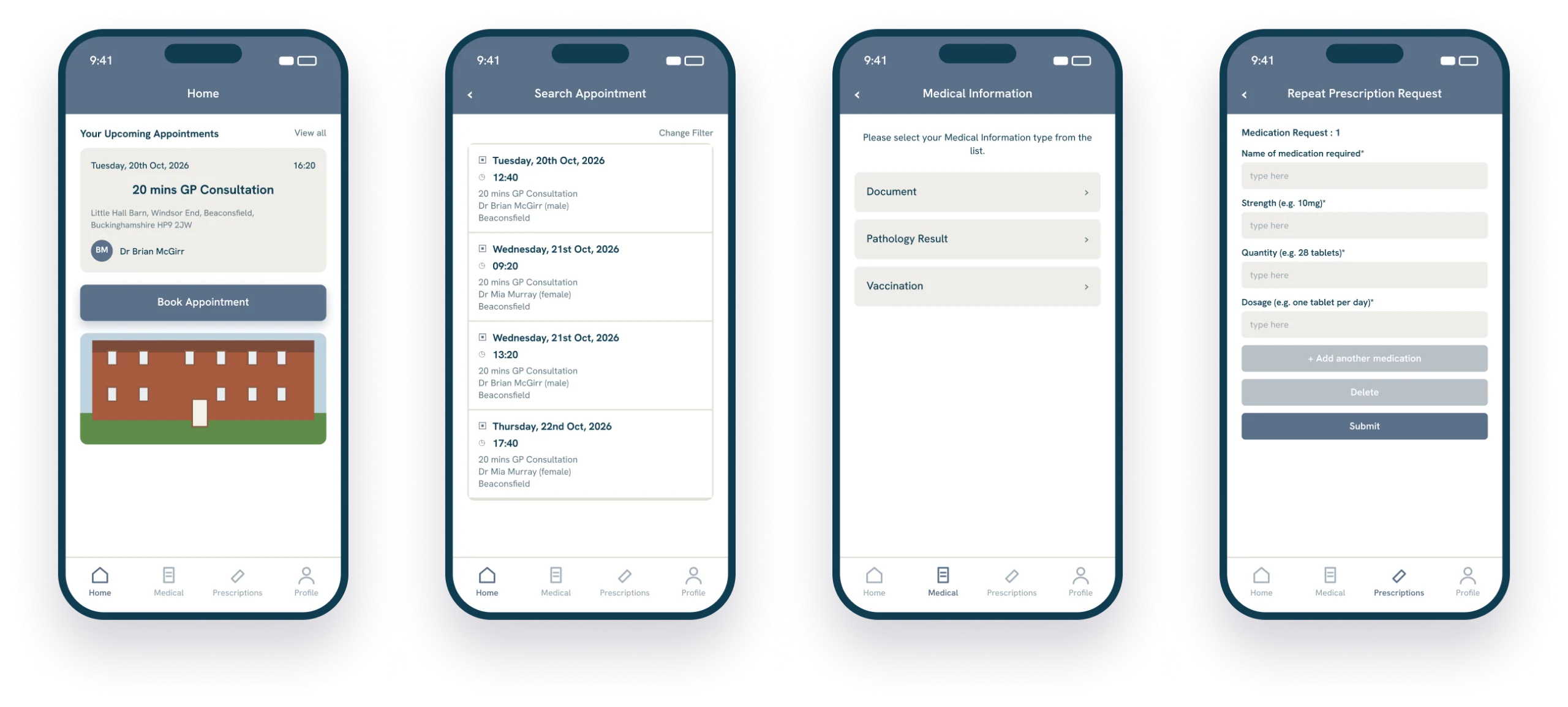
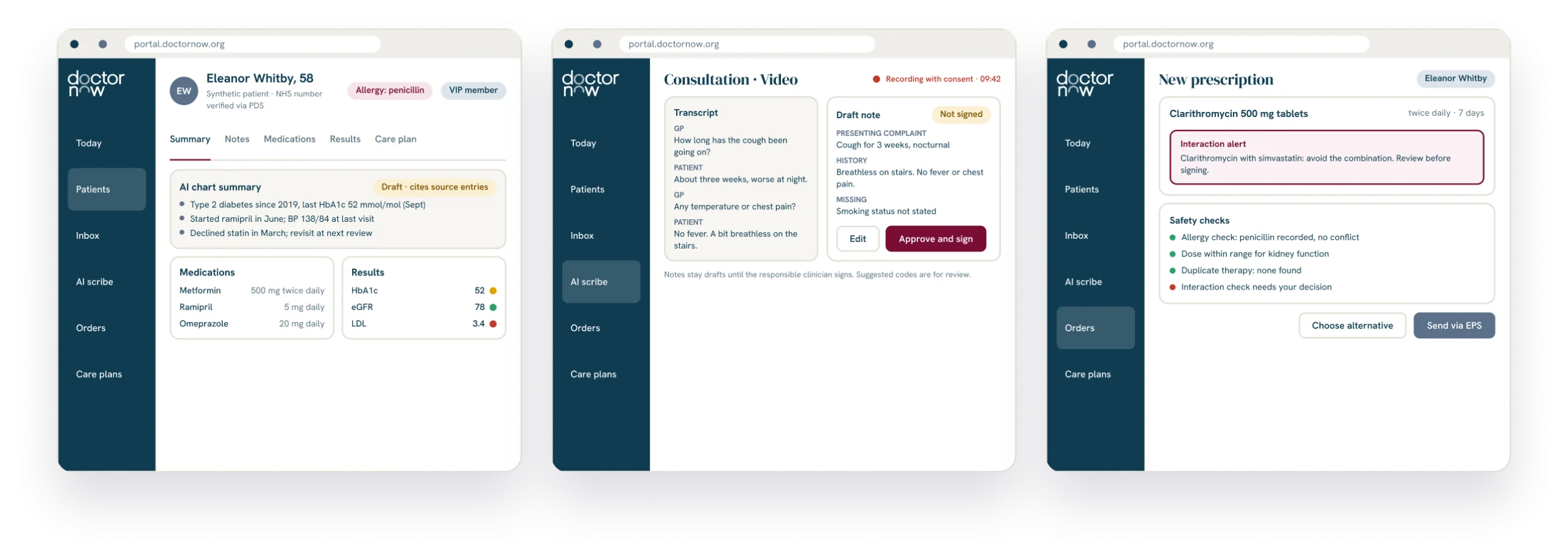
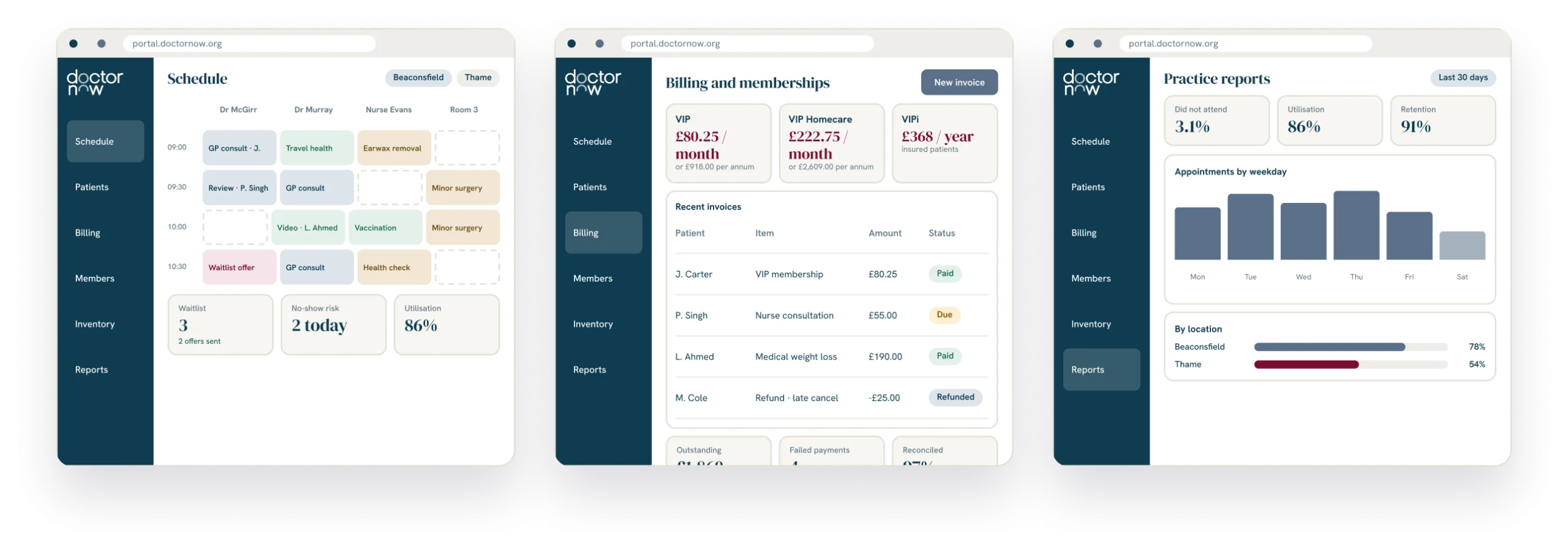
Nine products, one design language
A closer look at the screens each product ships with. The website and customer apps follow the live listings; the internal tools are illustrative.
Book with plain words or a tap, see an upfront price, track the driver live, and share the trip or call for help.
Illustrative. Designed in the same language as the live DriveTEGO app (indigo sheets, round map buttons, slide-to-confirm), with the ride types from the RideTego listing.
Drivers go online, accept matched trips with a slide, navigate to the rider, tap Arrived, and see what each trip earned.
Rebuilt from the live DriveTEGO app: map, indigo sheet, slide-to-accept, Arrived, Navigate, SOS and Rate Now.
The operations control centre: live map of rides and congestion, vehicle health, surge and price caps, and a fraud and risk queue.
Screens are illustrative.
Four models run on the ride engine’s event stream: demand forecasting pre-positions drivers, bots handle support, and telematics watches road safety.
Screens are illustrative.
Four AI modules, each with a guardrail
Predictive demand forecasting
Models learn from trip history, weather and local events, then tell the dispatch layer where to pre-position drivers before demand arrives.
Dynamic surge and fare pricing
A pricing model proposes a multiplier per zone. Hard caps and a human override sit around it, so affordability and driver utilization stay balanced.
Conversational chat and voice bots
Answer trip questions, change bookings and file lost-and-found claims 24/7 from trip data and policy. Refunds and safety reports go to a person.
Driver telematics and computer vision
Speeding, harsh braking, distraction and drowsiness are detected on the phone. Only event counts leave the device, and coaching is shown to the.
What it runs on
Passenger and driver apps
Flutter for iOS and Android, one codebase, native maps and location services
Admin panel
React, role-based access, audit log
Backend services
Node.js services over gRPC and REST, one service per domain: trips, dispatch, pricing, payments, safety
Data
PostgreSQL with PostGIS for trips and geo queries; Redis for live positions and trip
AI and data science
Python models for forecasting, pricing and fraud; a feature store and model registry; the language
Cloud
AWS, containerised, infrastructure as code, multi-zone
Maps and routing
Google Maps Platform for routing, ETA and traffic, with Mapbox as a fallback
Payments, messaging
Stripe Connect for cards, wallets and split payouts; Twilio for SMS, OTP and voice;
Safety is a product feature, not a checklist
Trust decides whether a rider gets in the car and a driver goes online, so the safety toolkit shipped in the first release.
Rider safety
SOS shares live location with emergency contacts and the operations team; trip sharing; a PIN checked at pickup; masked phone numbers between rider and driver.
Driver safety
On-device fatigue and driving-event detection, break prompts, and verified driver and vehicle documents before the first trip. [Confirm Texas ride-hailing background-check and insurance requirements.]
Payments
Card data stays with Stripe, keeping Tego’s payment scope small. Payouts are split and automatic.
Data and access
Role-based permissions in the admin panel with an audit log of price changes, refunds and overrides; data deletion on request. [Confirm encryption statements against the store data-safety declarations before publishing.]
Reliability
99.95% uptime over the 12 months after launch, multi-zone deployment, load-shedding under peak demand, and a ride simulator with 10,000 synthetic drivers used before each major release.
Shipped in two-week sprints, tested against simulated cities
The team shipped every two weeks behind feature flags. Before each major release, a ride simulator replayed synthetic cities, so dispatch and pricing were stress-tested before real riders saw them.
Releases
Every merge builds and tests automatically; apps go to internal tracks, then a staged rollout, with feature flags for anything rider or driver facing.
Quality
Automated API, dispatch and payment tests on every build, a real-device pass before each store submission, and load tests at ten times expected demand.
Launch
A Texas pilot with a small driver group, then open sign-up, with the admin panel and support bots staffed from day one.
Documentation and handover
Architecture decision records, runbooks and recorded walkthroughs; Tego engineers shadow on-call before taking it over.
Every design target beaten, with matches in under six seconds
Measured over the 12 months after launch.
Median ride-to-driver match time
Design target: under 8 s
Pickups within 90 seconds of the estimate
Design target: 80%
Requested rides completed
Design target: 90%
Driver cancellations after accepting
Design target: under 6%
Support chats resolved by the bot without a person
Design target: 50%
Flagged fraud stopped before payout
Design target: 85%
Platform uptime
Design target: 99.9%
Payments succeeding first time
Design target: 98%
What went wrong, and how we fixed it
Quiet hours were the hardest. In the pilot, a fixed search radius left riders waiting at night when few drivers were online. We moved to a widening radius, from two to six seconds, with a message to the rider while we searched, and we let the forecast pull drivers toward likely pickups before the lull. Late-night waits fell by about a third. The first fatigue alerts were also too noisy, so we moved scoring onto the phone and required three events before alerting.

We came to Excellent Webworld with an idea and a very short runway. Mahil Jasani took it on as if it were his own company. He sat with us through the hard calls, told us when something would not work, and kept three apps and an admin panel moving together. Our first drivers were on the road in Houston when he said they would be. We did not hire a vendor. We found a partner.
CEO, ClothesLyne, Inc.
Draft wording, pending the founder’s approval
Book a 30-minute architecture walkthrough with the lead architect on this project
Bring your market, your constraints and your launch date, and leave with a one-page sketch of how a ride engine would fit.