Built from scratch in 19 months: nine connected products now run on-demand laundry in 9 US states
Order dispatch in under 4 minutes, with 24-hour and 48-hour turnaround on one platform.
Excellent Webworld designed and built Clotheslyne’s whole stack with no legacy system to start from. All nine products read and write one order record.
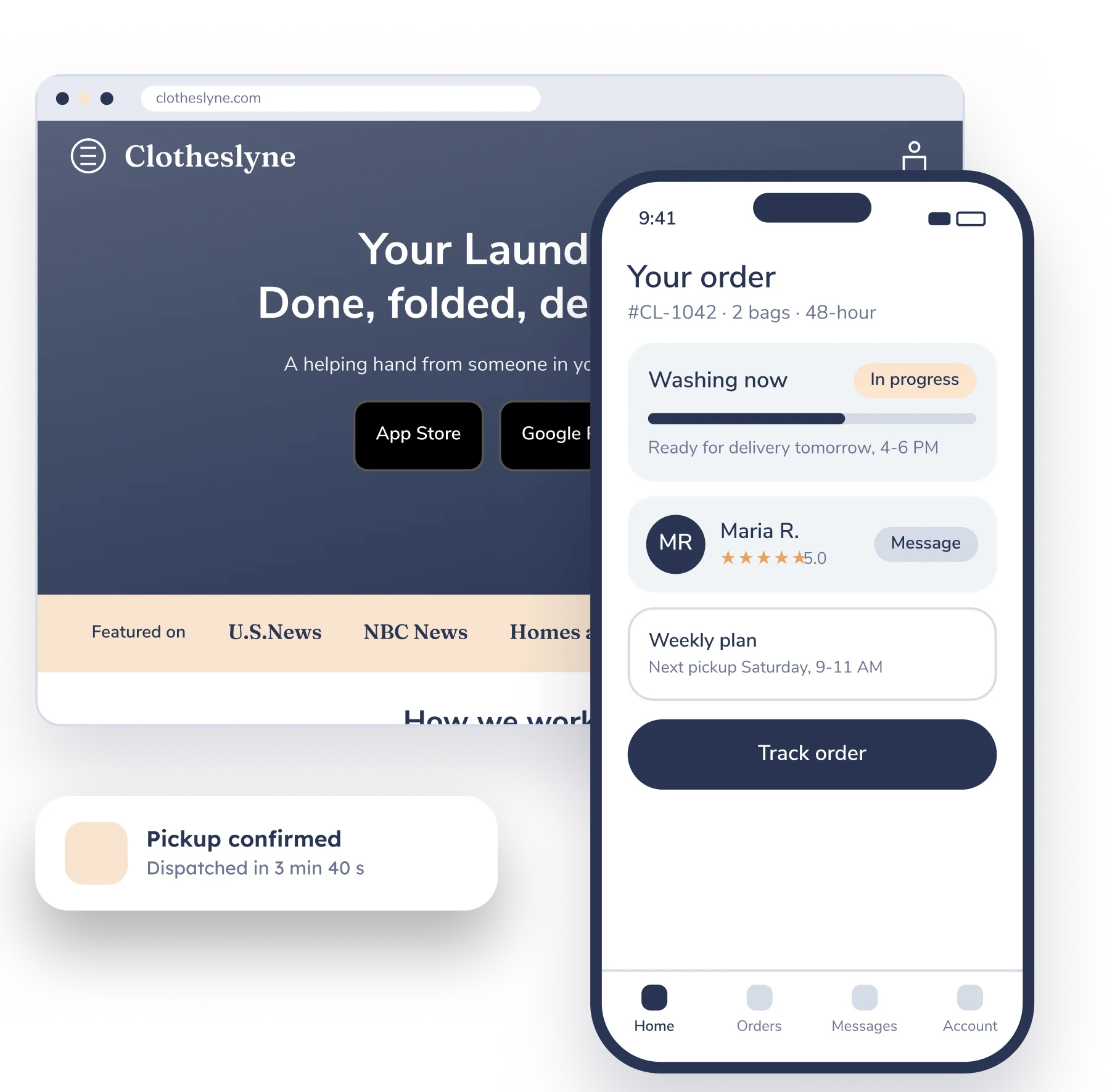
3min 40s
Median order-to-dispatch time
09
US states served
62%
Chats resolved by the AI assistant
99.95%
Platform uptime over 12 months
The project at a glance
Client
Clotheslyne, Inc.: on-demand wash-and-fold with home pickup and delivery Clotheslyne, Inc.: on-demand wash-and-fold with home pickup
Starting point
Greenfield: a business model and no software Greenfield: a business model and no software Greenfield: a business model and no software
Footprint
9 US states: Alaska, Connecticut, Florida, Massachusetts, Nevada, New Jersey, North Carolina, New York, Rhode Island
Service model
Vetted local operators (“Clotheslyners”) and partner laundromats; 24-hour or 48-hour turnaround; per-bag pricing at about 20 lb a bag;
Scope
9 products: website, iOS app, Android app, courier app, AI laundromat POS, admin dashboard, smart-machine control,
Scale
About 350 orders a day at peak; 4.7 stars on the App Store (229 ratings); 4.6 stars on Google Play (5K+ installs)
Team
9 engineers, 1 designer, 1 QA lead, 1 product manager
Timeline
Core order platform in 5 months; remaining modules over the next 14 months; then continuous delivery,
Engagement
Dedicated product team on an ongoing retainer
A business model, no software, and four hard constraints
Clotheslyne started with a business model and no software. Every order had to coordinate a customer, a courier, a local operator or partner laundromat, and support, while promising 24-hour or 48-hour turnaround, per-bag pricing and flexible pickup windows, Sundays included.
So every product was designed around one order record from day one.
Matching
Match a job to the right vetted operator within minutes.
Pricing by the bag
Price by the bag without disputes.
One shared state
Track one order across several hands with a single shared state.
Smart machines
Bring smart machines online later without a rewrite.
One order state engine connects all nine products
Every product reads and writes one order state engine, so a courier scan, a POS tag or a machine finishing its cycle updates everyone at once.
every channel reads and writes the same order
Order state engine
calls out to payments, maps, messaging and machines
Decisions, and what we rejected
One event-driven order record, not a database per app.
Rejected: syncing separate customer, courier and POS databases, where status drift and disputes begin.
Preference-first dispatch with a timed fallback.
Rejected: first-to-accept assignment, which overrides the operators a customer chose.
Rules for money and status, models for language and forecasting.
Rejected: letting a language model decide billing or order status, where one wrong answer costs money.
Bag count and photo captured at pickup, with a notice and receipt before any overage charge.
Rejected: surcharges explained after the fact.
One machine adapter interface for Bluetooth and cellular controllers.
Rejected: hard-coding a single hardware vendor into the POS.
Nine products, one design language
A closer look at the screens each product ships with. The website and customer apps follow the live listings; the internal tools are illustrative.
The marketing and acquisition site: pricing, locations, and the application page that recruits new Clotheslyners.
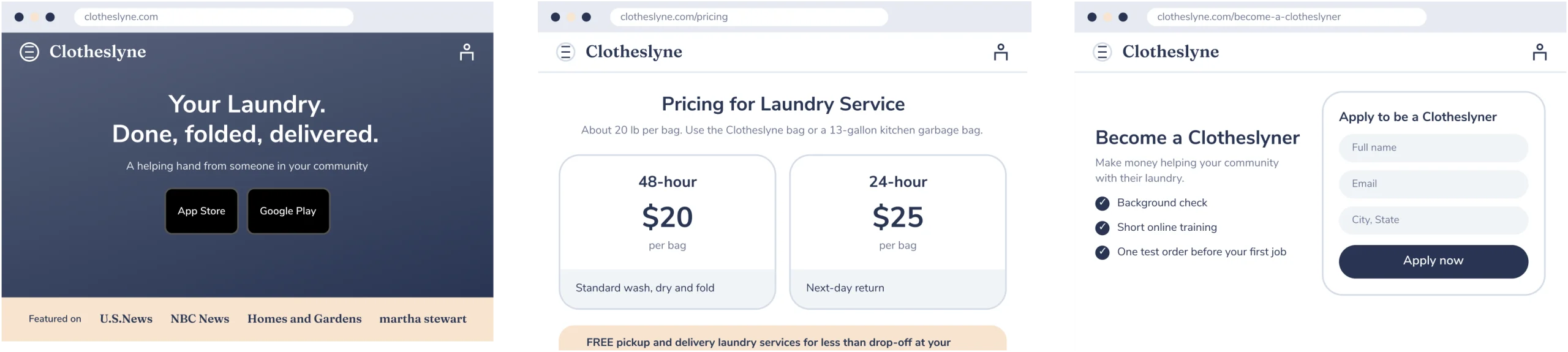
Modeled on the live site copy and navigation.
The iOS app for ordering by the bag, choosing a Clotheslyner, tracking an order and chatting with them.
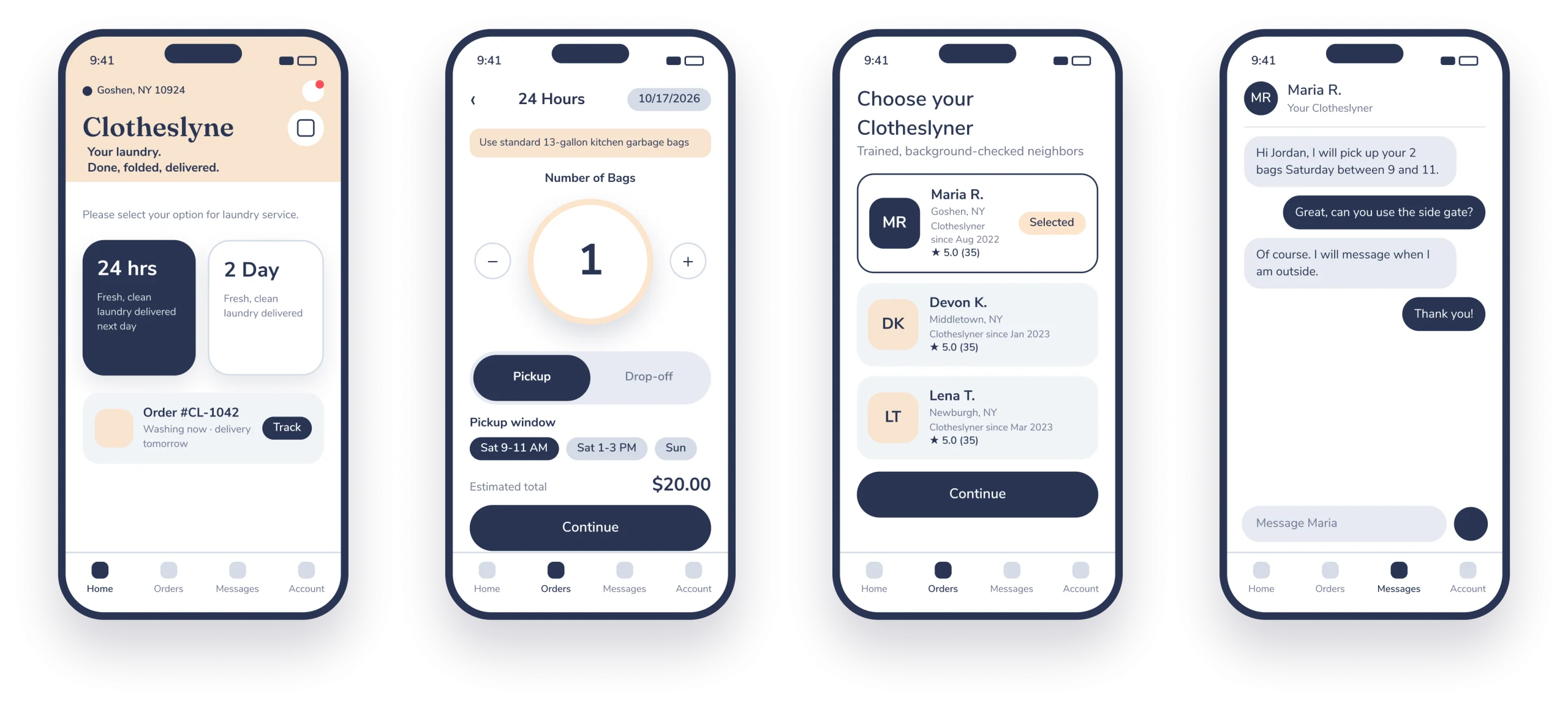
Flow and copy follow the App Store listing.
The same order flow on Android, with weekly and bi-weekly plans, live tracking, tip-and-pay, and reviews.
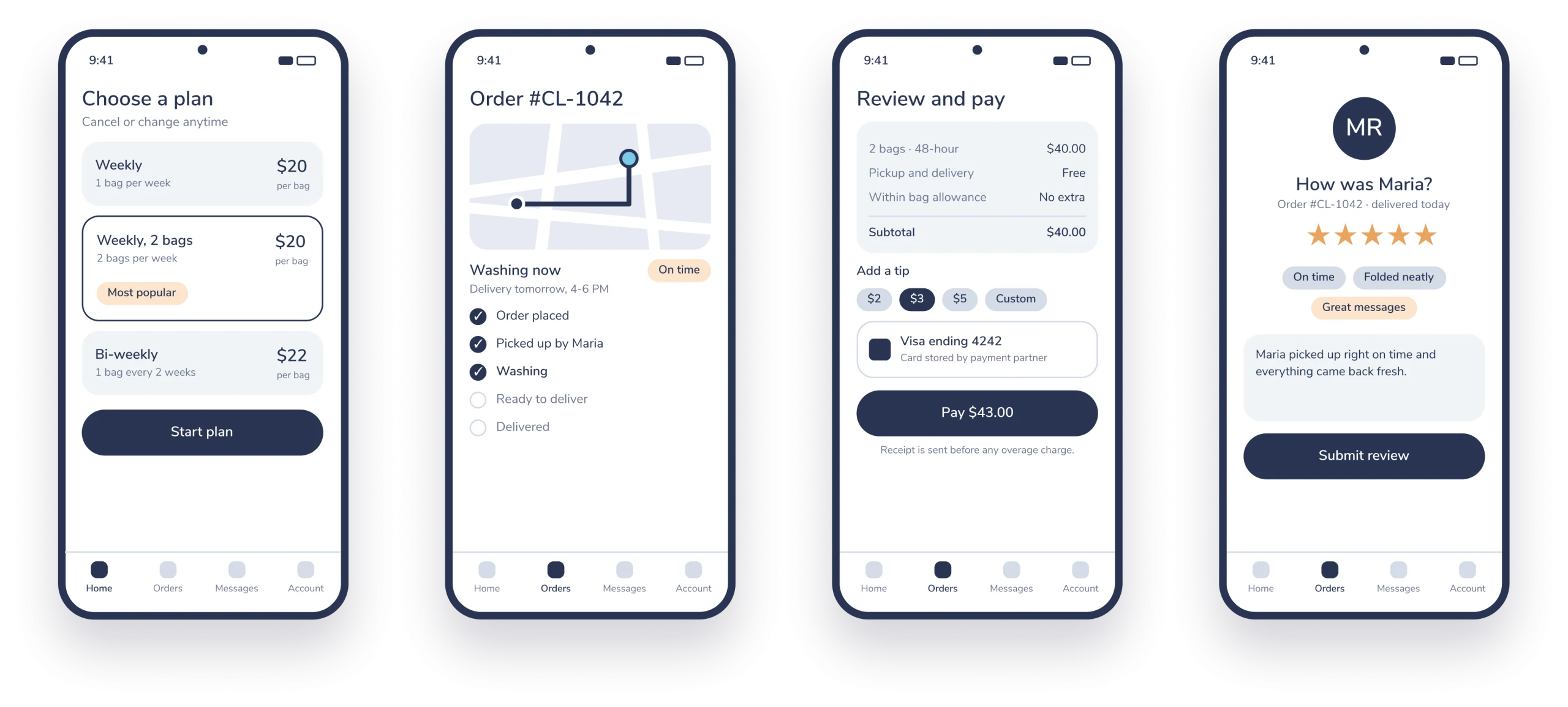
Flow and copy follow the Google Play listing.
Used by delivery staff to accept job requests, navigate with integrated maps, scan or log bags, and update order status.
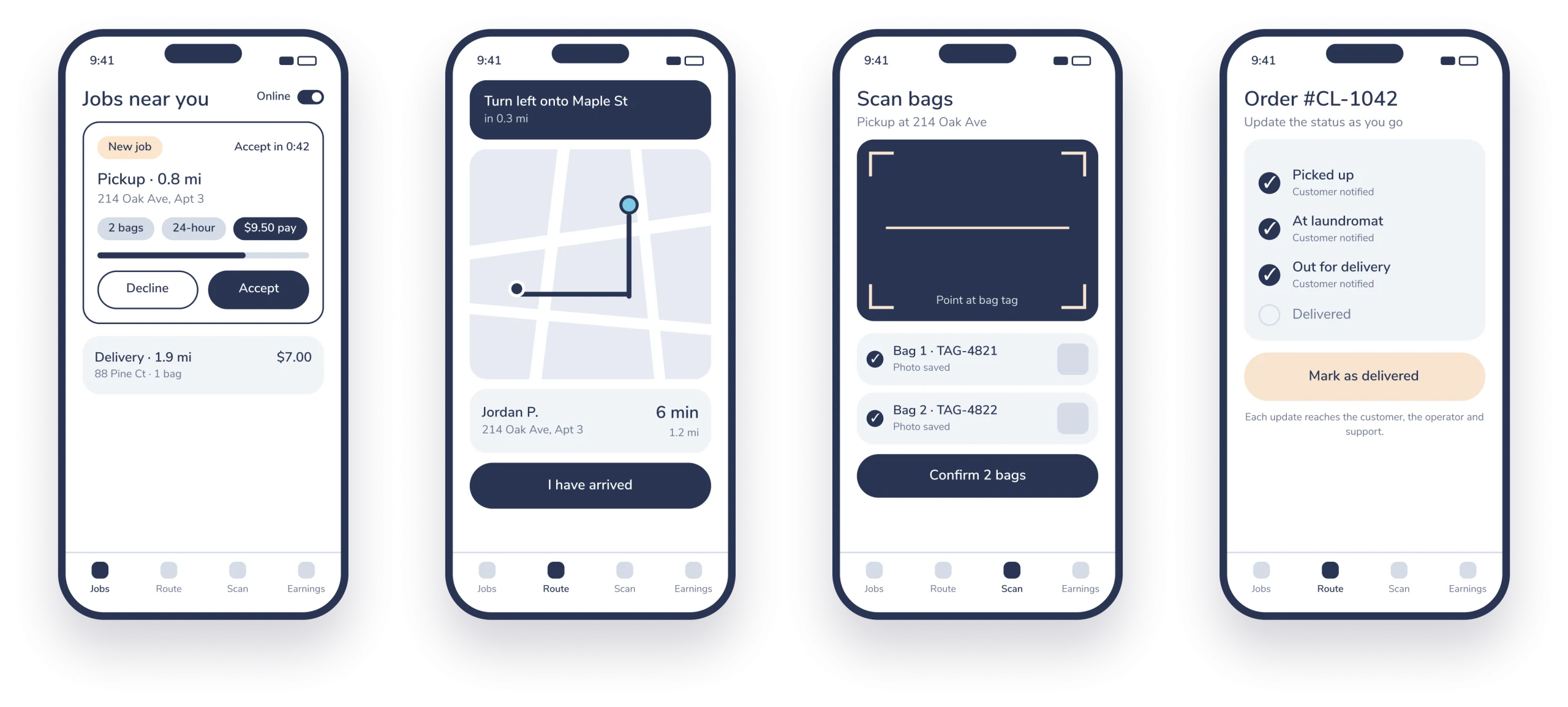
Illustrative screens.
Used by shop owners and staff to manage incoming orders, track wash-dry-fold work, assign tag IDs, generate invoices, and forecast utilities and demand.
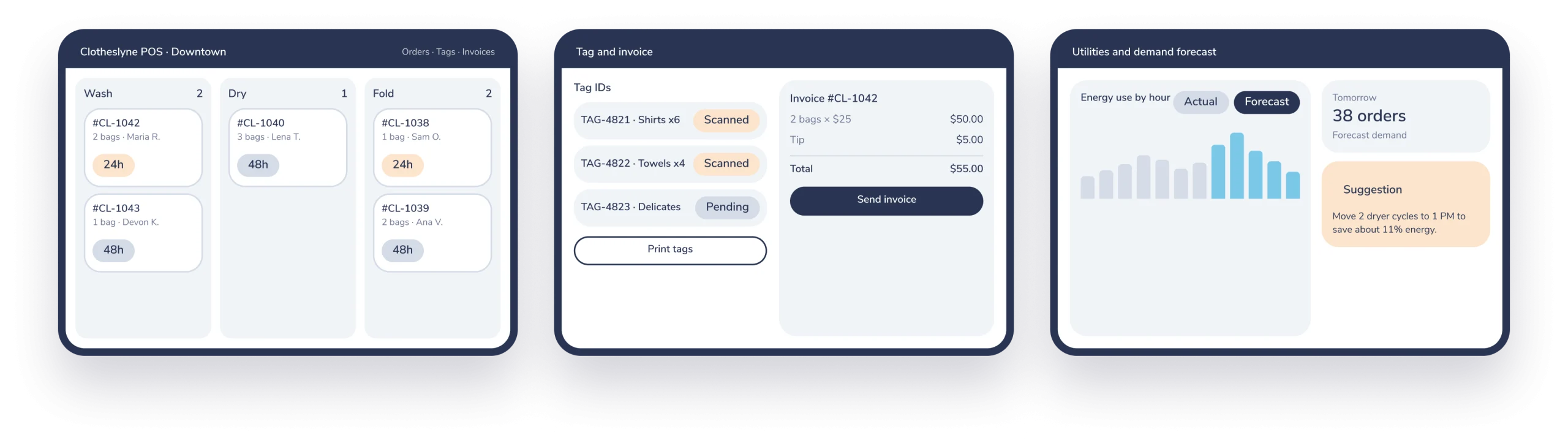
Illustrative screens.
Used by platform operators to monitor revenue, dispatch couriers, handle support tickets, and manage pricing and promotions.
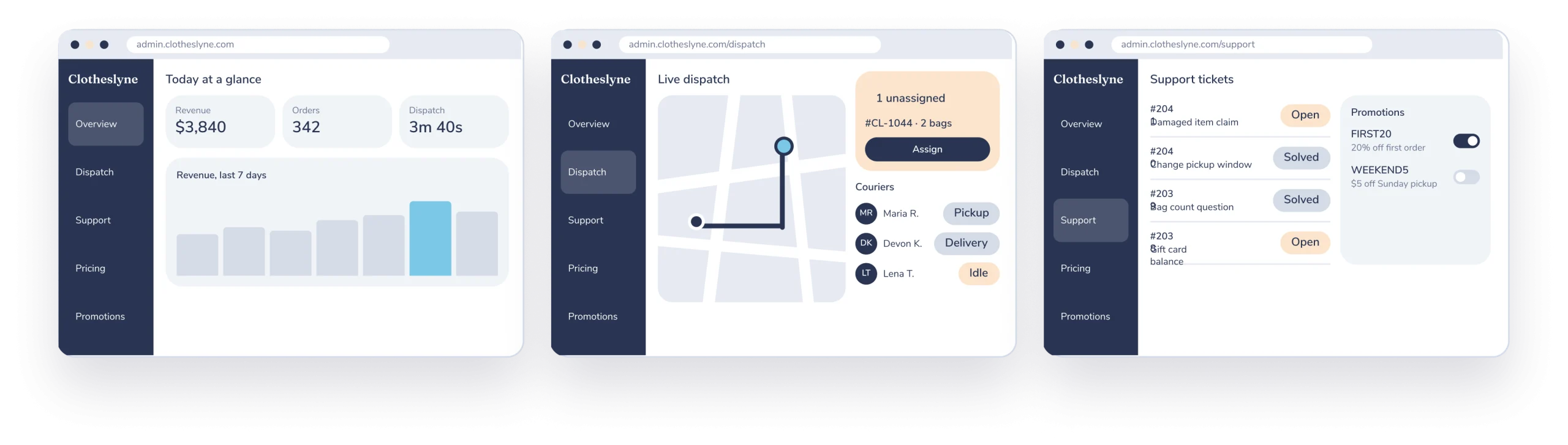
Illustrative screens.
Smart-enabled machines connect over Bluetooth or cellular so customers can start washers and dryers and get notified when a cycle finishes.
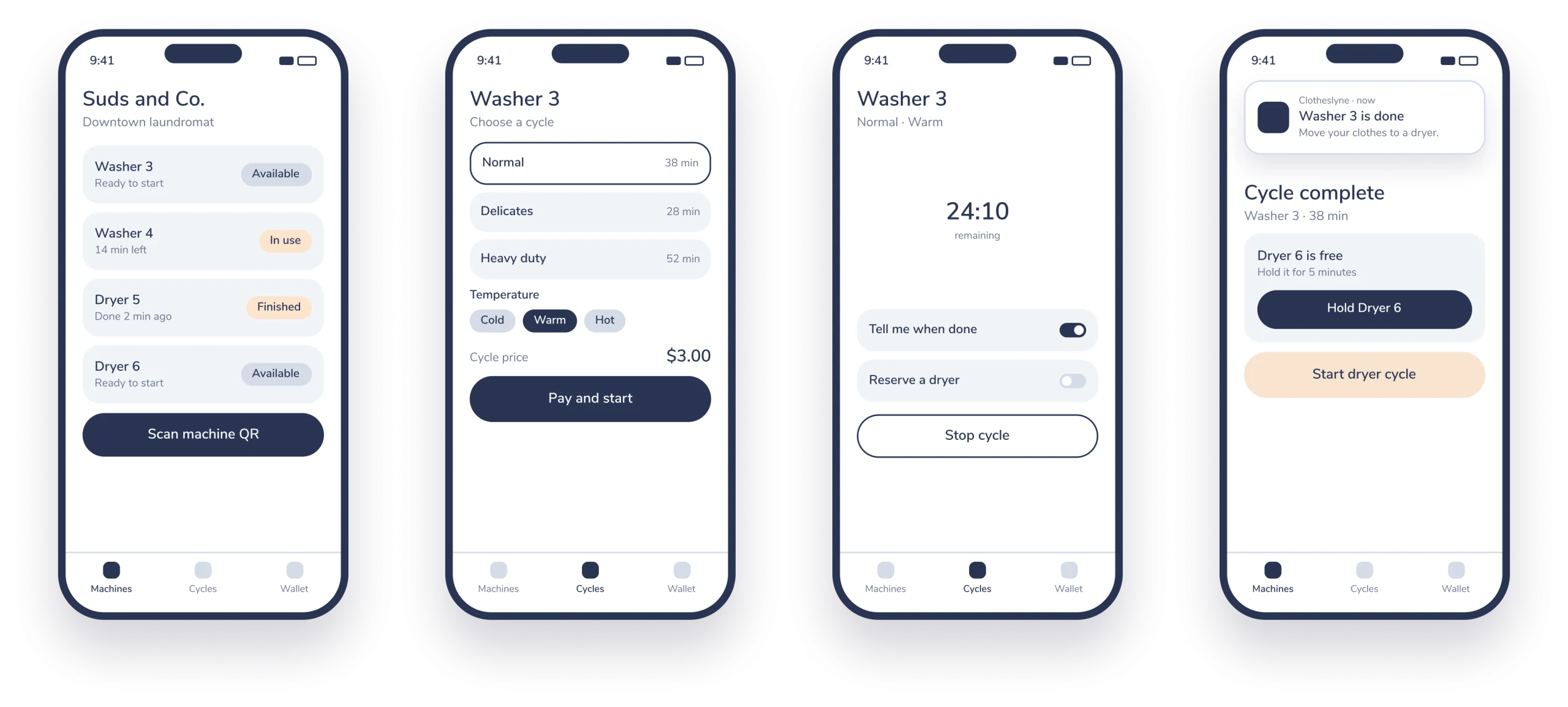
Illustrative screens.
Rules that move orders along without manual work: reminders, re-offers, price holds and exception flags.
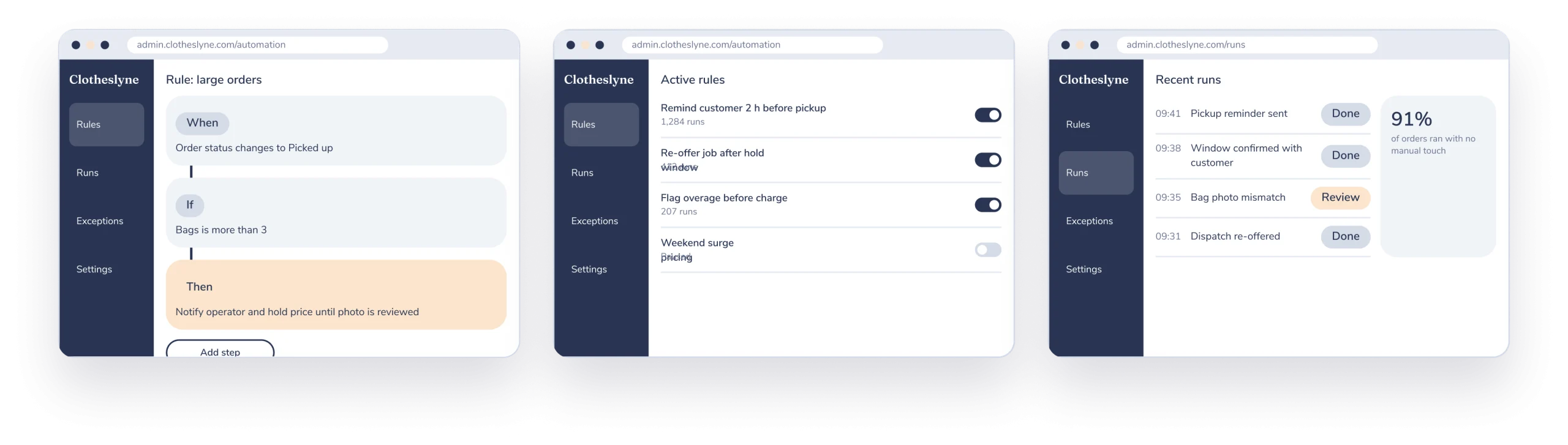
Illustrative screens.
Answers from order data and policy, hands refunds and damage claims to a person, and reschedules pickups in chat.
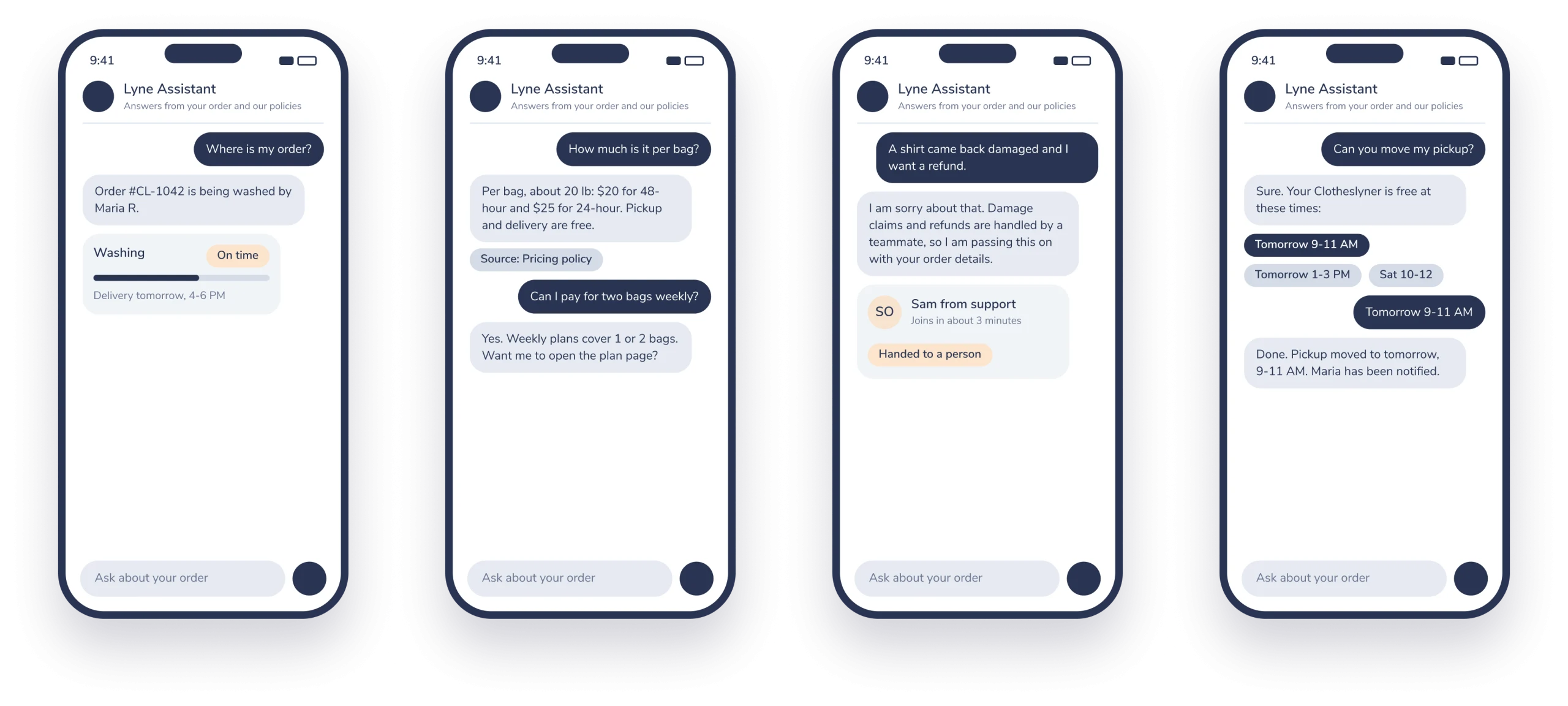
Illustrative screens.
What it runs on
Customer apps
iOS (15.6 and later) and Android, with social login and in-app
Courier app
Job inbox, turn-by-turn maps, bag scan and photo log, status updates
Web and admin
React admin dashboard; WordPress marketing site
Backend
Logs · Traceability · Explainability · Oversight
Cloud
AWS, containerised, with infrastructure as code
AI
Language model with retrieval over policy and order data
Machine control
Bluetooth and cellular adapters behind one interface,
Third-party systems
Card payments (tokenised), maps and routing, push and SMS,
Small payment scope, auditable access, guarded AI
Card data never touches Clotheslyne’s servers, so payment scope stays small. Customer data is encrypted in transit and can be deleted on request, as the Google Play listing declares.
Data handling
Contact details, precise location, photos and payment details are collected for app functionality, as the App Store privacy declaration states; payment details are tokenised by the processor.
Access
Role-based permissions in the admin dashboard and POS, with an audit log of price changes, refunds and manual overrides.
Operator trust
Every operator passes a background check, training and a test order before receiving jobs, and the platform blocks dispatch until all three are done.
Reliability
99.95% uptime over the 12 months after full rollout, with a median restore time of 18 minutes.
AI guardrails
The chatbot answers only from order data and published policy; refunds, damage claims and payment disputes always go to a person; personal data is masked before any model call; a fixed set of 200 real support conversations is replayed on every prompt or model change, and a drop in score blocks the release.
A release train that never stopped
The team shipped in two-week sprints with a release train that never stopped: 25 App Store releases between December 2022 and May 2026, each one small enough to roll back.
Releases
Every merge builds and tests automatically; apps go through internal tracks, then a staged rollout, with feature flags for anything customer-visible.
Quality
Automated API and workflow tests on every build, plus a real-device pass before each store submission. pass before each store submission. pass before each store submission.
What shipped along the way
Social login, an improved rating and review flow, bi-weekly plans and multiple plans per account, more pickup and delivery windows, and an in-app Messages tab.
Documentation and handover
Architecture decision records, runbooks and recorded walkthroughs; client engineers shadow on-call before taking it over.
Every design target beaten, with dispatch under 4 minutes
Measured over the 12 months after full rollout.
Order-to-dispatch time, median
Design target: under 5 min
Orders needing a manual support touch
Design target: under 10%
Missed pickup windows pickup windows
Missed pickup windows
Bag-count disputes, share of orders
Design target: under 2%
Support tickets per 100 orders
Design target: under 6
Chats resolved by the AI assistant without a person
Design target: 50%
Platform uptime Platform uptime
Design target: 99.9%
Median time to restore service
Design target: under 30 min
What went wrong, and how we fixed it
Matching was the hardest part. The first release gave a job to the first operator who accepted, which sometimes overrode the operators a customer had picked, and customers noticed. We moved to a hold window: the customer’s chosen operators see the job first, a timed fallback widens the pool, and the customer gets an alert before any reassignment. It added about 90 seconds to median dispatch time, which the automation layer won back by confirming pickup windows before the job was offered.

Excellent Webworld helped us build the technology foundation needed to expand into new markets. Their technical depth, adaptability, and ability to turn complex ideas into scalable solutions stood out.
CEO, ClothesLyne, Inc.
Book a 30-minute architecture walkthrough with the lead architect on this project
Bring your current stack and your messiest hand-off, and leave with a one-page sketch of how an order engine would sit on top of it.