In 2026, Forward Deployed Engineering (FDE) could mark a meaningful shift in how healthcare AI gets built and implemented. Rather than developing solutions at a distance and handing them over, FDE brings engineers closer to the people, systems, and workflows the technology must serve.
That proximity matters in healthcare, where an AI solution that performs well in a controlled pilot may struggle once it encounters fragmented data, legacy EHRs, interoperability issues, and the realities of clinical and administrative work.
By working through these constraints alongside the teams who face them, forward deployed engineering in healthcare AI offers a more practical path from AI experimentation to production.
Key Takeaways:
- Forward Deployed Engineering (FDE) places engineers directly within customer environments to build and implement technology solutions.
- Growing demand for FDE in healthcare AI reflects the challenge of moving promising AI pilots into production.
- FDE improves implementation through hands-on engineering, continuous feedback, and refinement beyond initial deployment.
- The right FDE partner brings healthcare expertise and the technical capabilities to carry AI implementations into production.
What is Forward Deployed Engineering (FDE)?
Forward Deployed Engineering (FDE) is an engineering approach in which engineers work directly with customers in their actual operating environments to build and implement technology solutions. Rather than working from a predefined set of requirements and handing over the finished product, they work alongside customer teams, observe how things operate, and resolve implementation challenges as they arise.
In healthcare AI, the FDE model puts engineers in the field, working directly with healthcare teams and the systems they use every day. They work through the practical details of AI implementation, from integrating with existing EHRs and connecting data across systems to fitting AI capabilities into clinical and administrative workflows. This close involvement helps ensure the solution reflects how the organization actually operates.
Did You Know?: The global data analytics giant Palantir helped popularize the FDE model, with CEO Alex Karp associated with its early adoption.
Why is Demand for Forward Deployed Engineering Growing in Healthcare?
The demand for healthcare forward deployed engineering comes down to a problem I see at the heart of enterprise AI: getting a solution to work in a demo is not the same as getting it to work inside a business.
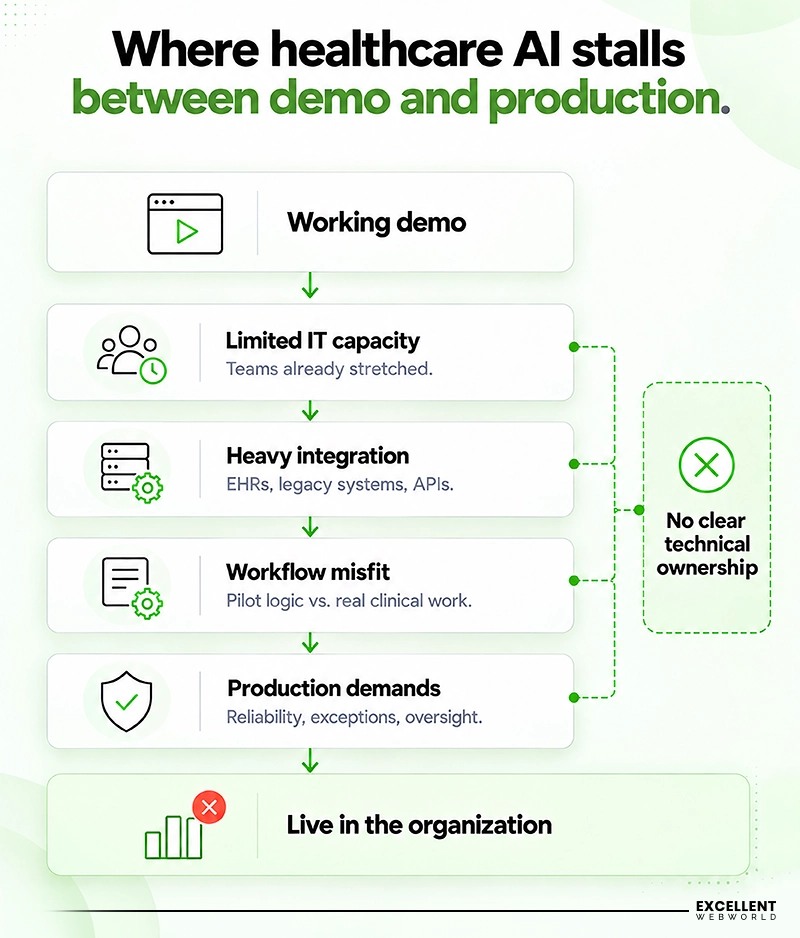
MIT NANDA’s State of AI in Business 2025 report illustrates this gap quite evidently. Despite an estimated $30-$40 billion in enterprise GenAI investment, the report found that 95% of organizations were not seeing measurable returns. Its analysis also highlighted the drop-off between evaluating task-specific AI tools, piloting them, and putting them into production.
Healthcare adds its own AI implementation challenges:
- Healthcare IT teams have limited capacity to develop, integrate, test, and maintain AI applications alongside their existing responsibilities.
- Connecting AI to EHRs, legacy infrastructure, APIs, and other healthcare systems requires substantial integration work.
- Solutions that perform well in controlled tests may not fit clinicians’ and administrators’ actual workflows.
- Production deployment requires reliability testing, exception handling, performance monitoring, and appropriate human oversight.
- Without clear technical ownership, promising pilots can stall before wider adoption.
The engineering work doesn’t end when the model performs well. Someone still needs to make it work with the organization’s systems, resolve the issues that emerge in real workflows, and take responsibility for what happens after deployment. FDE work in healthcare puts hands-on implementation at the center of the engagement, with engineers working directly alongside the teams who will use the solution.
MIT NANDA also reported stronger deployment outcomes for AI initiatives developed with external support than for internally developed tools. That finding, by itself, doesn’t establish FDE as the answer to every healthcare AI implementation problem, but it reinforces the value of dedicated expertise and execution capacity. FDE offers one way to bring both into the project.
How do Forward Deployed Engineers Accelerate Healthcare AI Projects?
Forward deployed engineers accelerate healthcare AI projects by combining hands-on healthcare AI with a deep understanding of healthcare workflows. From my perspective, the advantage is working with a healthcare app development company fluent in engineering systems that solve the real-world problems that emerge when AI meets clinical reality.
First, they get close to the actual workflow.
As an engineer, I want to understand how your team actually works before deciding how to build around that workflow. Process documents tell us how work is supposed to happen. But when we engage with the people using those systems, we often uncover manual workarounds, hidden exceptions, and fragile dependencies that never made it into the documentation. Those details can change the technical approach entirely.
Then, they bring that context into engineering decisions.
Let’s take EHR integration, for instance. Establishing an API connection is just a part of healthcare FDE work. It also requires ensuring the right clinical data reaches the right workflow is another. We need to understand how information moves between systems, which interoperability standards apply, and what happens when records are incomplete or an integration fails.
Depending on the project, this work can involve:
- Connecting EHRs through HL7 or FHIR interfaces, using SMART on FHIR where appropriate.
- Integrating fragmented healthcare data with existing systems and infrastructure.
- Implementing access controls, audit trails, and safeguards for sensitive health information.
- Embedding AI capabilities into clinical workflows through AI integration services, such as ambient clinical documentation with human review.
Someone needs to own what happens after the demo.
A working prototype proves that an idea has potential. It doesn’t tell us how the application will handle edge cases, behave with real-world data, or recover from integration failures. Those questions require realistic testing, debugging, coordination, and ongoing engineering effort.
An FDE brings dedicated capacity to that work instead of leaving an already stretched internal team to manage it alongside existing responsibilities.
But the work doesn’t stop at deployment.
Once people start using the solution, we get the kind of feedback that testing alone may not reveal. Depending on the use case, I would want the team to examine measures such as documentation accuracy, coding accuracy, claim denial patterns, or time spent completing a workflow. If the AI introduces extra steps or produces outputs that staff struggle to verify, we need to understand why and refine the implementation.
Mayur Panchal, CTO, Excellent Webworld: “With FDE, the objective is not to rush AI into production but to identify problems earlier, give them clear ownership, and resolve them without compromising testing or clinical validation.”
By bringing workflow discovery, integration, engineering, and feedback into the same process, FDEs help address implementation problems earlier, giving healthcare AI deployment a more practical path from development to production.
How Does the Forward Deployed Engineering Model Work in Healthcare?
Forward deployed engineering follows an iterative cycle of embedding with the customer, diagnosing problems, building and integrating solutions, testing, and refining the implementation. More importantly, what distinguishes the FDE approach is how closely engineers work with the people and systems involved.
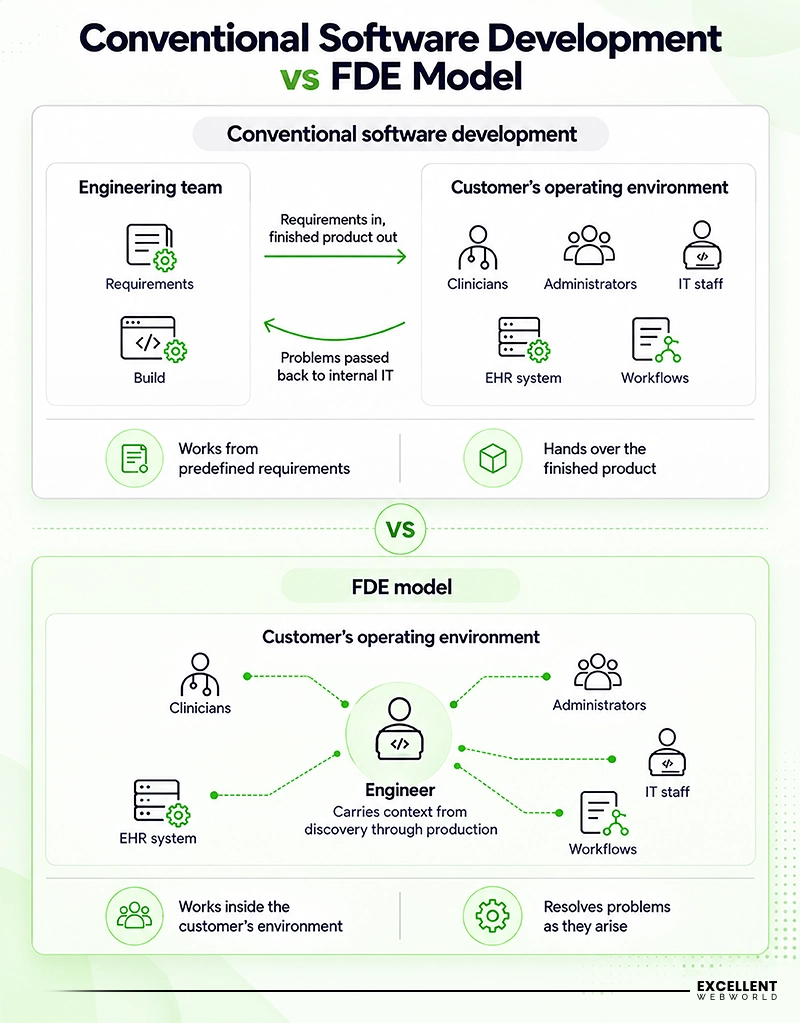
In healthcare, that proximity helps them make decisions based on actual workflows, infrastructure, and operational constraints rather than assumptions made during planning.
1. Embed With the Clinical and Technical Teams to Discover the Actual Problem
As a forward deployed engineer, I want to understand what your team needs to solve, not just what it initially asks us to build. By working alongside clinicians, administrators, and IT staff, we can uncover undocumented workflows, manual workarounds, and problems that requirements documents may overlook. That context helps us determine where AI can add value without introducing unnecessary complexity.
2. Diagnose the Environment and Plan Around Its Constraints
Rather than designing for an assumed environment, we examine your actual EHRs, APIs, data sources, and infrastructure. We identify integration dependencies, data access limitations, and applicable security requirements before deciding how to implement the solution. The technical approach must fit the organization’s environment and the specific healthcare use case.
3. Build and Integrate Around Real World Requirements
Integration decisions evolve as engineers encounter customer systems firsthand. Implementation often requires API integration services, HL7 or FHIR interfaces, SMART on FHIR standards, and safeguards for protected health information (PHI).
When real data or system behavior exposes an overlooked dependency, the team can adapt the implementation rather than simply passing the problem back to internal IT.
4. Validate the Complete Solution in Context
A successful AI demonstration tells us very little about how the complete application will behave in clinical workflows. I’d want to evaluate the AI’s output quality, integration behavior, edge cases, and compatibility with the intended workflow.
Let’s take AI clinical documentation, for example. I’d want to examine:
- The accuracy and completeness of the AI-generated notes.
- How reliably AI in EHR transfers notes into the target system.
- Whether clinicians can review and correct them before finalizing the record.
We also need to validate the human-review process and address any clinical safety or security requirements before deployment.
5. Stay Involved Through Deployment and Adoption
The FDE team’s involvement continues as the solution enters production. We work through integration issues, observe how staff interact with the application, and address workflow friction that controlled testing may not have exposed.
The objective here is to resolve AI implementation problems with clear technical ownership, rather than treating go-live as a handoff.
6. Refine the Implementation Through Real-World Feedback
Actual use reveals problems that initial testing cannot anticipate. Depending on the application, we might examine documentation quality, coding accuracy, or time spent completing a workflow. Feedback from users and operational data then helps us identify what needs to change, whether that’s an integration, an AI configuration, or the workflow itself.
What Makes This an FDE Engagement Rather Than a Conventional Handoff?
The distinction lies in continuous customer proximity and technical ownership across the implementation lifecycle.
What distinguishes FDE is the continuity of that involvement: engineers carry context from discovery through production and use what they learn in the customer’s environment to guide subsequent decisions.
A Quick Note
An FDE engagement doesn’t necessarily mean working with a single engineer. Depending on your project’s complexity, you can also have a multidisciplinary team of specialists embedded alongside your team, bringing together the expertise needed to implement your solution.
FDE vs. AI Engineer vs. Solutions Architect: What’s the Difference?
| Dimension | Forward Deployed Engineer (FDE) | AI Engineer | Solutions Architect |
|---|---|---|---|
| Primary Focus | Customer-specific implementation | Building AI-powered systems | Designing the technical architecture |
| Core Responsibilities | Workflow discovery, integration, implementation, and troubleshooting | Model integration, AI application logic, RAG, and evaluation | Component selection, system design, integrations, and scalability |
| Customer Interaction | Works directly with customer teams in their environment, often throughout the engagement. | Typically works with product and technical teams; direct customer contact varies by role | Engages customer stakeholders mainly during scoping, design, and technical review |
| Main Question | How do we make this work in your environment? | How do we build an AI system that performs the task? | How should the system be designed? |
| Production Involvement | May own implementation through deployment and refinement | May develop, deploy, and maintain AI systems | May guide implementation and resolve architectural issues |
| Healthcare Example | Adapting an ambient AI documentation toolto a provider’s EHR and workflow | Developing and evaluating clinical note generation | Designing the architecture connecting AI, EHRs, data services, and security controls |
Please note: These roles overlap to a certain extent, and responsibilities vary by organization and project
FDEs don’t replace AI engineers or solutions architects.
Complex healthcare AI implementations may require all three, alongside clinical, security, and interoperability specialists. Understanding healthcare FDE roles alongside those of AI engineers and solutions architects helps clarify their primary responsibilities and how closely each remains involved with the customer’s implementation.
How to Choose the Right FDE for Healthcare AI Projects
| Evaluation Criteria | What to Look For | Why It Matters |
|---|---|---|
| Healthcare Domain Expertise | Familiarity with clinical and administrative workflows, stakeholder responsibilities, exceptions, and workarounds. | Helps uncover undocumented requirements and avoid building around incorrect workflow assumptions. |
| AI Use-case Identification | Ability to identify the underlying problem, assess AI feasibility, and distinguish AI opportunities from simpler automation or integration needs. | Prevents investment in AI capabilities that don’t address the actual operational problem. |
| AI and Software Engineering | Experience with AI development, model/API integration, RAG, or agent workflows where relevant, and real-world debugging. | Helps turn AI capabilities into a functioning application that can operate reliably within existing systems. |
| Interoperability, Security, and Compliance | Knowledge of EHR/EMR integration, HL7/FHIR, SMART on FHIR (where applicable), PHI protection, access controls, and audit trails. | Reduces the risk of integration failures, inappropriate data access, and costly architectural changes late in implementation. |
| Validation and Human Oversight | Ability to test realistic scenarios, evaluate AI output quality, investigate recurring errors, and establish appropriate human review within a clear AI governance framework. | Helps determine whether the solution is reliable enough for its intended use and where human review remains necessary. |
| End-to-end Ownership and Collaboration | Commitment to implementation through deployment and refinement, with effective coordination across customer teams and technical specialties. | Reduces the risk of implementation issues falling between teams or becoming an unmanaged burden on internal staff. |
Moving Healthcare AI from Pilot to Production with FDE
I’ve said throughout this article that the real test of healthcare AI begins when it meets the systems and workflows it was built to support. A model can deliver promising results in a controlled environment, but those results mean little if the solution cannot fit into your existing infrastructure or hold up under the demands of everyday healthcare operations.
That’s the problem I believe forward deployed engineering is designed to solve. By keeping engineers involved from workflow discovery through deployment and refinement, the FDE model gives healthcare AI implementation challenges the technical attention and ownership they need.
Of course, the model itself isn’t a guarantee of success. The engineers you bring in, their familiarity with the healthcare domain, and their ability to work through your technical constraints will determine how much value the engagement delivers.
If you’re considering FDE for your healthcare AI initiative, let’s discuss what your project needs and how we can help you move forward.
Frequently Asked Questions

Article By

