What It Takes to Build a Production-Ready Enterprise Agentic AI System
- Production-ready agentic AI systems need reliable architecture, governed data, secure tool integrations, and operational controls beyond model capabilities.
- Traceability, bounded authority, and recoverable state are the three foundational properties of enterprise-grade agentic AI systems.
- The right architecture depends on workflow requirements, with deterministic pipelines, single-agent systems, and multi-agent systems serving different operational needs.
- Data quality, context management, tool reliability, and failure recovery determine how effectively AI agents operate in real-world enterprise environments.
- Enterprise deployment requires behavioral testing, human oversight, observability, and continuous monitoring to maintain reliability and security.
- Long-term success depends on measurable business outcomes, cost per completed task, operational efficiency, and ongoing agent lifecycle governance.
Suppose a version of agentic AI performs exceptionally well in a recorded demo. The agent receives a clean prompt, calls two tools, produces the desired output, and the whole room applauds.
Now, fast forward six months, and the same system is either being babysat by two engineers whose job is to catch what it gets wrong or is switched off. This is why organizations need to build enterprise agentic AI system capabilities around reliability, failure recovery, and ongoing operational control.
So what changed during this period, or what was the root cause? People may think that an agentic AI development company may not have devised a good AI model. However, the problem was never the model. We assumed that any capable AI model, with a well-crafted prompt, would run just as well in a demo as in production. However, that theory is completely off-target.
Enterprise production environments are never the same as demo environments. There are lots of dependencies that you need to deal with while working in any production environment, like data arriving late, data being incomplete, version control issues, permissions expiring, a field that always had a value suddenly doesn’t, or a user submits an input the system was never trained to work on.
When any of these things happen, the agent, without proper system design, either halts or hallucinates. Neither is acceptable when critical business operations depend on agentic systems' outputs.
This guide aims to close that gap. We’re not going to improve prompting or switch to a newer model; instead, we’ll solve the issue by applying systems thinking to the layers beneath AI. After reading this guide, you’ll be able to build enterprise agentic AI systems that remain dependable in production.
What Does "Production-Ready" Mean for an Enterprise Agentic AI System?
Production-readiness is a system property, not a model property.
An AI model can be state-of-the-art and still fail in production. On the other hand, a well-designed system can mask model limitations, catch errors early and deliver reliable outcomes in real-world conditions.
A production-ready agentic AI system has three major foundational properties:
|
Property |
What It Means In Production |
|---|---|
| Traceability | Every action the agent takes – tool call, decision branch & escalation – can be traced to a system state & specific input. |
| Bounded Authority | The agent can access only what it is authorized to view for the task it is currently executing. |
| Recoverable State | The system has a predefined response when APIs time out, humans reject outputs, the model misroutes decisions, or other failures occur. |
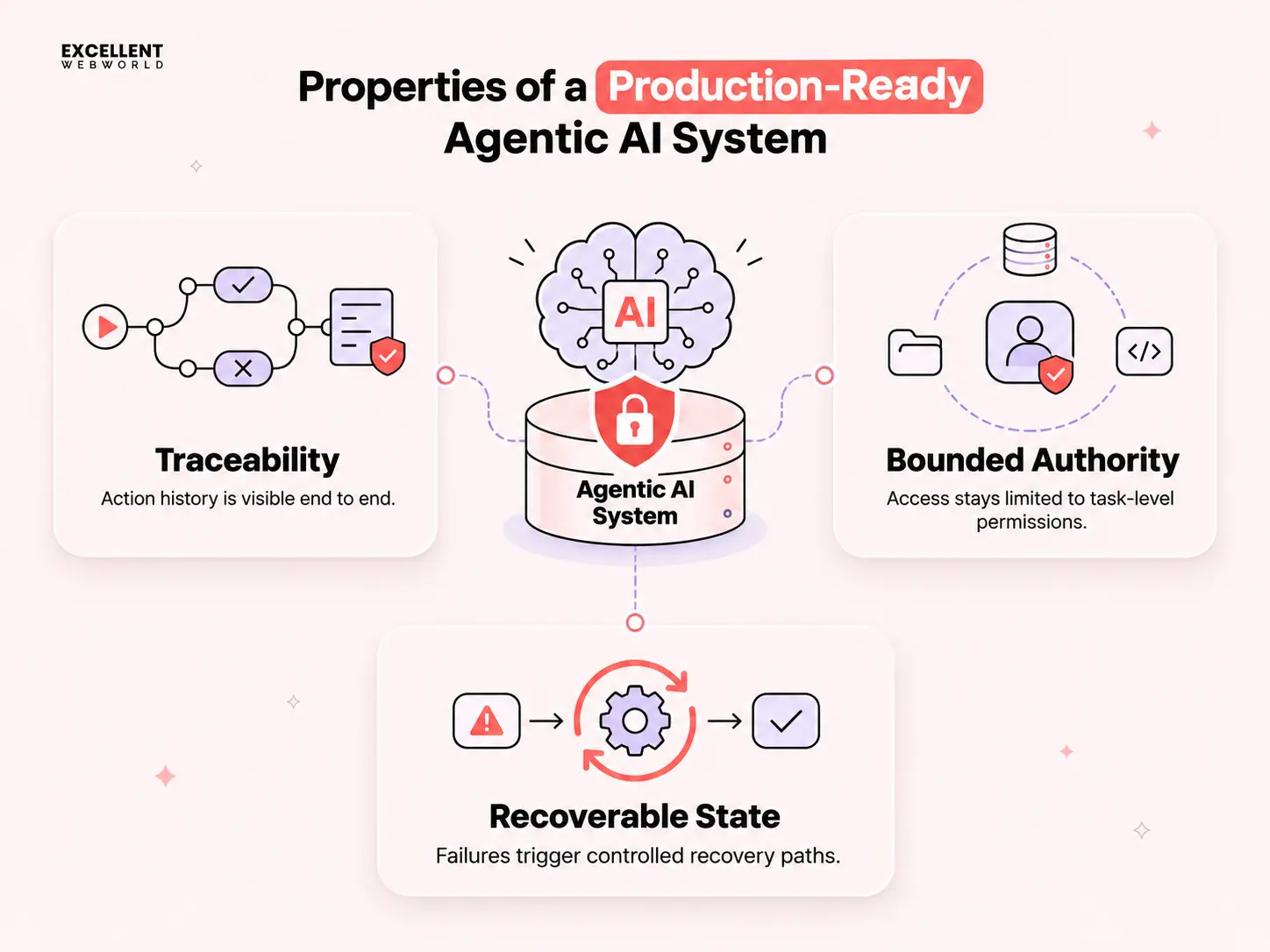
1. Traceability
Every action the agent takes, i.e., a tool call, decision branch, or escalation, must trace to a specific input and state. When organizations develop enterprise agentic AI systems, this traceability allows engineering teams to investigate failures, identify incorrect decisions, and establish accountability for agent actions.
If something goes wrong and you can’t reconstruct what happened and why, you don’t have a production system. You just have a black box with consequences. So, if you’re building an AI agent, make sure that it’s traceable.
2. Bounded Authority
A production agent shouldn’t have access to everything it might conceivably need. It should only have access to what it is authorized to touch for the task it’s currently executing. Authority that expands on demand is an AI security risk waiting to happen. An experienced AI agent development company can help you out in this regard.
3. Recoverable State
Things can go wrong pretty quickly. APIs can time out, models may misroute a decision, or a human will reject an output. A production system must have a defined answer for each scenario. That’s what we call a recoverable state.
These three properties define the target. Below are the steps to achieve them.
11 Steps to Build an Enterprise-Grade Agentic AI System
Step 1: Start with the Workflow, Not the Agent
The general instinct when building anything with AI services & solutions is to start with a model, pick a provider, write a system prompt, select a few tools, and see what happens.
However, for developing enterprise agentic AI systems, this flow reverses.
For enterprise systems, the right starting point is the business workflow the system needs to improve. You should map:
- The boring steps
- The execution path that is achieved only 3% of the time
- The human judgment calls that are currently inside someone’s head
Five Questions to Answer Before Building
| Question | What it establishes |
|---|---|
| 1. Which steps require genuine reasoning? | Identify where the system must weigh trade-offs, interpret ambiguity, or handle novel inputs rather than execute a known role. |
| 2. Which outcomes carry consequences if wrong? | Identify reputational, legal, financial, and operational consequences to determine the required level of human oversight. |
| 3. What does the agent need to know? | Identify information the agent can’t know at prompt time and where that information lives. |
| 4. What does success look like? | Define measurable business outcomes such as error rate reduced, time saved, or cost per unit processed. |
| 5. What happens if the agent is unavailable? | Identify what would break and who would be accountable for fixing it. |
These questions don’t produce an architecture; they produce a constraint set instead. Now, this constraint set is more valuable than any architecture because it tells you:
- What the system must never do wrong
- What it must always do when things go sideways
- How you will know whether the system is working as desired
The Operating Definition
This step's output is not a simple architecture diagram. It’s a one-page operating definition for each agent:
| Operating Definition | Required |
|---|---|
| Trigger | What starts the agent |
| Termination condition | When the agent must stop |
| Authority boundary | What the agent is allowed to access or change |
| Escalation path | What happens when the agent cannot safely proceed |
| Success metric | How business performance is measured |
Everything else, i.e., tool design, model selection, AI framework choice, is downstream of this. Once these operating requirements are clear, engineering teams can build enterprise agentic AI system components with well-defined responsibilities, access boundaries, and success criteria.
Step 2: Choose the Simplest Architecture That Fits
A recurring pattern in enterprise AI projects is adding complexity because the workflow feels impressive, not because it is the need of the hour.
From my experience, multi-agent orchestration sounds sophisticated, and a hierarchical reasoning loop looks good in architectural diagrams. But neither of these is a strong reason to build them.
Every agent you add to a system is:
- A new failure surface
- A new latency source
- A new cost center
- A new thing your team has to monitor
This cost and risk is only justified when the workflow is the need of the hour, not when a system designer finds multi-agent patterns intellectually appealing. You need to keep these aspects in mind to build enterprise agentic AI systems.
Three Enterprise Agentic AI Architecture Patterns
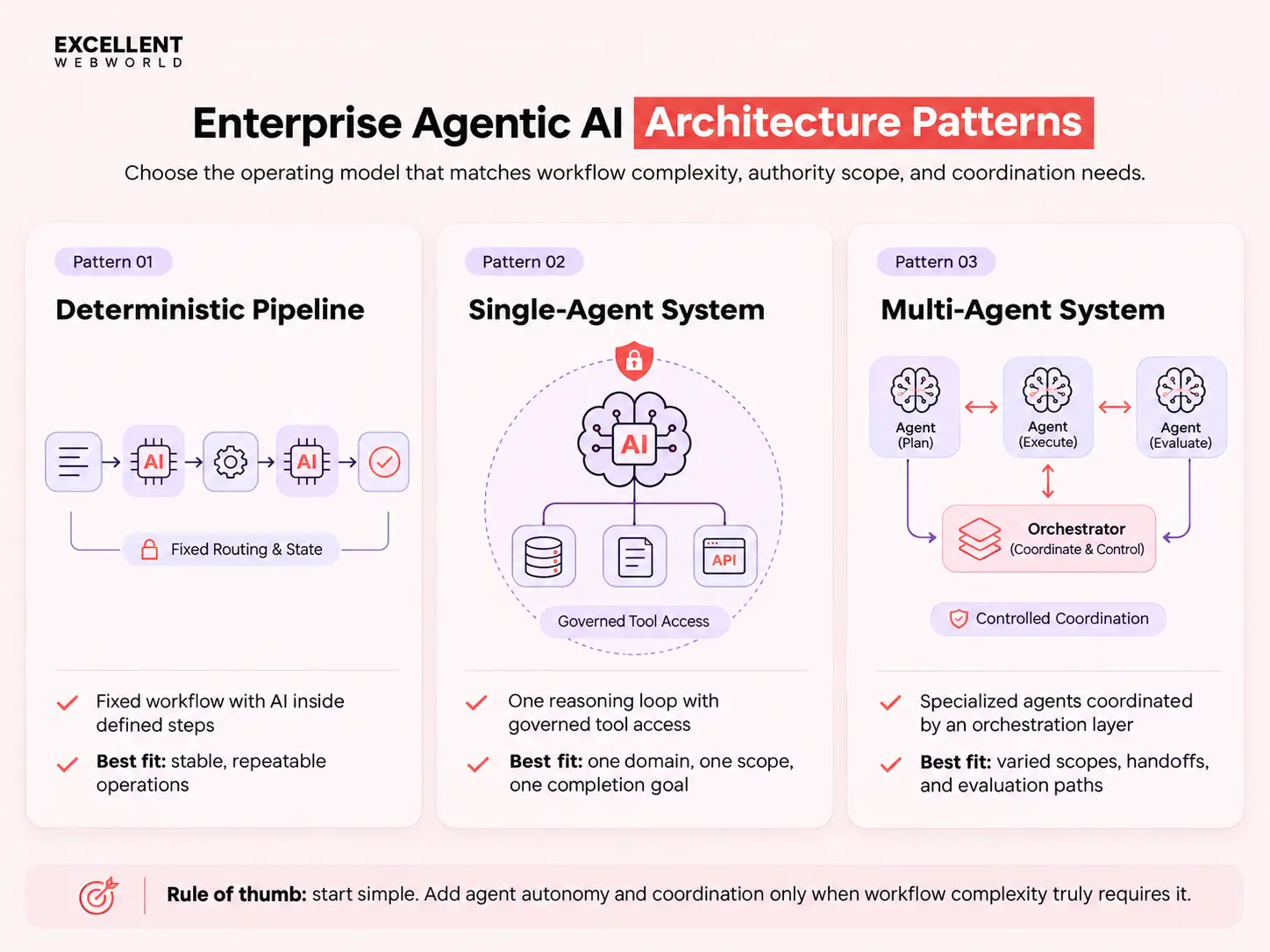
| Architecture pattern | How it works | When it fits |
|---|---|---|
| Deterministic pipeline with AI steps embedded | The workflow follows a fixed sequence. Here, AI handles specific activities like classification, extraction, or structured summarization, while state management, routing, and branching remain deterministic. | Generally, the right starting point. For many workflows, it is also the right ending point. |
| Single-agent system with governed tool access | One reasoning loop handles a task end to end. It calls tools as needed and manages its own context within defined boundaries. | Works really well when the task is coherent – one domain, one permission scope & one complete condition. |
| Multi-agent system with explicit coordination contracts | Multiple specialized agents operate within niche scopes, and an orchestration layer coordinates them, managing state, routing tasks, and handling handoffs. | Well suited when different parts of the workflow genuinely require different failure boundaries, authority scopes, or evaluation criteria. |
The keyword for a multi-agent system is explicit: each agent's tool contracts must precisely define coordination between agents.
Agents that communicate through vague shared state aren't a multi-agent system; they’re a single-agent system with extra failure points.
Single-Agent vs. Multi-Agent: The Decision Rule
For deciding single-agent vs. multi-agent,
The question is not:
"How complex is the task?"
The question is:
"Do different parts of this task require genuinely different authority scopes, failure boundaries, or evaluation criteria?"
If yes, opt for a multi-agent system; if no, opt for a single-agent system. Clear decision-making helps the engineering team build enterprise agentic AI system architectures that balance workflow complexity and operational control.
For enterprises that need multiple specialized AI agents, building everything from scratch isn't always necessary. At Excellent Webworld, we've developed a ready-to-deploy Multi-Agent AI Chatbot for Enterprises that brings multiple AI-powered capabilities into a unified solution. With our pre-built foundation, businesses can focus on customizing workflows, integrating enterprise data sources, and adapting the solution to their operational needs instead of starting development from zero.
Step 3: Prepare a Dependable Data Path
Any agent reasons over the information it receives, so the quality of its reasoning depends entirely on the quality of the information it gets.
This sounds obvious, but it is ignored most of the time.
Enterprise data is not clean; it contains:
- Records that have missing fields.
- Systems with conflicting versions of the same entity.
- A “current” record that is hours or days old depending on the system’s update routine.
- Documents with information that was accurate when written but is no longer accurate.
The Three Data Questions Every Agentic AI System Must Answer
| Question | Requirement |
|---|---|
| Where is the authoritative source? | Identify the system of record that owns the data, is accountable for its accuracy, and serves as the primary source for other systems that derive data from it. |
| What makes the data fit for agent consumption? | Use explicit nulls, stable business identifiers, consistent field names, and timestamps showing when the data was last validated. |
| What happens when data is wrong, late, or missing? | Define whether the workflow halts, routes the request to a human, attempts an alternative lookup, or proceeds with explicit uncertainty. |
If the authoritative source answer is “it depends” or “we’re not sure,” then that is a data governance problem that you should resolve beforean agent is deployed.
Raw enterprise data is often structured for human reading or for the application that created it. However, agents need machine-readable data.
Every data dependency also requires defined degradation behavior. So, when you develop enterprise agentic AI systems, you must define whether an agent should stop, request human intervention, or use an approved alternative in case of unreliable behavior.
The answer cannot be:
"The agent figures it out."
The principle is pretty simple:
“Never let an agent act on data it can’t verify is fit for the decision it needs to make.”
Step 4: Give Agents Governed Context and Memory
Context is the main resource agents use for reasoning. Like any resource, you need to manage it properly; don't let it accumulate without limits.
Early in any workflow, the agent has clean context and clear reasoning. But as the task progresses and more tool results, intermediate outputs, and retrieved documents pile up, the context window fills. Once that happens, the model starts to lose track of earlier constraints, and the initial instructions get diluted.
As a result, the model starts making decisions that would have been obviously wrong 20 steps earlier. This isn't a model failure; it’s a resource management failure & it can be prevented. When developing enterprise agentic AI systems, make sure you resolve this issue firsthand.
Three Context and Memory Layers
| Layer | Purpose | Governance |
|---|---|---|
| Active Task State | Records where the workflow currently is, including completed steps, structured tool outputs, and decisions locked in by human approval or business rules. | Store the model’s context window and inject it as needed, rather than accumulating it continuously. |
| Retrieved Knowledge | Provides the information for the next course of action, such as product specifications, policies, and customer records. | Retrieve on demand and make retrieval permission-aware. |
| Persistent Memory | Stores durable information that informs future interactions, such as facts, learned preferences, previous decisions, and their rationale. | Write sparingly, and govern explicitly with an owner, a correction path, and a retention period. |
A. Active Task State
The active task state is a structured record of where the workflow currently is.
It comprises:
- Completed steps
- Pending actions
- Tool outputs captured as structured data
- Decisions locked in by human approval or business rule
It lives outside the model’s context window and is injected as required.
B. Retrieved Knowledge
Retrieved knowledge is everything the agent needs to know to complete a particular task.
It comprises:
- Policy documents
- Customer records
- Product specifications
This data is fetched on demand based on what the task state says is needed next. To build enterprise agentic AI systems, any retrieval task should be permission-aware, meaning the agent shouldn’t be able to retrieve documents it’s not authorized to access.
C. Persistent Memory
Persistent memory is the durable record of the business information that should inform future interactions about:
- Learned preferences
- Facts about an entity
- Previous decisions and their rationale
Every write to the persistent memory should have:
- An owner
- A defined retention period
- A correction path
Remember that: Persistent memory that no one owns is persistent confusion.
The common goal across all three layers is:
Provide the agent with the exact context it needs for the decision in front of it, sourced from a place you can audit.
Step 5: Treat Tools as Production Contracts
Any agentic system’s reliability in production depends on the quality of its tool contracts.
The general instinct is to focus on the model, prompt, and reasoning loop. But the model always reasons with whatever the tool returns. If the tool returns garbage, the model will reason over garbage.
In a prototype, a tool is basically a function that works well when called correctly. But to build enterprise agentic AI system integrations for production, each tool must operate through a defined contract that validates inputs, controls permissions, and handles failures consistently.
While a tool in a production system is a contract that defines:
- What it accepts
- What it returns
- What it costs
- What it can affect
- What it does when something goes wrong
It enforces all of these consistently, regardless of how the model calls it.
Production Tool Contract Requirements
| Requirement | What Production Requires |
|---|---|
| Explicit input schema with validation | Actual schema validation that rejects malformed calls before they reach the underlying system. |
| Structured & typed error responses | Errors are actionable, with a defined handling path in the orchestration layer. |
| Idempotency on write operations | Retried calls shouldn’t create duplicate orders, charges, notifications, or other unintended state changes. |
| Scoped, independently revocable credentials | Each tool authenticates with the minimum access needed for a specific function. |
| Version and deprecation path | Tool versions can be pinned to a specific behavior, and deprecated versions should have a defined migration path. |
For example, if a model passes an account ID where a product ID is required, the tool should return a structured error instead of proceeding with the wrong input.
A useful structured error could look like:
{"error": "ACCOUNT_SUSPENDED", "retry_allowed": false, "escalation_required": true}
The model can’t learn from an exception trace; it learns from a structured, actionable error.
A. Idempotency Matters for Every Write Operation
Any tool that modifies a state, i.e., sends a message, creates a record, triggers a payment, or updates a database, must be idempotent. This becomes particularly important when teams build enterprise agentic AI systems that execute financial transactions or update business records.
If the agent retries a call because it didn’t receive confirmation, the result shouldn’t match what it would have been if the call succeeded the first time.
Otherwise, the system risks:
- Duplicate orders
- Duplicate notifications
- Duplicate charges
B. Credentials Must Be Independently Revocable
A tool should always authenticate with the minimum access required for a specific function. For example, if an expense-submission tool’s credentials are compromised, you should be able to revoke them without touching the invoice-retrieval tool's credentials.
A single identity for all tools creates a single point of failure.
Step 6: Design Failure Controls Before Scaling
Every agentic system will encounter conditions it wasn’t designed for. So the question isn't whether it will happen; it's how the system will respond.
Failure in any production agentic system is gradual, not sudden.
For example:
- A tool takes 20% longer to respond.
- A retrieval index has not been updated in three days.
- A model starts selecting a slightly wrong tool variant.
These can all be managed in isolation, but to develop enterprise agentic AI systems, they should compound into a system that runs technically well but produces outputs of no business value.
Production Failure Controls
| Failure control | Production requirement |
|---|---|
| Iteration limits | Each task has a maximum step count and a defined exit behavior. |
| Per-tool retry budgets | Retries are scoped to particular tool calls with maximum attempts, fallback behavior, and exponential backoff. |
| Task-level cost ceilings | Budgets are defined per task with an alert at 75% consumption and a defined fallback mechanism for the ceiling. |
| Tamper-evident audit records | Every state transition, human approval, tool call, and escalation is recorded in an append-only audit log. |
| Defined rollback scope | Every write-enabled tool should have a defined mechanism to reverse actions when possible. |
A. Iteration Limits
An agent that doesn’t know when to stop can be an operational liability. Every task execution should have a maximum step count limit, and when that limit is reached, the agent should:
- Save its current state.
- Flag the task as incomplete.
- Route it to a human.
- Provide a structured summary of where it got stuck.
B. Per-Tool Retry Budgets
If you apply retry logic globally, a single flaky API can make the agent retry an entire multi-step workflow. That’s why retries should be scoped to the specific tool that failed, with:
- Exponential backoff
- Maximum attempt count
- Defined fallback behavior
C. Cost Ceilings Per Task
Session-level token budgets are too coarse to be useful. A single task that spirals into ten model calls and forty invocations can exhaust a session budget sized for normal behavior.
So, if you’re building enterprise agentic AI systems, always budget for a particular task and set an alert at 75% consumption. Also, define a fallback mechanism when the cost reaches the ceiling.
D. Tamper-Evident Audit Records
Every tool call, human approval, state transition, and escalation should write to an append-only audit log. This isn't for debugging; it's for accountability.
When an agent takes a consequential action, there must be a complete and unmodifiable record of:
- Inputs
- Decision
- Output
This is the difference between a system that your legal and compliance system can support and one they can’t.
E. Defined Rollback Scope
Before deploying any write-enabled tool, answer:
“If action needs to be reversed in the next 24 hour, can it be, and how?”
Some actions are irreversible by nature and require human approval before execution.
Step 7: Prove Quality, Safety, and Business Value
Evaluation for enterprise agentic AI shouldn’t be about benchmark scores. It’s more about knowing, with documented evidence, that the system will perform as designed under the conditions it will encounter, including the conditions no one thought to test for.
So, when developing enterprise agentic AI systems, your evaluation approach needs to cover three layers before reaching production.
Enterprise Agentic AI Evaluation Framework
| Evaluation Layer | What To Test |
|---|---|
| Behavioral testing | Edge and adversarial conditions include empty retrieval results, missing fields, tool timeouts, prompt injection, and conflicting data. |
| Operational baseline measurement | Tool error rate, escalation rate, median task latency, cost per completed task, and token consumption per task. |
| Business outcome validation | Compare the agent system with the existing process using a predefined set of tasks. |
A. Behavioral Testing Against Adversarial Conditions
The happy path is always easy to test. You need to build test cases around edges:
- Required fields are missing.
- The retrieval system returns no results.
- A tool times out mid-workflow.
- User input contains instructions designed to manipulate the agent's behavior.
- Two data sources disagree on the same value.
In these cases, the system’s behavior is more revealing than its behavior on well-defined inputs.
B. Operational Baseline Measurement
Before going live, define the quantitative baselines for every metric you wish to monitor post-deployment:
- Median task completion latency
- Tool error rate
- Escalation rate
- Cost per completed task
- Token consumption per task
Without a baseline, you can’t know whether your agentic AI system is succeeding or failing. That's why teams aiming to build enterprise agentic AI systems should establish measurable performance targets before deployment.
C. Business Outcome Validation With a Control Group
The only evaluation that justifies the investment is comparing business outcomes with and without the system. You should run the agentic system and existing process in parallel on a predefined set of tasks and then measure:
- Time
- Error rate
- Cost
- Human effort
This is your evidence that helps you convert a successful pilot into organizational commitment to scale.
D. Negative Capability Testing
Most evaluation frameworks skip one discipline: negative capability testing.
You should define the things that the system should never do:
- Access records outside its authorization scope
- Take an irreversible action without human approval
- Make a financial commitment above a defined threshold
After defining these things, write tests that verify whether these constraints hold when a cleverly constructed input tries to push past thresholds.
Step 8: Deploy and Operate as a Running Business System
As soon as a production credential is issued, the agent system becomes a business system.
It has:
- Operational dependencies
- A service-level expectation
- A cost structure
- Users whose work depends on it
The engineering decisions made during deployment determine whether you can operate it with confidence or merely tolerate it with anxiety.
Deploying AI products using CI/CD is not a one-time event. It is the beginning of an operating posture. So, to build enterprise agentic AI systems, you need to be aware of these things.
Production Operating Model
| Component | Requirement |
|---|---|
| Release gates | Every model update, tool schema change, prompt revision, or retrieval index requires evaluation criteria before production. |
| Rollback triggers | Every release requires an operational signal that tells the team whether the previous version should be restored. |
| Distributed tracing | Every workflow step creates a trace event with a correlation ID attached to the originating task. |
| Named ownership | A specific person or team is accountable for improvements, escalations, costs, and system behavior. |
| Cost review | The team regularly reviews API, token, and human escalation costs, especially early in the production cycle. |
Remember that “We'll know it when we see it" is not a rollback trigger. When something goes wrong, you should be able to reconstruct the whole execution path in a few minutes.
Also, observability isn't optional in production environments; it’s what makes everything else fixable.
A. Named Ownership
Every agentic AI production system requires a named owner. "The AI team owns it" is not ownership. Proper ownership is a specific engineer or team lead with a defined on-call rotation and an escalation path.
B. Review the Cost Model, Not Just the Cost
Review token, API call, and human escalation costs every week in the early days of production. With that review, you will get insights like:
- Which task types are expensive
- Which tool calls are retried frequently
- Which workflows generate disproportionate escalations
These patterns tell you whether the system needs redesign.
Step 9: Design the Human-in-the-Loop Model Deliberately
Human oversight in agentic AI is often treated as a user experience feature. People think that you just need to add an approval button, and you’re good to go. However, that’s not a human-in-the-loop model. It’s just a checkbox. So, when you develop enterprise agentic AI systems, human oversight must be integrated into the execution workflow.
The real human-in-the-loop model starts from a different question:
For which specific decisions in this workflow is human judgment not just useful but required?
The answer is mostly driven by:
- Regulation
- Organizational policy
- The stakes involved
- The current maturity of the system
Three Human Roles in an Agentic AI Workflow
| Human Role | Purpose | Example |
|---|---|---|
| Pre-action authorization | Human approval is needed before consequential actions execute. | Financial commitments above a materiality threshold or irreversible actions. |
| Exception resolution | Human resolves cases agents can’t safely complete. | A structured handoff with escalation reason, context, available options, and a specific decision request. |
| Periodic oversight | Human review outputs independently of incidents to identify gradual drift. | Sampling agent outputs on a defined cadence. |
A. Pre-Action Authorization
Some actions should never execute without explicit human handoff, regardless of the agent’s confidence. Examples include:
- Financial commitments above a materiality threshold
- Changes to records subject to regulatory audit
- Actions with consequences that cannot be reversed
These situations require a synchronous approval gate. Here’s what happens in a pre-action authorization, basically: the workflow pauses, presents the proposed action with full context to a human reviewer, and doesn’t proceed until a decision is made. This approval mechanism allows organizations to build enterprise agentic AI systems that automate routine work while keeping high-risk decisions under human control.
B. Exception Resolution
A well-designed agent knows its limits, i.e., what it can’t handle and stops. Exception resolution is the structured process of handing off to a human. This handoff comprises:
- Complete task context
- Reason for escalation
- Options available
- A clear request for a specific decision
The message of the handoff shouldn’t be like:
"Something went wrong, please investigate."
Instead, it should present a specific question that a human can answer quickly and return to the workflow.
C. Periodic Oversight
Someone should review a sample of agent outputs on a defined cadence to catch gradual drift that doesn’t trigger any individual alert. Without periodic oversight, you’re flying on instruments with no window.
D. Human Oversight Should Evolve With Evidence
Human involvement should decrease with time as the system's maturity increases. But this should happen in response to measured evidence that the system’s judgment is trustworthy in specific decision categories.
Step 10: Build for Commercial Unit Economics from Day One
Enterprise agentic AI has a fundamentally different cost structure than the software it replaces. Most organizations discover this after committing to scale. So, when developing enterprise agentic AI systems, you need to make sure that you get this right in the initial phase.
A conventional software feature has a cost structure that is:
- Engineering time to build it
- Infrastructure to run it
- Marginal cost per transaction that is effectively zero
An agentic AI system has a non-trivial cost per task.
The cost can vary based on:
- Input complexity
- Number of reasoning steps
- Tools invoked
- Retrieval calls
- Tokens consumed
If your workflow has tasks that vary significantly in complexity, costs can vary by an order of magnitude between the simplest and most complex cases.
But that shouldn’t be a reason to avoid agentic AI. It should be the reason to instrument it properly from the beginning.
Enterprise Agentic AI Unit Economics
| Principle | What to measure or define |
|---|---|
| Define the unit of value | Determine what the system produces: processed invoice, resolved support ticket, a completed claim, generated compliance report, or another measurable business unit. |
| Measure cost per unit | Include retrieval, tool calls, model inference, and human escalation time to calculate the total cost of producing one completed unit. |
| Route models for economics | Use smaller, faster, cheaper models where they can perform the required task with without measurable quality degradation. |
| Account for escalation cost | Include the fully loaded cost of human escalation, which comprises resolution time and context switching. |
A. Define the Unit of Value Before Building
You should define what the system is producing:
- A completed claim
- A processed invoice
- A resolved support ticket
- A generated compliance report
This defined unit is the denominator in every commercial calculation. Before writing any code, you need to agree on what counts as a completed unit and how it will be measured. These measurements help teams build enterprise agentic AI system cost models around actual business outcomes rather than relying only on token usage or API expenses.
B. Measure Cost Per Unit, Not Cost Per Call
Token cost and API call cost are part of the implementation details. The commercial metric here is the total cost to produce one completed unit of business output.
This comprises:
- Model inference
- Retrieval
- Tool calls
- Human escalation
This number, measured from the start, tells you whether the system is commercially viable or improving.
C. Design Model Routing for Economics
The most expensive model may not always be the right model for every step. Field extraction from structured documents, classification steps, and formatting outputs that have already been reasoned over can often perform just as well with a faster, smaller, cheaper model as with a frontier model.
Routing by task complexity, rather than using the highest-capability model for everything, can reduce per-unit economics by 40–60% without measurable quality degradation.
D. Account For Escalation Cost
Human escalation doesn’t come for free. A system that automates 80% of a workflow and escalates 20% to human review doesn’t eliminate the human cost. So, organizations that build enterprise agentic AI systems must account for both of these expenses.
In numbers, it sounds like a 20% role for the human, but in reality, those 20% are the hardest, take a very long time to resolve, and the cost doesn’t get reduced significantly.
The full commercial model must include the fully loaded cost of human escalation, such as:
- Resolution time
- Context switching for the person receiving the escalation
Step 11: Govern Agent Lifecycle, Drift, and Continuous Improvement
An agentic system at six months in production is not the same system that was launched. The reason behind that is that models change, the data the agent retrieves changes, business rules change and the edge cases it encounters grow in variety.
Unlike conventional software development services, where changes are versioned and explicit, most significant changes in an agentic system happen without anyone touching the code. This is called agent drift.
What is Agent Drift?
Agent drift is the gradual divergence between the behavior the system was validated for and the behavior the system is delivering currently.
If left unmanaged, drift can undermine your business operations by Q3 that were running well in Q1. That’s why organizations need to build enterprise agentic AI system monitoring capabilities that detect changes in agent behavior, tool usage, and output quality.
Four Practices for Managing Agent Drift
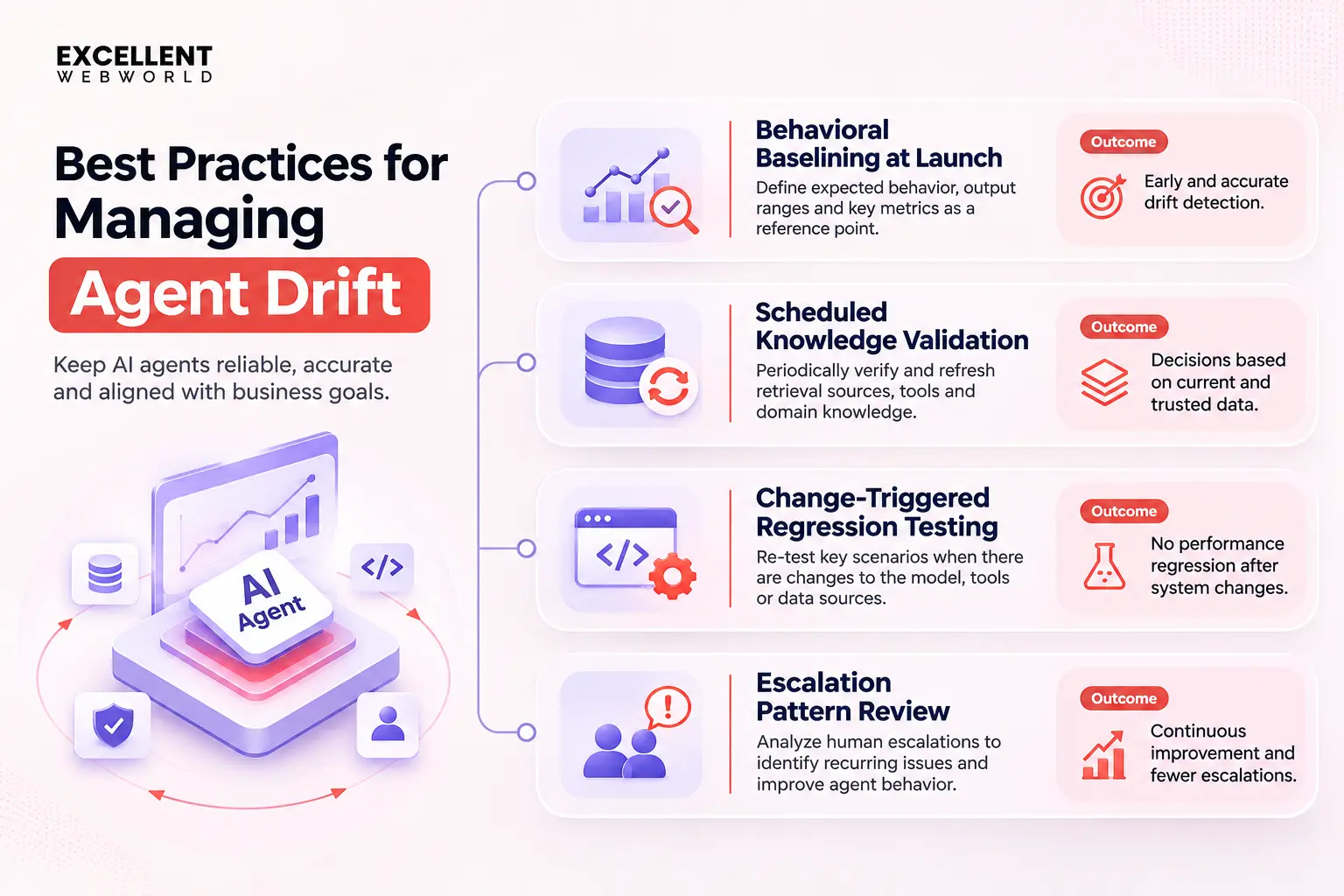
| Practice | Purpose |
|---|---|
| Behavioral baselining at launch | Lay out the behavioral distribution that can become the reference point for identifying drift. |
| Scheduled knowledge validation | Prevents agents from retrieving and acting on stale information. |
| Change-triggered regression testing | Detects regression caused by API, model, or retrieval changes. |
| Escalation pattern review | Utilize human escalations as a structured dataset for continuous improvement. |
A. Behavioral Baselining at Launch
When the system goes live, don’t just capture the performance metrics but also the behavioral distribution:
- How often it uses each tool
- Task duration at the 50th and 95th percentile
- Percentage of tasks that escalate
- Reasons for escalation
- Output quality distribution across task types
Without establishing these baselines, you can’t measure drift.
B. Scheduled Knowledge Validation
Retrieval-augmented generation depends on the accuracy of what it retrieves. So, if the knowledge base is not updated when the products, policies, or regulations change, the agent will continue to retrieve and act on stale information – incorrectly and confidently.
Every knowledge source feeding your agent requires:
- A validation cadence
- Someone responsible for reviewing it
- A freshness check
- A process for updating it when the underlying reality changes
C. Change-Triggered Regression Testing
Model providers tend to update model behavior without any notice. If that’s the case, then tool API schema changes and retrieval index schemas evolve. Each of these points is a potential regression. Every change, whether it’s minor or major, triggers a regression run against the evaluation suite defined at the time of launch.
So, the cost of running evaluation is orders of magnitude lower than the cost of discovering a regression through customer-facing failures. Organizations that develop enterprise agentic AI systems should therefore treat regression testing as a continuous engineering requirement.
D. Escalation Pattern Review
The cases that an agent escalates to humans are not just operational overhead. They’re a structured dataset that shows where the system’s current design falls short.
A monthly review of escalation patterns should:
- Categorize escalations.
- Identify clusters.
- Trace them back to specific workflow steps or data conditions.
- Resolve recurring patterns at the system level.
Every escalation pattern that you can resolve correctly at the system level is one fewer human interruption per thousand tasks going forward.
Enterprise Agentic AI Production-Readiness Checklist
Use this checklist before committing to a production deployment. For teams developing enterprise agentic AI systems, it provides a structured way to verify architecture, data dependencies, security controls, and human oversight.
A single “no” is a reason to pause, not a reason to ship and monitor.
Foundation
- Is there a written operating definition available for each agent – trigger, termination, authority, escalation, success metric?
- Have you mapped the workflow, including the exception paths and human judgment steps?
- Are your business outcomes measurable with current instrumentation?
Architecture
- Is this the simplest available architecture that can reliably complete the workflow?
- Does every agent in a multi-agent system justify its existence with a distinct scope?
- Is there a defined coordination contract between agents if multiple agents are used?
Data
- Is the authenticated source identified for every data element that an agent depends on?
- Is every data dependency validated before the agents act on it?
- Is the degradation behavior defined for every missing, late, or conflicting input?
Context and Memory
- Is the task state stored externally and injected when required instead of accumulated?
- Is retrieval permission-aware?
- Does every write to a persistent memory have a defined owner and retention policy?
Tools
- Does every tool enforce typed input validation and return structured errors?
- Are all write operations idempotent?
- Are all tools authenticated with scoped, independently revocable credentials?
- Is there a version and a deprecation path for each tool?
Failure Controls
- Is there an iteration limit with a defined exit behavior for every task?
- Are retries scoped to particular tool calls with defined budgets?
- Is there a cost ceiling per task with alerting at 75% and a defined fallback at 100%?
- Is there an append-only audit log covering every state-changing action?
Human Oversight
- Have you defined pre-action authorization gates for all consequential actions?
- Is there a structured escalation handoff format that gives human reviewers full context?
- Is there a periodic oversight review independent of incident response?
Evaluation
- Do adversarial test cases comprise missing data, tool failures, and prompt injection?
- Have you established an operational baseline before going live?
- Is there a business-level comparison between the existing process & agentic system?
- Have you defined negative capability tests?
Operations and Lifecycle
- Have you defined a release gate with defined evaluation scores for every deployment?
- Is there a named owner with defined on-call and escalation responsibilities?
- Is the cost reviewed per unit on a weekly cadence post-launch?
- Have you defined a behavioral baseline and a drift detection process?
- Is there a scheduled knowledge validation for all retrieval sources?
The Real Shift: From AI Feature to Business Infrastructure
For years, the conversation about agentic AI in enterprise environments has been more focused on capability – what models can do, how many tools an agent can juggle, how complex a workflow it can navigate.
But with evolution, capability is not a bottleneck anymore.
The real bottleneck is:
- AI governance for enterprise
- Reliability
- Commercial discipline
The organizations that are reaping the benefits of agentic AI have made a fundamental mindset shift:
They have stopped thinking about agents as AI features and started thinking about them as business infrastructure.
This infrastructure has to:
- Work every time
- Be explainable to compliance teams
- Justify its operating cost against its business output
- Survive the departure of the engineer who built it
This shift changes everything about how you design the system.
It shifts the focus from the model and pushes it towards:
- The workflow
- The controls
- The escalation paths
- The operating economics
The so-called boring stuff – data validation, tool contracts, audit logs, cost tracking – is the most important stuff.
The enterprises building agentic systems and still running three years from here on won’t be with the most sophisticated prompts.
They will be the ones who will treat system design with the same focus as they would apply to any other piece of business-critical infrastructure.
Key Takeaways
- Define agent responsibilities before development: Establish triggers, termination conditions, authority boundaries, escalation paths, and success metrics.
- Select architecture based on operational needs: Avoid unnecessary multi-agent complexity unless workflows require separate permissions, coordination, or evaluation criteria.
- Make enterprise integrations reliable: Enforce input validation, structured error handling, idempotent operations, and independently revocable credentials.
- Prepare for failures before deployment: Implement retry limits, cost ceilings, rollback mechanisms, and tamper-evident audit records.
- Evaluate real-world performance: Test edge cases, unauthorized actions, tool failures, and business outcomes against predefined benchmarks.
- Establish continuous operational governance: Assign system ownership, enforce human approval for critical actions, monitor agent drift, and optimize cost per completed task.
Frequently Asked Questions

Article By

