ERP systems run thousands of business processes across finance, supply chain, HR, sales, and procurement. Yet much of this operational architecture still depends on deterministic logic like fixed rules, predefined workflows, and hard-coded decision paths. That actually works when businesses are predictable, but generally it becomes less effective when exceptions, ambiguity, and cross-functional decisions enter the picture. That’s why it’s suggested to implement Agentic AI in ERP systems.
Integrating Agentic AI in ERP systems offers a new way to add intelligence into the system without replacing the systems that enterprises already rely on. Unlike conventional automation approaches, AI Agents for ERP can interpret business goals, conduct reasoning across the enterprise context, select tools, execute approved actions & also escalate smarter decisions whenever human judgment is needed. McKinsey’s global AI survey determined that almost 62% of organizations were at least experimenting with AI agents, while 23% were already scaling agentic AI somewhere in the enterprise.
Basically, it can be said that the opportunity is not only to replace deterministic ERP logic, but to develop a hybrid operating model that is generally utilized for stable, high-accuracy operations & agentic reasoning in terms of exceptions, investigation and also in terms of cross-process coordination.
For enterprises that are considering AI integration with existing systems like an ERP, the difference is quite critical. This comprehensive guide blog helps to explore what agentic AI is in ERPs and the requirements for enterprise-grade implementation, architecture, performance benchmarks, cross-platform considerations, and also the limitations that organizations need to plan for.
Why Agentic AI in ERP Is a Natural Fit?
ERP systems stand as the core aspect of enterprise operations that mainly connect finance, procurement, supply chain systems, sales, HR, and other critical functions through shared datasets & structured workflows.
A closer look at an ERP software development guide makes one thing quite clear: modern ERP platforms are not simply transaction systems, but are deeply interconnected environments where business work processes, datasets, rules, and all applications run together within a unified approach.
This makes the ERP a naturally connected ecosystem for agentic AI. Agents can work within the already existing processes, utilize the enterprise datasets as the context, interact with the approved business tools, and also coordinate actions across functional boundaries. Other than forcing organizations to replace their ERP foundation, the agentic layer can extend what the system actually already does.
In particular, this seems quite valuable for organizations that are especially operating older ERP environments. However, for them, rather than replacing established systems outright, legacy software modernization actually offers a proper pathway to introduce modern capabilities while preserving the valuable business logic & existing investments before implementing agentic AI in ERP.
And I would say that the strongest opportunity isn’t just an ERP replacement. It is the intelligent augmentation post-process that helps in keeping the deterministic automation where precision matters & also incorporating AI agents for ERP automation, where the processes need reasoning abilities, exception handling, contextual decisions, and also coordinated workflow.
20 Requirements for Implementing Agentic AI in ERP Systems
It’s one thing to implement agentic AI in ERP, but making it quite reliable enough for enterprise operations is another. The frameworks below are derived from Sia Sarferaz’s research study on implementing agentic AI into ERP software, which identifies 20 functional & non-functional requirements for integrating agentic AI in the ERP space.
The original research assigns each requirement a fixed REQ-01 to REQ-20 identifier, so that the number is retained exactly. With these requirements, there is much expansion in openness, integrations, standard governance, performance, and also in resilience.
In terms of practices, meeting these requirements also depends on how effectively AI connects with the existing ERP applications & enterprise datasets, and AI agents in ERP. This is where AI integration becomes so important, not only as a separate layer, but as a core connectivity factor among the agents, ERP work processes, APIs, and also in terms of business systems.
Openness & Flexibility
| IDs | Requirement | What It Means |
|---|---|---|
| 01 | Vendor Diversity | Avoid dependence on a single AI vendor or model. Support multiple LLMs and model providers as requirements evolve. |
| 05 | Model Adoption | Provide tools for prompt engineering, embeddings, and adapting models to domain-specific ERP contexts. |
| 14 | Configuration | Allow adjustable agent parameters, including reasoning steps, temperature, and resource limits, while preserving configurations through upgrades. |
| 15 | Extensibility | Enable customers and third-party developers to extend agent capabilities without making extensions fragile during system updates. |
Integration & Operations
| IDs | Requirement | What It Means |
|---|---|---|
| 02 | Built-in Agentic AI | Embed agents directly into ERP workflows instead of operating them as disconnected tools. |
| 03 | Standardized Development | Provide a consistent programming model for building agents regardless of the underlying agent technology. |
| 04 | Standardized Operations | Maintain consistent configuration, monitoring, and management across ERP modules. |
| 09 | Customer Lifecycle | Support agent setup, reuse, monitoring, optimization, and ongoing lifecycle management. |
| 10 | Provider Lifecycle | Support provisioning, updates, maintenance, support operations, and zero-downtime deployments. |
Compliance & Trust
| IDs | Requirement | What It Means |
|---|---|---|
| 06 | Legal Compliance | Support privacy requirements, consent management, access logging, and auditability of agent actions. |
| 07 | Content Validation | Validate business correctness while addressing bias, inappropriate content, and adversarial inputs. |
| 18 | Security | Apply granular RBAC, zero-trust controls, encryption, and safeguards against output tampering. |
| 19 | Explainability | Provide understandable, auditable explanations of AI decisions and maintain traceability of agent activity. |
| 20 | AI Ethics | Embed fairness, transparency, privacy, and accountability across agentic applications. |
Performance & Scale
| IDs | Requirement | What It Means |
|---|---|---|
| 08 | Response Time | Support different latency expectations, from near-instant interactions to complex agent executions. |
| 12 | Mass Processing | Queue and batch large AI workloads without disrupting normal ERP operations. |
| 13 | Scalability | Handle increasing agent execution volume and growing multi-tenant workloads. |
| 17 | Metering | Track AI usage for resource allocation, cost management, billing, and performance optimization. |
Resilience
| IDs | Requirement | What It Means |
|---|---|---|
| 11 | Error Handling | Provide structured logging, anomaly monitoring, fallback mechanisms, and controlled recovery when agents fail. |
| 16 | Localization | Support multiple languages and regional business contexts beyond simple translation. |
The framework highlights an important dependency, where the agents require reliable access to the right enterprise dataset and context. With strong data engineering services, there is strong support for ERP data logs for AI workloads by improving their structure, accessibility & also governance.
Takeaway: These 20 requirements should function as the enterprise evaluation checklist. With an ERP agent, you need openness, integration, governance, performance & resilience that work together prior to shifting from AI demonstration to a dependable business capability.
Content-Based vs. Code-Based AI Agents for ERP
One of the most practical architectural decisions is selecting among how the agents should be defined vs how they are executed. The distinction isn’t like simple vs complex; it is about how the agent runs, how its behavior is defined, and how the interaction is with the ERP capabilities.
For organizations that are mainly analyzing agentic AI development, content-based agents provide a point for standardized workflow, whereas code-based agents become more valuable when there is deeper ERP integration or custom business logic is needed.
The teams that are developing some sophisticated AI agent solutions need to select the approach based on the process, integration depth & level of customization, not just the complexity of the AI model.
On the other hand, the content-based agents are quietly developed programmatically utilizing languages such as Java, Python, ABAP, or other enterprise technologies. This basically operates closer to the ERP platform & has access to business datasets, private methods, analytical models & search capabilities directly.
| Dimension | Content-Based Agents | Code-Based Agents |
|---|---|---|
| Definition | Declarative, configuration-driven | Programmatic |
| Typical technologies | YAML and configuration artifacts | Java, Python, ABAP, enterprise languages |
| Runtime | Centralized agent runtime | ERP/platform runtime |
| State management | Managed by agent runtime | Managed by application or ERP runtime |
| ERP access | Primarily through APIs | Direct access to platform capabilities and data |
| Best suited for | Standard workflows and cross-system scenarios | Deep ERP integration and custom business logic |
| Customization | More constrained | Highly customizable |
| Maintenance | Easier to configure and govern | Requires conventional software development and maintenance |
| Ideal starting point | Proofs of concept and standardized use cases | Advanced production scenarios requiring deeper control |
Content-Based Agents
The content-based agents are the ones defined declaratively, often through structured configuration or files such as YAML. They are quite useful for;
- Classification
- Routing
- Standard Workflow Triggers
- FAQ-style interactions
- Cross-system coordination
- Common business assistance
Code-Based Agents
The code-based agents are implemented programmatically utilizing languages like Java, Python, ABAP, and other enterprise technologies. They become valuable when the agent requires;
- Deep ERP integration
- Custom business logic
- Specialized algorithms
- Platform-specific capabilities
- Custom machine-learning models
- Complex orchestration
My Recommendation: You should start with the content-based agents, as they are quite fast to build, easier to govern, and also sufficient for most of the initial AI agents for ERP use cases. Also, I suggest moving towards code-based agents only if deeper ERP integration, a custom reasoning algorithm, or even direct access to platform-specific assets that API’s can’t reach.
Agentic AI Architecture for ERP: The Six Layers Behind Enterprise Deployment
So, implementation of agentic AI in ERP systems is not only a single framework decision, but a 6-component architecture where every layer is associated with specific functionality.
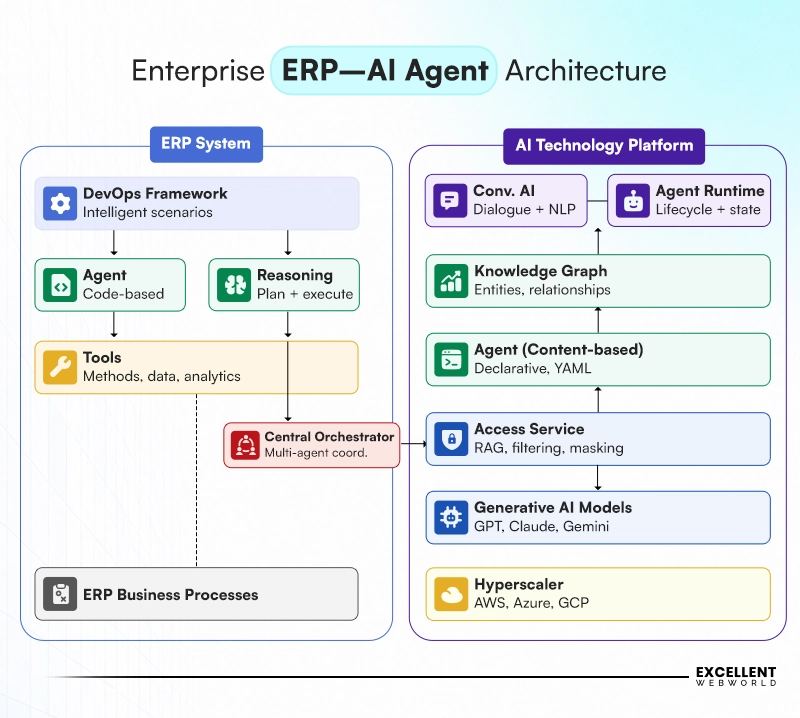
If you remove any of the layers, then the whole system becomes either unscalable or ungoverned, creating various issues. Together, these components enable the AI Agents for ERP to operate securely and reliably at an enterprise level.
| Component | Role in Architecture |
|---|---|
| Agent Runtime | This executes & manages AI agents for ERP, including lifecycle management, state persistence, concurrent orchestration, security boundaries, monitoring, logging, version control, & resource management. |
| Conversational AI Runtime | This handles user inputs, dialogue flow, and context-aware responses through generative AI models, while connecting conversations directly with ERP through an embedded web-based interface. |
| Knowledge Graph | It maps ERP entities and relationships across customers, products, orders, suppliers, & contracts to enable contextual reasoning beyond flat-table queries. |
| Central Orchestrator | It coordinates multi-agent systems by task allocation, inter-agent communication, system-state management, conflict resolution, and dynamic execution. |
| Access Service | This component helps connect GPT, Claude, Gemini, Mistral & open-weight models through a unified interface, thus combining RAG, content filtering, data masking, & also a single pipeline. |
| DevOps Framework | Standardizes the development process & deployment utilizing the Intelligent Scenario artifact, which basically connects prompts, model metadata, & agents |
All together, these layers offer a great foundation for a governed, scalable & production-ready agentic architecture for an ERP system. For enterprises that are shifting from architectural design to implementation process, agentic AI development services can help translate this architecture into a great autonomous workflow system aligned with the multi-agent orchestration, enterprise integrations & controlled deployment approach.
How It Works in Practice: Dispute Management
A billing dispute actually shows how the agentic AI in ERP systems coordinates the operations, combining reasoning, automation & human oversight. Here is the use case of dispute management resolution, where a customer billed €200/month receives a €211.40 charge, and the agent investigates, helps resolve eligible cases, and escalates exceptions.
| Stage | Agent Action | Outcome |
|---|---|---|
| 1. Classify | Uses NLP to detect the dispute and create a case. | Automated intake |
| 2. Investigate | Checks billing history, contracts, and pricing policies; identifies the correct €204 charge and €7.40 discrepancy. | Root cause identified |
| 3. Resolve | Calculates the overcharge and generates a credit note within approval limits. | Automated resolution |
| 4. Communicate | Sends the customer a resolution explaining the correction and credit. | Consistent response |
| 5. Learn | Updates records and flags recurring billing patterns. | Process improvement |
| 6. Escalate | Routes complex or high-risk cases to humans through human-in-the-loop controls. | Governed decisions |
The infographic below basically explains how these 6 stages actually connect to establish a governed, end-to-end ERP agentic AI workflow.
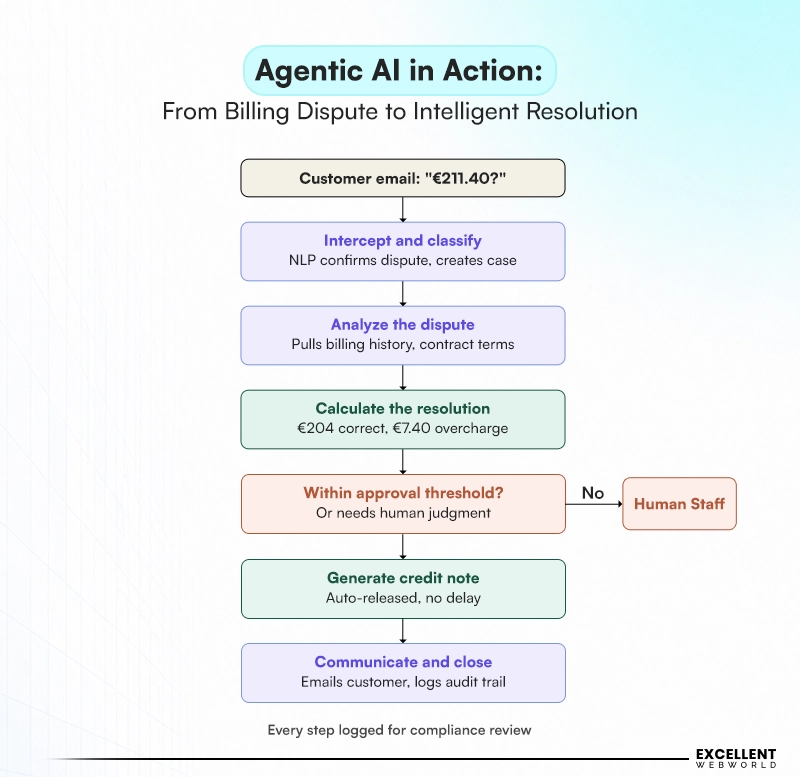
Every tool call, data source, and decision is logged, creating a total audit trail for standard compliance & operational control.
Agentic AI in ERP: Performance, Accuracy & Business Impact
I strongly believe that performance matters more than promises. The below-mentioned benchmarks actually demonstrate how agentic AI in ERP systems performs across processing speed, accuracy, cost, scalability & infrastructure overheads, while also indicating where the deterministic ERP logic remains stronger.
| Performance Area | Benchmark | What It Actually Means |
|---|---|---|
| Standard dispute processing | <1,000 ms | Supports near-real-time handling of straightforward cases |
| Simple billing cases resolved within target | 81% | Strong potential for automated exception handling |
| Complex multi-contract disputes | 3,100 ms average | More complex reasoning introduces additional latency |
| 1,000-record batch processing | 0.9 hours vs. 128 human-hours | Significant productivity improvement for high-volume workloads |
| Operational cost reduction | 67% | Demonstrates measurable savings in dispute resolution |
| Agentic classification accuracy | 81.7% | Effective for ambiguous cases, but not accuracy-equivalent to deterministic rules |
| Rule-based classification accuracy | 97.3% | Deterministic logic remains preferable for high-accuracy processes |
| Inference cost per execution | $0.002–$0.008 | Supports economical, high-volume execution |
| Memory per 100 concurrent agents | ~1.2 GB | Indicates manageable runtime overhead |
| Orchestration CPU overhead | 1–2% | Relatively modest infrastructure impact |
| Network bandwidth per execution | 50–80 KB | Low communication overhead for individual agent executions |
What Do These Numbers Actually Mean?
The benchmarks actually showcase that AI agents for ERP automation create the most value when implemented in the right workloads, not simply where AI can perform faster.
Here, cost & productivity are the strongest ones. A 67% reduction in operational cost, batch processing generally reduced from 128 human-hours to almost 0.9 hours, and also $0.002–$0.008 per execution tend to make agentic AI more attractive for higher-volume workloads.
Accuracy generally needs a balanced approach. The agentic classification achieved about 81.7% vs. 97.3% for rule-based processing. And in terms of the key failure modes, they basically include incomplete email parsing (12.3%), invalid contract references (5.8%), and also model timeouts (3.2%). And in terms of the validations, fallback paths, monitoring & continuous evaluation part, it generally remains the same.
Also, I would say that the scaling is quite promising. As with the testing process across 50-50 simultaneous cases, it generally produced 847-2340 ms processing times with ~1.2 GB memory per 100 agents and also with 1-2% CPU overhead. This indicates manageable performance under increased concurrency rates.
Hybrid cloud execution supports scale. The AI inference can run through AWS, Azure, or GCP, while the ERP system tends to manage orchestration, state, and also the API documentation aspects.
Additionally, I can tell you that enterprise readiness basically depends on trust, sovereignty, model flexibility, and also on vendor lock-in aspects. The enterprise agentic AI landscape is changing in current times & indicates that lock-in can be extended beyond the model into the agent runtime, orchestration, business context, and also the broader AI stack.
Cross-Platform Agentic AI for ERP Systems: SAP, Oracle & Dynamics
The architecture is not limited to SAP only. Agentic AI in ERP systems can actually extend across SAP, Oracle ERP Cloud, Microsoft Dynamics, & also other enterprise platforms, but each needs specific integration & data modeling capabilities.
| Architecture Area | Cross-Platform Consideration |
|---|---|
| Agent Runtime | Adapt to each ERP environment while preserving lifecycle management, state persistence, security boundaries, and monitoring. |
| AI Model Access | Connect SAP AI Core, Oracle AI Services, Azure AI, AWS Bedrock, or SageMaker through a standardized orchestration layer. |
| Data Integration | Map ERP business objects, metadata, and configuration data into a Knowledge Graph; platform differences make this one of the most complex steps. |
| API-First Architecture | Use RESTful APIs and OpenAPI 3.0 with platform-agnostic JSON schemas for agent configurations, prompts, execution results, and knowledge integration. |
| Portability | Decouple the agentic AI layer from the ERP so agents remain reusable across multi-vendor environments and future migrations. |
In terms of the multi-vendor ERP space, portability also depends on building scalable APIs, integrations & custom enterprise software around the agentic layer. This is where software development services can actually support these types of integrations while establishing reliability, scalability & compatibility across platforms.
The Challenges of Agentic AI in ERP Systems
Agentic AI in ERP systems can generally improve the exception-handling process & also the complicated workflows smartly, but enterprise adoption actually comes with some technical & operational challenges.
| Challenge | What Enterprises Need to Consider |
|---|---|
| Accuracy | There is a need for human verification for processes like financial reporting, regulatory filings, & other accuracy-critical processes, and agentic classification reached 81.7 vs. 97.3% for rule-based processing. |
| Long-Term Maintenance | There is a need for continuous monitoring for scenarios like Model drift, changing capabilities, backward compatibility, & evolving security risks. |
| Change Management | There can be involvement of significant implementation costs due to training, role transformation, governance, user adoption, and AI oversight. |
| Architecture Complexity | With the agent runtimes, knowledge graphs & model integrations, there is an increase in latency, compute requirements, security controls, and also operational overheads. |
| Testing & Evaluation | Non-deterministic agent behavior means traditional testing is insufficient; continuous evaluation and specialized testing approaches are required. |
From the understanding of the challenges, it can be said that these challenges don’t make the ERP agentic impractical. They reinforce the need to start with well-bounded use cases, establish AI governance with necessary compliance at an early stage, and also maintain human-in-the-loop controls whenever it is necessary. Additionally, a hybrid approach is needed that can preserve the deterministic ERP logic for predictable & high-accuracy processes.
What Enterprise Leaders Should Take From This
In my opinion, in terms of agentic AI in ERP systems, it is simply not about ERP logic, but about implementing AI where it creates measurable value while preserving the enterprise controls. The way I see it, the practical path towards agentic AI implementation in ERP generally comes down to 5 priorities that help to balance innovation, accuracy, governance & enterprise scalability.
How Excellent Webworld Approaches Enterprise Agentic AI
The shift to agentic AI is no longer about chasing the next technology trend; it’s actually about solving the right business problems with the right level of intelligence. The greatest opportunities lie in workflows where AI agents for ERP reduce manual effort, improve decision-making, and manage exceptions without any compromise on governance or enterprise control.
At Excellent Webworld, we generally believe that successful adoption actually starts with the process, just before the technology. By combining enterprise AI architecture, data engineering, secure integrations & production-grade governance, we help organizations introduce intelligent automation solutions alongside ERP systems. The outcome is simply not about more AI, but a scalable, auditable & measurable approach that is able to deliver business value while preserving the reliability & compliance that enterprises already depend on.
- Agentic AI in ERP systems extends traditional automation by adding reasoning, contextual decision-making, and autonomous execution within defined boundaries.
- The strongest opportunities are high-volume, exception-heavy, judgment-dependent workflows where conventional rules struggle.
- Enterprise-grade implementation requires a strong foundation across AI architecture, integrations, security, governance, scalability, and lifecycle management.
- A hybrid architecture is the most practical approach: deterministic ERP logic handles predictable operations, while AI agents manage ambiguity and exceptions.
- Accuracy, testing, model drift, and maintenance remain important challenges, making human oversight essential for high-risk decisions.
- Cross-platform adoption across SAP, Oracle, and Microsoft Dynamics requires API-first architecture and careful data integration.
- The best implementation strategy is to start with a measurable business process, validate ROI, establish governance, and then scale gradually.
- The goal isn’t to deploy AI everywhere; it’s to apply agentic intelligence where it creates measurable business value without compromising enterprise control.
Frequently Asked Questions

Article By

