During one of our recent healthcare AI projects, a client posed an interesting question to me: “Should I invest in building the AI clinical documentation engine or integrate an existing one?”
That question set off a conversation between the client, me, and our CTO, and got me thinking more seriously about ambient AI medical scribes. After all, the underlying goal is essentially the same: automating clinical documentation without taking clinical judgement out of the process.
I wanted to find a more definitive answer to the build-vs-buy question. The more I looked into it, the more I realized that the answer had less to do with the AI model itself and more to do with the architecture built around it.
That is what led to this guide.
Key Takeaways:
- Speech-to-text is only part of the AI medical scribe development architecture. For a production-ready ambient AI scribe, you need an architecture that turns clinical conversations into reliable medical notes using clinical language processing, structured note generation, clinician oversight, and EHR integration.
- AI scribe accuracy is just as important as the model’s benchmark scores, if not more. Even when the reference transcript is fully accurate, it can produce misleading clinical notes. You must consider ASR accuracy, speaker attribution, hallucination prevention, PHI protection, and EHR compatibility from the start. Clinical validation is non-negotiable before production deployment.
- Build vs. buy isn’t always a binary decision. You can adopt ready-made AI medical software, build around existing AI APIs, or go for custom AI medical scribe development, depending on your integration needs and desired control.
- Development costs extend beyond the initial build. A single-department pilot may cost $50K – $75K, while enterprise multi-EHR deployments can reach $300K – $700K and beyond. AI inference, infrastructure, clinical validation, and ongoing maintenance also influence total cost of ownership.
What is an Ambient AI Scribe?
An ambient AI scribe is an AI-powered clinical documentation system that listens to a patient-doctor conversation and turns that interaction into a structured clinical note. In modern healthcare environments, the technology is often built into the very architecture of an AI-native EHR system.
You might wonder, “How is an ambient AI scribe any different from the speech-to-text feature inside my smartphone?” Although it uses the same underlying functionality, an AI medical scribe is considerably different from basic dictation or transcription software. It uses clinical language processing to understand context, instead of simply converting speech into text.
In terms of ambient AI scribe development, this functionality is a system of interconnected technology layers rather than a single AI model.
Audio Capture → Automatic Speech Recognition (ASR) → Speaker Diarization → Clinical Information Extraction → LLM-based Note Generation → Validation → EHR
Building one therefore involves decisions around model accuracy, PHI handling, interoperability, deployment, and the degree of control you need over note formats and clinical workflows.
How an Ambient AI Scribe Actually Works
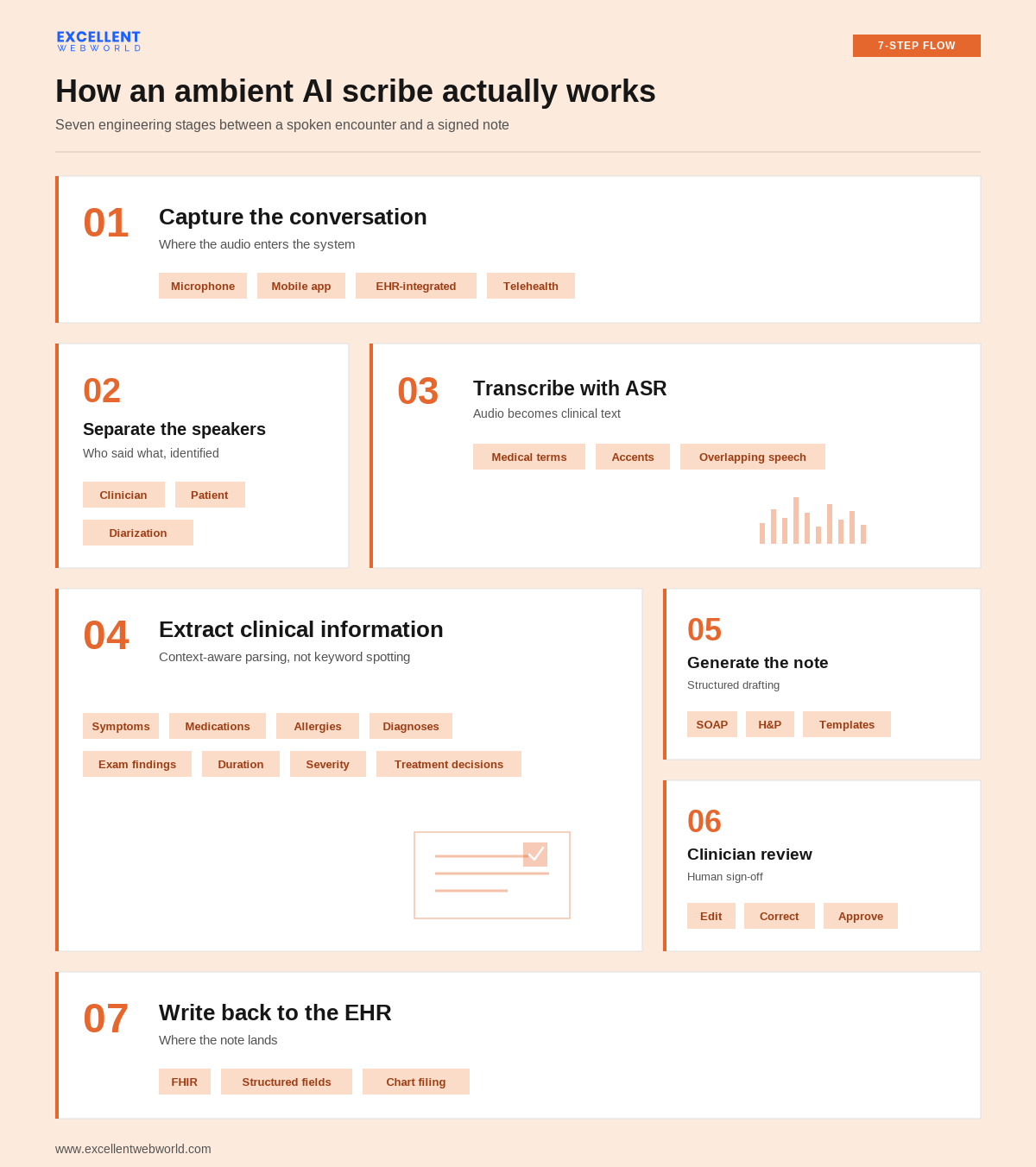
1. Capture the Conversation Ambiently
The AI medical scribe captures the patient-clinician conversation via a microphone, mobile device, EHR-integrated application, or an audio stream from a telemedicine app. The biggest advantage here is that ambient capture facilitates a more engaging encounter, with the doctor not constantly having to switch between note-taking and talking to the patient.
2. Separate the Speakers
Speaker diarization is the ambient AI scribe’s capability to identify who said what in a conversation, which is especially useful for distinguishing the clinician from the patient and (potentially) other participants. It’s a pivotal function because a clinical statement can have a vastly different meaning based on who said it.
3. Transcribe the Audio with ASR
This is perhaps the most significant layer with far-reaching consequences as much of what follows depends on the quality and accuracy of the resulting transcript. ASR converts the audio stream/recording into text and for healthcare applications, the speech-recognition layer needs to account for medical terminology, accents, interruptions, overlapping speech, and other conditions affecting transcription accuracy.
4. Extract Clinical Information
Clinical language processing identifies the information that matters to the medical record, including:
- Symptoms
- Medications
- Allergies
- Diagnoses
- Examination findings
- Duration
- Severity
- Treatment decisions
It must also understand context such as negation, attribution, and temporality.
5. Generate a Structured Clinical Note
The extracted information is organized into a clinical documentation format such as a SOAP or H&P note. A general LLM can generate the narrative. But when it comes to healthcare engineering, it is always advisable to modify and constrain the model using validated clinical facts and specialty-specific templates rather than relying on a raw transcript alone.
6. Route the Draft for Clinician Review
The physician or the authorized clinician receives the LLM-generated clinical note draft for review and editing. They can correct, remove, or add relevant data before approving the documentation.
7. Write the Approved Documentation Back to the EHR
The ambient AI scribe workflow ends when the final approved note transfers into the correct patient record through EHR integration. Depending on the depth of integration, your system might also be able to support other downstream documentation workflows like structured fields and ICD-10 coding suggestions.
This should make it perfectly clear that ambient AI scribe technology is indeed not a simple audio-to-text pipeline. Each stage adds clinical context and structure before the information becomes part of the medical record.
That layered approach also makes developing an ambient AI scribe more complex than just connecting a microphone to a general-purpose LLM. Accuracy, validation, security, and EHR interoperability must all work together.
The Architecture Stack Behind a Production-Grade Ambient AI Scribe
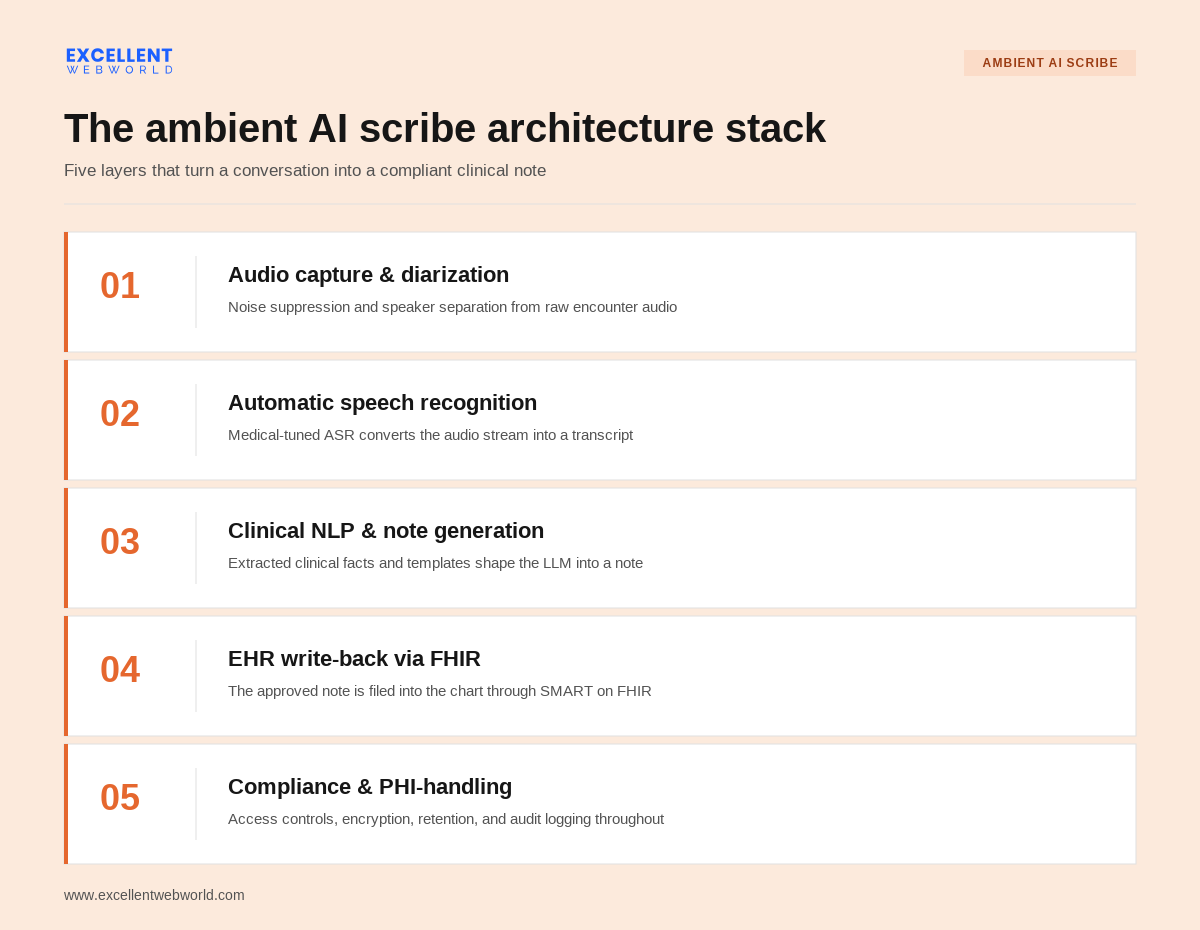
As I established early on in the article, an ambient AI scribe (especially one at the production-grade level) is nothing like a speech recognition tool combined with an LLM. The architecture decisions you make at each layer directly affect accuracy, latency, operating cost, clinical safety, and how easily the system can reduce the clinical documentation burden without creating new work for clinicians
For an ambient AI scribe, effective AI development work depends on how the components interact, rather than just choosing the latest or most powerful models.
Audio Capture & Diarization
At the risk of stating the obvious, a consultation room does not have the acoustics of a controlled recording studio. Background noise, interruptions, overlapping speech, and multiple speakers can affect input quality. Your capture layer must account for the environments in which the ambient AI scribe will be used: whether that means device-level noise suppression, echo cancellation, streaming audio or support for additional participants.
Now you might realize why diarization is important too. The system must reliably separate the physician’s statements from the patient’s symptoms and history. An otherwise accurate transcript can still become clinically misleading if the system attributes a statement to the wrong speaker.
Automatic Speech Recognition (ASR) Layer: Medical-Tuned vs. General Models
I wouldn’t choose an ASR model based on its headline transcription accuracy alone. From my experience with AI scribe projects, clinicians care more about whether the words carrying clinical weight are transcribed correctly than an impressive overall accuracy score.
In simple terms, they aren’t concerned whether the tool is “more or less” accurate in its entirety. They want specific assurance that the word “Paracetamol” indeed appears as Paracetamol and not “Pair A See The Mole”.
General-purpose ASR models can be a practical starting point, but medical terminology, abbreviations, drug names, multilingual conversations, accents, and specialty-specific vocabulary can change the equation.
Your evaluation should focus on clinically meaningful errors, latency, language coverage, and per-minute inference cost, not just a single accuracy score.
Clinical NLP & Note Generation (The LLM Layer)
The biggest architectural mistake you could make at this stage is treating the transcript as the final input and asking a general-purpose LLM to “write a medical note.”
When developing the LLM layer for an ambient AI scribe, I’d first extract and structure clinical information, preserving critical context such as negation, attribution, and temporality. The generation layer can then use these validated facts, relevant patient or encounter context, and specialty-specific templates to produce the required SOAP, H&P, or other formats.
This is also where I would pay particular attention to the clinician-review interface. They should be able to spot errors, make corrections, and approve the documentation with ease. If the draft needs constant checking and rewriting, the ambient AI scribe has missed the point.
EHR Write-Back via FHIR & SMART on FHIR
The depth of EHR integration should be decided early because it can materially change the architecture. If the only requirement is writing an approved clinical note, the integration may be relatively straightforward. A more deeply integrated AI scribe may require working with structured patient and encounter data, populate specific documentation fields, or support medical coding and other downstream workflows.
HL7 FHIR provides a standard data-exchange layer, while SMART on FHIR supports secure application access to FHIR-enabled systems. In practice, however, the target EHR still decides what your application can access and write back. Patient and encounter mapping, authorization scopes, and the specific resources exposed by the EHR all need to be accounted for during development.
Compliance & PHI-Handling Layer
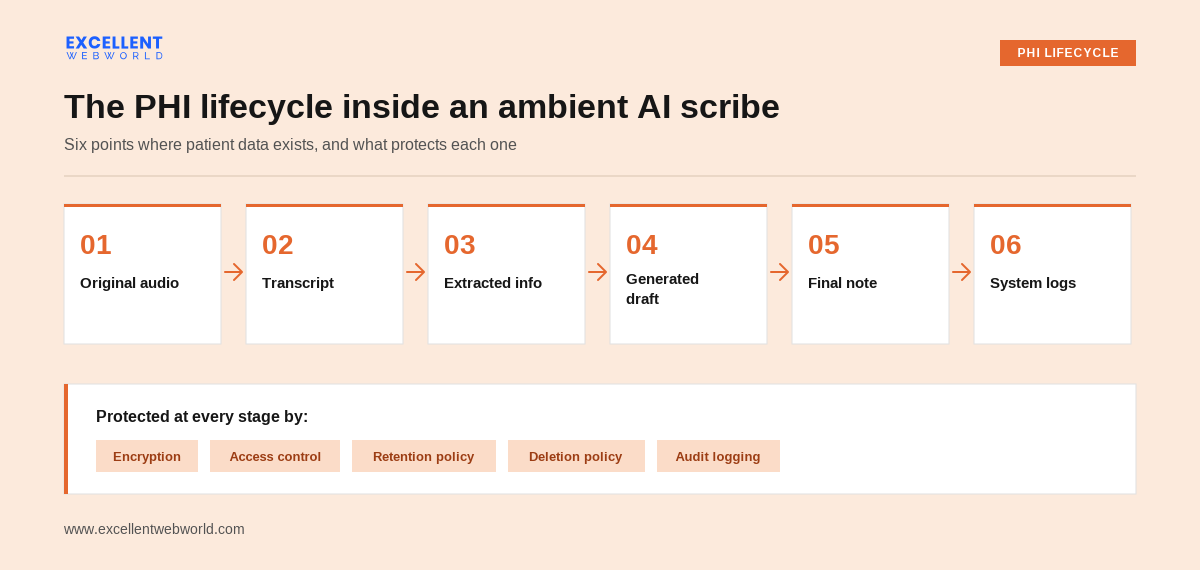
Think about PHI as a lifecycle rather than a single record stored in a database. An ambient AI scribe can generate sensitive patient data at several points:
- Original audio
- Transcript
- Extracted clinical information
- Generated draft
- Final note
- System logs
That makes data retention an architectural decision alongside encryption, access control, audit logging, and deletion policies.
The same scrutiny applies to third-party AI infrastructure used by your AI integration partner. If an external model processes clinical conversations, your team needs to understand where that data is processed, whether it is retained or used for training, and what contractual and deployment controls are available.
Depending on those requirements, a managed API, private cloud or VPC, or self-hosted model may make more sense.
How To Develop an Ambient AI Scribe
Developing an ambient AI scribe involves translating the clinical documentation process into an AI-powered workflow that can capture consultations, interpret clinical information, and prepare medical notes for clinician approval.
If you’re considering the possibility of a custom AI medical scribe, these six steps address the critical engineering decisions from initial design to clinical deployment.
| Step | Development Phase | What You Need To Do |
|---|---|---|
| 01 | Define clinical documentation requirements |
→ Start by identifying the specialties and encounter types your scribe will support. Work with clinicians to establish note templates, mandatory fields, documentation rules, and approval workflows. A primary care SOAP note, for instance, has different documentation requirements from a psychiatric evaluation. |
| 02 | Evaluate clinical speech recognition |
→ Test speech-to-text models against representative clinical conversations. Pay particular attention to medication names, medical terminology, accents, overlapping speech, and speaker identification. → Overall transcript accuracy alone won’t tell you whether the model is making mistakes that could change clinical meaning. |
| 03 | Develop clinical note generation with safeguards |
→ Structure the clinical information extracted from the transcript before generating notes. → Configure the AI to preserve negation, uncertainty, attribution, and clinical context. → Where possible, link generated statements to their source so clinicians can verify the information and identify unsupported conclusions. |
| 04 | Build the clinician review workflow |
→ Develop an interface where clinicians can inspect generated notes, correct mistakes and approve the final documentation. → Highlight statements that require verification and maintain a record of corrections. These edits also help your engineering team identify recurring model errors and improve subsequent iterations. |
| 05 | Integrate and test EHR documentation workflows |
→ Identify the target EHR’s supported APIs, authentication requirements, and documentation formats. → Implement patient and encounter matching, clinician-approved write-back, and safeguards against duplicate or failed submissions. Integration Note: Always use HL7 FHIR or other supported interfaces according to the capabilities of the target EHR. |
| 06 | Validate clinical safety before scaling |
→ Evaluate generated notes against clinician-reviewed encounters. Check especially for omitted findings, incorrect medications or dosages, misattributed statements, and unsupported conclusions. → Start with a controlled clinical pilot, track correction rates, and establish clear acceptance criteria before expanding deployment. |
One particular decision I’d make early is to validate the clinical documentation workflow before expanding the AI capabilities. Let me explain why. As you proceed with the AI medical scribe development process, it’s easy to get caught up in improving transcription accuracy or experimenting with more sophisticated LLMs. But if the resulting notes still require extensive corrections, you’re essentially transferring the documentation burden from one part of the workflow to another.
On top of that, you must account for HIPAA safeguards throughout development, particularly when handling encounter audio, transcripts, extracted clinical information and generated documentation.
Remember: the goal is not to build an AI medical scribe that just “works”. The resulting tool must be something that your clinicians can use safely within their existing documentation process.
How Do You Validate an Ambient AI Scribe Before Clinical Deployment?
Validating an ambient AI scribe before clinical deployment means establishing whether its documentation is accurate, clinically reliable, and safe enough for use under clinician supervision. This requires a structured evaluation against predefined acceptance criteria, not just a successful technical test. Here's a practical checklist to guide that evaluation.
Clinical AI Scribe Validation Checklist
HIPAA and PHI: What Compliance Actually Requires at the Architecture Level
Even though it goes without saying, I’d still reiterate that HIPAA compliance needs to be embedded into the AI scribe architecture from the beginning. The HIPAA Privacy Rule governs how PHI can be used and disclosed, while the Security Rule establishes safeguards for ePHI.
For a HIPAA-compliant AI scribe, that means thinking about how PHI moves through the system, where it is stored, who can access it, and when it should be deleted.
| Architecture Mechanism | What It Means for an Ambient AI Scribe |
|---|---|
| BAA-Covered Cloud vs. On-Premises/VPC |
|
| Zero-Retention API Configuration |
|
| Audio PHI Retention Policy |
|
| Role-based Access Control |
|
| Audit Logging |
|
A BAA doesn’t make the architecture compliant by itself. It establishes the contractual responsibilities between the covered entity and business associate, while the underlying technical and operational safeguards still need to be implemented. HHS also makes it abundantly clear that a cloud provider acting as a business associate can have direct HIPAA obligations of its own.
There's another distinction worth making here: HIPAA compliance doesn't automatically mean an AI scribe is clinically safe. In practice, HIPAA-compliant app development addresses the privacy and security of patient information, while clinical safety depends on the accuracy and reliability of the documentation being generated. An AI scribe can protect PHI appropriately and still produce an incorrect medication, omit a critical finding, or misinterpret a patient's statement.
That's why clinical validation and clinician approval remain essential, regardless of how securely the system handles data.
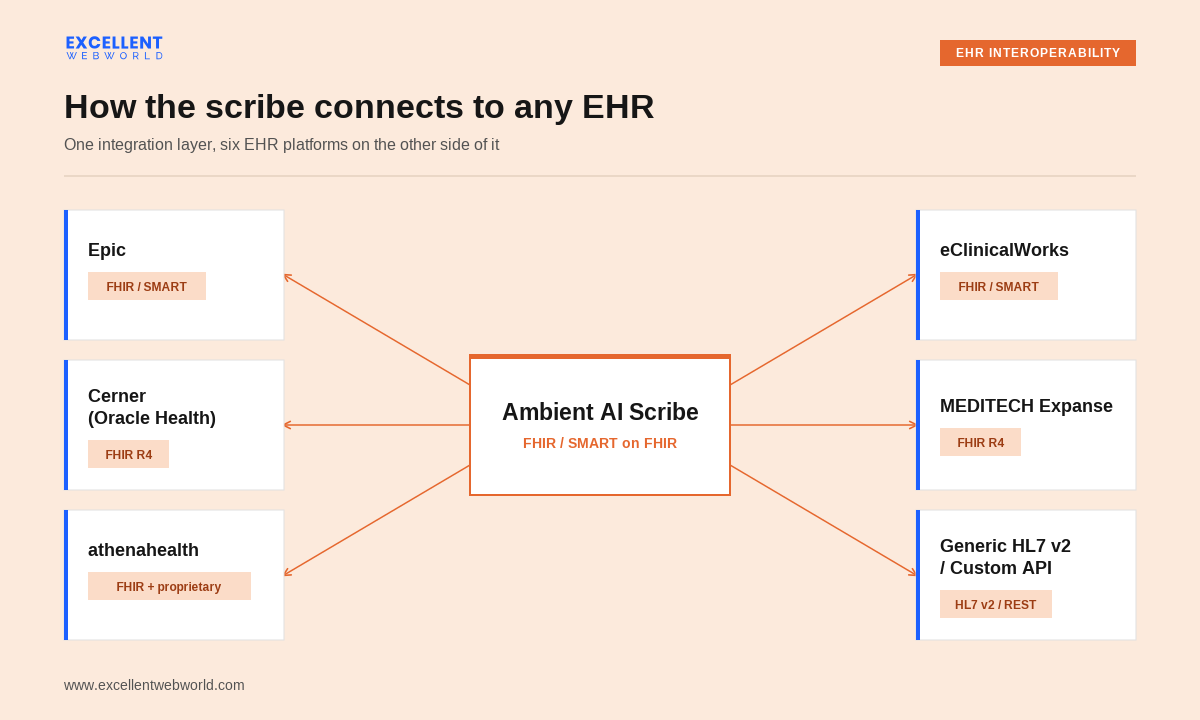
EHR Integration: Getting Notes into Epic, Cerner (Oracle Health), or athenahealth
| EHR Platform | Integration Standard | Write-Back Method | Notes |
|---|---|---|---|
| Epic | FHIR / SMART on FHIR | FHIR DocumentReference | Supports clinical-note creation through designated interfaces, subject to the Epic version, enabled APIs, authorization, and encounter workflow. |
| Cerner (Oracle Health) | FHIR R4 / SMART on FHIR | FHIR APIs | SMART applications can access authorized patient and encounter context; authenticated APIs support write operations. |
| athenahealth | FHIR + proprietary APIs | FHIR DocumentReference and proprietary write APIs | Offers FHIR APIs alongside proprietary APIs with write interactions across clinical, administrative, and financial workflows. |
| eClinicalWorks | FHIR / SMART on FHIR | FHIR APIs; other interfaces where required | Supports provider-facing FHIR integrations, including SMART on FHIR and backend services. |
| MEDITECH Expanse | FHIR R4 | FHIR APIs for supported data access; note write-back may require additional vendor-supported interfaces | Provides patient health data APIs and an application ecosystem for third-party integrations. |
| Generic HL7 v2 / Custom API | HL7 v2, REST, proprietary APIs | Interface engine or vendor-specific endpoint | Useful when the target EHR lacks the required FHIR capability or when deeper vendor-specific integration is needed. |
There’s an important caveat here that you should bear in mind while evaluating AI medical scribe integration: “FHIR supported” doesn’t automatically mean “plug-and-play.” Each EHR offers different resources, API capabilities, authorization scopes, and write-back workflows.
When it comes to developing an ambient AI scribe for multiple health systems, I’d treat each EHR integration as its own implementation. This reflects the broader challenge of integrating AI in EHR: the AI layer has to work within the capabilities, data structures, and workflows of the EHR. Don’t assume one FHIR connector works for all. An Epic ambient AI scribe integration, for example, may use FHIR/SMART workflows, while Oracle Health and athenahealth similarly expose standard FHIR and proprietary interfaces.
I should mention that patient and encounter mapping also deserves particular attention here. Each note must match the correct patient and encounter with proper authorization. Even a technically successful write-back can cause problems if the documentation ends up in the wrong chart or under the wrong encounter.
Build vs Buy: The Real Tradeoffs for Health Systems and Digital Health Companies
The build-vs-buy software decision is often framed as an either-or choice. But when considering custom AI medical scribe development, buying an off-the-shelf solution isn’t your only alternative to building everything in-house. You can also integrate an existing ambient scribe API into a custom application, giving you a middle ground between ready-made functionality and complete controls over the development.
| Decision Criteria | Buy Off-the-Shelf | Build with AI API Integration | Custom Ambient AI Scribe Development |
|---|---|---|---|
| Cost Structure | Lower upfront investment, but recurring subscription or usage costs can become significant as clinician volume grows. | Lower initial engineering effort than developing the underlying models, but API usage, infrastructure, integration, and maintenance contribute to ongoing costs. | Higher upfront development cost, followed by infrastructure, maintenance, model, and engineering costs. |
| Time to Pilot | Usually the faster route. Existing products can often be configured and introduced without building the underlying AI stack. | Existing speech and language model capabilities can accelerate development, although clinical workflows, EHR integration, and validation still require engineering. | Takes longer because the engineering team has to develop, test, integrate, and validate the system before a meaningful pilot. |
| Data & Model Ownership | Your data remains subject to the vendor’s infrastructure, policies, and contractual terms. Model behavior is also largely outside your control. | You control the application and clinical workflows, while the API provider retains control over its underlying models and relevant processing infrastructure. | Greater control over your data pipeline, models, infrastructure, and how the system evolves over time. |
| Specialty-Template Depth | Entirely subject to what the vendor already supports. Customization may be limited to available specialties and configuration options. | Specialty-specific templates and documentation logic can be developed around the capabilities and limitations of the integrated APIs. | Clinical workflows, templates, and generation logic can be designed around your specific specialties and documentation standards. |
| Vendor Lock-in | Integration, clinicians becoming accustomed to the workflows, and accumulated documentation data can make switching providers down the line increasingly difficult. | You retain ownership of the application but remain dependent on external API providers. Designing interchangeable components can reduce switching difficulties. | You assume more responsibility for the technology, but reduce dependence on a single AI scribe vendor and can retain greater control over the underlying architecture. |
| Compliance Control | You depend partly on the vendor’s security architecture, contractual terms, data-handling policies, and available compliance controls. | You manage application-level safeguards while assessing each API provider’s security controls, BAA availability, and PHI-processing arrangements. | You have substantially more control over retention policies, access controls, infrastructure, third-party dependencies, and PHI-handling. |
- If You’re a Single, Small Practice
Buying is often the better choice. If your priority is a faster time to pilot, you can probably find a ready-to-use solution from an AI medical scribe company that fits your practice’s specialty and EHR system. In that case, I’d say that developing an ambient AI scribe from scratch may not provide enough strategic return.
- But that Equation Changes If You’re an Enterprise Healthcare Provider
Large healthcare organizations and healthtech companies building a product around the AI scribe itself have to look at things from a different lens.
At that point, specialty-specific workflows, deeper EHR integration, data and model control, long-term operating costs, and differentiation can outweigh the speed advantage that comes with an off-the-shelf solution.
In such cases, you can approach custom ambient AI scribe development through two routes. You can build a proprietary AI scribe stack for greater control over model behavior, infrastructure, and clinical documentation logic. Alternatively, you can integrate existing AI APIs into a custom application, tailoring the workflows and EHR connections without developing every underlying AI capability yourself.
If you choose the API-based route, our Application Integration Services can help integrate speech AI technologies like Whisper and Deepgram into your existing healthcare applications, EHR systems, and clinical documentation workflows.
I’d favor API-based development when your differentiation lies primarily in the clinical experience and workflows. Building more of the AI stack in-house becomes worth considering when proprietary capabilities or greater technical control justify the added investment.
On The Build-vs-Buy Dilemma
Mayur Panchal, CTO, Excellent Webworld: “When I’m presented with two options, I often tend to ask whether there’s a third, somewhere in the middle. For me, buying makes sense when speed and operational efficiency come first. Building from scratch does give you more control. But integrating AI APIs can offer a practical balance between the two.”
How Much Does It Cost to Develop an Ambient AI Scribe?
The cost of developing a custom ambient AI scribe generally ranges from $50,000 for a single-department pilot to $700,000 or more for an enterprise deployment spanning multiple specialties. However, I’d recommend defining your project scope before settling on a budget. After all, the initial development investment is only part of the equation. Your total cost of ownership will also depend on the infrastructure, clinical requirements, integrations, and ongoing maintenance your solution demands.
| Scope | Indicative Development Range | The Usual Scope |
|---|---|---|
| Single-department pilot | $50K – $75K |
– One specialty – Limited EHR integration – Core ambient capture and note generation – Cloud deployment |
| Multi-department rollout | $150K – $225K |
– Multiple specialties – Deeper EHR integration – Specialty-specific templates – Clinician workflows – Expanded compliance controls |
| Enterprise, multi-EHR deployment | $300K – $700K+ |
– Multiple EHRs and departments – Extensive customization – Private/VPC or on-premises deployment – Enterprise security and compliance requirements |
I. The number of EHR integrations and specialty-specific workflows are among the first things to consider when estimating a project like this. Every additional EHR can introduce its own APIs, authorization model, patient and encounter mapping, write-back workflows, and testing requirements.
II.Deployment also matters: a cloud implementation using managed AI services can have a very different cost profile from a private VPC or on-premises environment.
III. Then there’s the compliance requirements. The scope of PHI controls, retention policies, auditability, validation, and any required certification or documentation can all increase the engineering effort.
Beyond development costs, you also need to consider what it takes to operate the AI medical scribe over time. Speech processing and AI model usage, cloud infrastructure, clinical quality monitoring, EHR integration maintenance, and ongoing security updates all contribute to the total cost of ownership. These expenses can change significantly as clinician adoption and encounter volumes grow.
Ultimately, the cost of implementing any AI technology in EHR systems depends not only on the scope and architecture of the initial deployment but also on what it takes to maintain the system in production.
Planning Note
These figures are indicative of standard ranges, not fixed quotations. Your actual cost will depend on the EHR integrations, specialty coverage, deployment model, compliance requirements, and level of customization involved.
How Excellent Webworld Approaches Ambient AI Scribe Development
Clinical documentation is one area where our experience as a healthcare application development company translates directly into practical AI engineering decisions.
With Braive, we created an AI-powered clinical documentation engine alongside clinical decision support for an EU MDR Class IIa medical device. The system uses fine-tuned models, safety classifiers, audit trails, HL7 FHIR, and privacy controls as part of the wider clinical architecture.
That experience shapes how our healthcare specialists and AI engineers approach ambient AI scribe development:
- Clinical documentation with clinician oversight: Braive Note generates clinical session notes while keeping clinical judgement with the practitioner. The documentation engine achieved 99.8% reported note accuracy and saved clinicians an average of 15 minutes per session.
- Healthcare interoperability: In another healthcare AI project, we architected an interoperability layer using FHIR and HL7, unifying all clinical data from EHRs, labs, and imaging systems. That experience is directly relevant when an ambient AI scribe has to move beyond generating text and work with the clinical data environment around it.
- Specialty-aware AI workflows: Our work on a men’s healthcare platform included domain-specific AI components, specialty-specific data handling, and an AI symptom checker that achieved 93% reported accuracy. The same principle applies to documentation: clinical context should guide the AI workflow instead of being added later.
- Security and deployment constraints: Our healthcare projects have included encrypted data handling, access controls, audit logging, HIPAA/GDPR requirements, and cloud infrastructure. If a project demands a more controlled infrastructure still, we can even design the architecture for private VPC or on-premises deployment.
This experience gives the Excellent Webworld team a clear view of what must work when an ambient AI scribe moves from a controlled demo into real clinical use.
If you’re evaluating a custom ambient AI scribe, I’d be happy to discuss the architecture and work out what it would take to make it production-ready for your organization.
Frequently Asked Questions

Article By

