Your logistics operations deal with lots of data from every corner of the supply chain. You get TMS alerts piled up, WMS exceptions, supplier delays, customer complaints, and missed forecasts. 100+ signals demanding attention every day, yet teams cannot respond at the pace logistics require.
- By the time you notice a delay, the disruption has already spread.
- By the time forecasts catch up, inventory is already out of position.
- By the time planners reroute a truck, excessive fuel is already consumed.
Serving the industry with an experience of 14+ years, I can say this is where most supply chains fail. It’s the time between identifying an issue and taking action before it erodes margins.
A perfect solution to close this gap is an AI agent. What these autonomous systems do is monitor signals, assess context, and then take action across logistics operations. No waiting for human review or manual interventions, just constant decision-making that gets smarter with every shipment.
A report by McKinsey & Company highlights that AI cuts logistics costs by 5% to 25% and cuts forecasting errors by 20% to 50%. Even UPS reported that it saved an estimated $300–400 million annually via AI-optimized routing.
Let this guide support you in exploring top AI agents for supply chain and logistics.
What Are AI Agents in Logistics?
AI agents are systems that make autonomous decisions by perceiving operational data, reasoning through constraints, and taking action, without requiring a human to trigger each step. AI agents are not some kind of dashboards, nor are they rigid RPA workflows. They are continuous intelligence layers that evolve with every decision made.
You can think of AI agent like if they act as a 24/7 decision layer running across WMS, TMS, ERP, and carrier systems. AI agents identify a port closure → assess 45 reroute options in 3 minutes → select the optimal route and execute it automatically → inform the customer with the updated ETA and delivery information → automatically adjust dispatch priorities → log the decision for future learning or analysis. Then they do it again next cycle, slightly smarter than before.
This is just an ideal use case; understanding the full spectrum of AI agent use cases for logistics shows how these capabilities apply to logistics workflows. These include exception management, demand forecasting, route optimization, and supplier risk monitoring. Let’s have a look at how AI agents work in real time to help you get an idea.
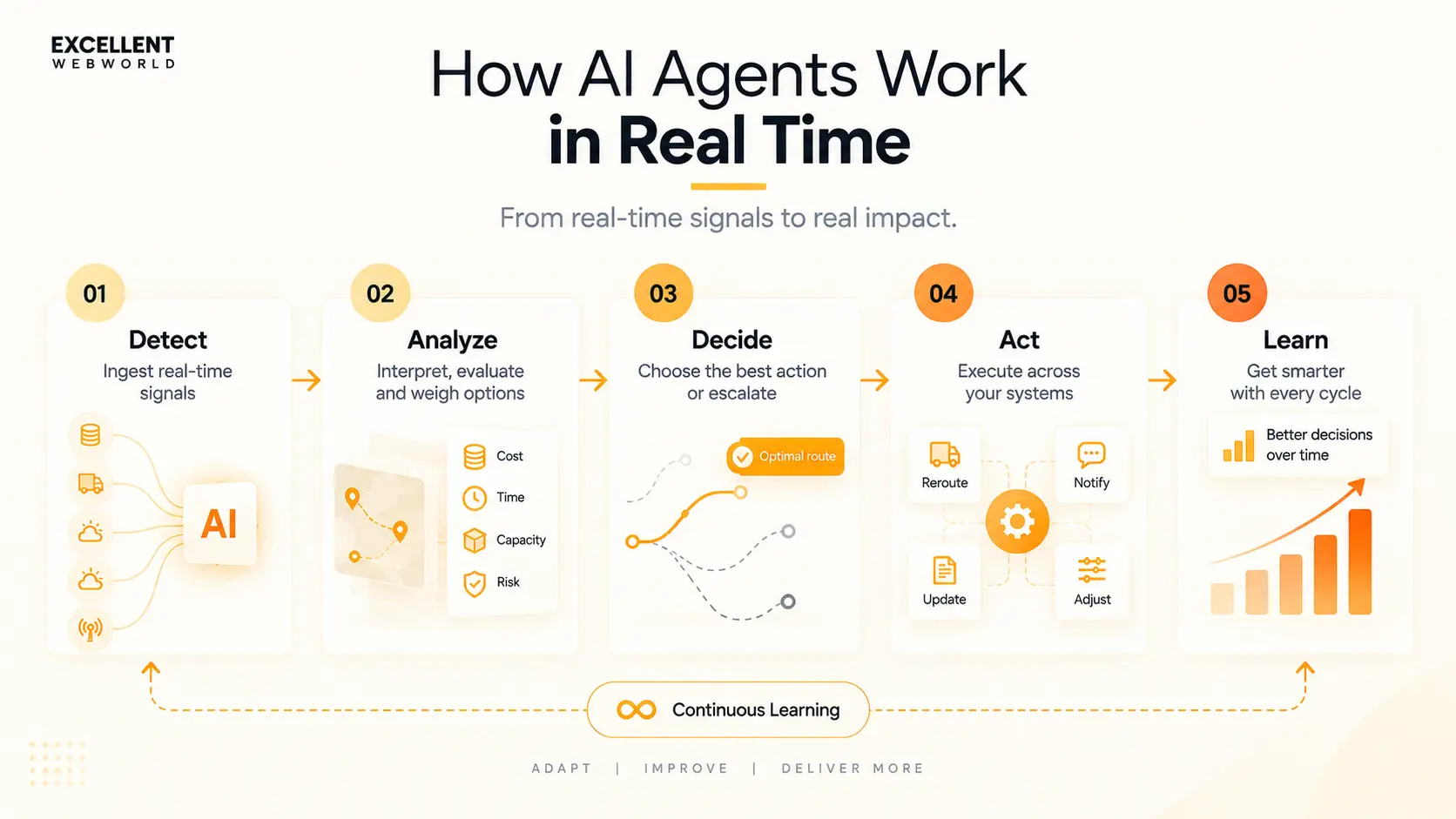
First comes the detection part, where agents ingest data from a warehouse management system, transport management system, enterprise resource planning software, IoT sensors, carrier APIs, and external feeds, which include weather, fuel prices, and traffic. Every data point is immediate context.
Then comes the analysis part, where AI agents interpret operational signals with the help of natural language processing and reasoning models. With a shipment delay, the agent evaluates 48 potential reroute options and the time it takes to deliver, weighing fuel cost, regulatory compliance, carrier capacity, and customer preferences.
When it comes to a decision, the system selects and executes the optimal routes or escalates with full context and a recommended action; then it's time for the action, where secure APIs let AI agents execute tasks across connected systems. These tasks range from rerouting vehicles to adjusting dispatch priorities.
At last, in the learning phase, every decision becomes data. Decisions providing desired outcomes are reinforced while ineffective ones are adjusted. Such a constant feedback loop makes AI agents smarter month over month.
What Your Business Must Consider When Evaluating AI Agents for Logistics
What most businesses do is that they choose platforms based on features. Ensure you are not making the same mistake. Choose based on your specific requirements. Here is an evaluation checklist you can consider.
Logistics Domain Expertise
Integration Coverage
Complex integrations are the #1 deployment risk. When ERP, TMS, and WMS run on different platforms, custom middleware can significantly extend deployment timelines. Choose platforms offering AI integration services with pre-built connectors and API gateway architecture to cut integration time from 16+ weeks to 6–8 weeks.
AI Agent Governance & Compliance
PoC Timeline & Time to Value
The fastest-deploying platforms focus on high-ROI use cases first. Identifying which supply chain bottlenecks AI can fix helps you target early wins, with route optimization and exception handling typically delivering 12–15% improvement.
Multi-Agent Workflow Management
How AI Agents Perceive, Reason, Decide, and Act in Supply Chain Operations
Port closure detected via carrier API → Agent analyzes 47 alternative routes considering fuel cost, delivery time, carrier capacity, regulatory zones, customer SLAs → Selects optimal route (15% fuel premium, +2-hour delivery, avoids regional congestion) → Auto-reroutes shipment, updates customer ETA, adjusts dispatch priorities, triggers new fuel budget allocation → Logs decision + actual outcome → Refines constraint models for next similar scenario. This continuous loop is core to how modern AI in logistics differentiates from static TMS routing.
Time elapsed: 3-5 minutes
Manual rerouting time: 60-90 minutes
AI Agents vs. Traditional Approach: Comparing Operational Capabilities
| Workflow | Traditional Approach | AI Agent Approach |
|---|---|---|
| Route Changes | Static plan, manual re-routing on exception, 60-90 min recalc time | Real-time signal monitoring, auto re-route in 3-5 minutes, continuous optimization |
| Inventory Positioning | Monthly/quarterly reviews, batch replenishment | Continuous signal analysis, dynamic safety stock, auto-trigger orders |
| Exception Escalation | Manual ticket creation, human review, delayed notification | Auto-detection with context, immediate escalation with recommended action |
| Document Processing | Manual data entry per document, 20+ min per BOL | Automated extraction + validation, 2-3 min per document, 85%+ straight-through |
| Supplier Risk | Quarterly scorecards, manual monitoring | Always-on monitoring, risk scoring, automatic alerts before disruption |
Traditional software plateaus. After week two, performance stabilizes; same efficiency, same error rates, same insights. AI agents improve continuously. Month 1 might yield 8% fuel savings. Month 6 often shows 18-22% improvement as the agent refines constraint models with actual performance data.
This compounding effect is where long-term competitive advantage emerges.
8 Best AI Agents for Supply Chain & Logistics by Workflow in 2026
| Platform | Core Strength | Integration Speed | Best For | Trade-off |
|---|---|---|---|---|
| Excellent Webworld Custom AI Agents | Adaptability + fast deployment on YOUR workflows | 4-6 weeks | Custom needs without platform replacement | Requires integration planning |
| Blue Yonder Luminate | Demand sensing + inventory optimization | 8-12 weeks | Retail, high-velocity networks | More focused on planning than execution |
| Oracle SCM Cloud | Native ERP integration + procurement AI | 10-16 weeks | Oracle-locked enterprises | Less suitable for non-Oracle environments |
| Kinaxis Maestro | Concurrent planning + scenario modeling | 12-20 weeks | Complex manufacturing, volatile supply | Requires greater planning maturity |
| Pando AI Agents | Freight cost optimization + multimodal routing | 6-10 weeks | Freight brokers, 3PLs | Focused primarily on freight |
| AutoScheduler.AI | Warehouse-specific labor + slot optimization | 4-8 weeks | Fulfillment centers, high-volume ops | Does not replace broader TMS/WMS platforms |
| assistents.ai | Document AI + multilingual voice support | 6-10 weeks | Global operators, customs-intensive | Smaller integration ecosystem |
| C3 AI Supply Chain | Configurability + digital twinning | 14-24 weeks | Unique operational models | Requires stronger in-house data capabilities |
1. Excellent Webworld Custom AI Agents
Custom agents built directly into your existing ERP/TMS/WMS. No platform migration. No forced architectural changes.
Why choose it: Fastest deployment on YOUR specific workflows. Agents evolve with your business, not locked into vendor systems. We deliver agentic AI development services for mid-market 3PLs, with agents cutting exception response time from 90 minutes to 18 minutes and delivering 22% fuel optimization.
2. Blue Yonder Luminate Platform
Enterprise platform for demand-driven supply chain optimization. Built for retail and high-velocity distribution.
Why choose it: Proven track record in retail. Strong demand-sensing accuracy. Excellent for synchronized planning across regions. If demand forecasting and inventory accuracy are core pain points, Blue Yonder's signal analysis often maps directly to inventory and replenishment bottlenecks that logistics app development teams struggle to automate manually.
3. Oracle SCM Cloud (AI Agents)
Oracle SCM Cloud provides AI capabilities across procurement, logistics, and inventory within the Oracle ecosystem.
Why choose it: If you're already on Oracle Cloud, this integrates seamlessly. No middleware complexity.
4. Kinaxis Maestro Agent Studio
Kinaxis Maestro combines supply chain planning with real-time scenario modeling. It can evaluate thousands of supply chain scenarios within minutes.
Why choose it: If demand/supply volatility is your core problem, this is the deepest planning tool available.
5. Pando AI Agents
Pando provides an AI-native freight management platform designed for multimodal logistics and carrier optimization.
Why choose it: If freight execution is your highest-friction area, this is purpose-built for it.
6. AutoScheduler.AI
AutoScheduler.AI provides decision intelligence designed specifically for warehouse and fulfillment center operations. It can help manage changing workloads during peak-demand periods.
Why choose it: Deepest warehouse focus available. Handles peak-demand surges autonomously.
7. assistents.ai
assistents.ai provides enterprise agentic AI with pre-built logistics agents and multilingual capabilities.
Why choose it: If customs clearance or multilingual operations are critical, built-in templates save months.
8. C3 AI Supply Chain Suite
C3 AI provides an enterprise AI platform for organizations with dedicated data science teams and specialized operational requirements.
Why choose it: Maximum configurability for non-standard workflows. Deepest customization available.
Here is when you need to consider which AI agent based on workflow categories:
- Demand Forecasting & Inventory → Blue Yonder, Excellent Webworld, C3 AI
- Enterprise Planning & Orchestration → Kinaxis Maestro, C3 AI, Oracle SCM
- Warehouse & Fulfillment → AutoScheduler.AI, Excellent Webworld
- Route Optimization & Logistics Execution → Pando, Excellent Webworld
- Document Processing & Compliance → assistents.ai, Excellent Webworld
- Procurement & Supplier Risk → Oracle SCM, C3 AI, Excellent Webworld
Which Features and Functionalities Make an AI Agent Effective in Logistics
1. Context Awareness
Agents must understand the full constraint landscape simultaneously: capacity, time, cost, regulatory requirements, carrier performance, customer preferences. Single-variable optimization creates problems (fastest route = most expensive; cheapest = SLA miss).
Outcome: Better decisions across all dimensions, not isolated optimization.
2. Multi-Agent Orchestration
Agents should communicate seamlessly. Document parsing agent feeds order creation agent feeds exception management agent. No manual handoffs between workflows.
Outcome: Compounding ROI as workflows interact, not isolated gains.
3. Predictive Analytics + Scenario Simulation
Humans cannot evaluate 1000s of operational scenarios manually. AI agents can assess them in seconds and test “what-if” outcomes before execution.
Outcome: Better decisions with lower risk.
4. Real-Time Operational Adaptation
Pre-determined plans can become obsolete during execution. Agents can recalculate plans every few minutes based on current conditions, outperforming nightly batch-based planning.
Outcome: Faster response to disruption, fewer cascade failures.
5. AI Agent Governance & Auditability
Every agent decision can be logged with its rationale for auditability and compliance. This provides the traceability required in regulated logistics operations.
Outcome: Audit-ready operations, reduced compliance risk.
6. Interoperability & API-First Architecture
Agents can work with existing systems such as SAP, Oracle, TMS, and WMS through APIs. This allows businesses to add agent capabilities without replacing their current systems.
Outcome: Faster deployment, lower cost, less organizational disruption.
7. Human-in-the-Loop Design
Autonomous execution does not mean unsupervised execution. Agents can follow defined escalation paths while humans retain final approval for high-value or sensitive decisions.
Outcome: Safety, trust, compliance alignment.
How AI Agents Improve Logistics Operations (Real-World Business Impact)
| Metrics | Before AI Agents | After AI Agents | Impact |
|---|---|---|---|
| Fuel Cost per Delivery | $12.50 | $9.40 | 25% Reduction |
| Exception Response Time | 90 Minutes | 30 Minutes | 60% Faster |
| Forecast Accuracy | 78% | 94% | 18-22% Improvement |
| Inventory Carrying Cost | High Overstock | Optimized | 15-20% Reduction |
| Document Processing (Manual Hours/Day) | 5 Hours | 1 Hour | 80% Time Savings |
| Labor Scheduling Efficiency | 75% | 92% | 17% Improvement |
| On-Time Delivery Rate | 89% | 96% | 7 Point Improvement |
1. Real-Time Visibility With Faster Operational Response
Fragmented systems delay signal detection, allowing disruptions to cascade before teams can act. AI agents monitor systems simultaneously, helping organizations respond to exceptions 25-30% faster, reducing SLA misses, escalation costs, and customer communication delays.
In a recent deployment of our fleet telematics platform, we reduced exception escalation time by 34% while cutting missed SLAs by 12%, demonstrating how real-time agent monitoring compounds operational resilience.
2. Lower Costs Across Logistics Network
Logistics costs often hide in inefficient routing, poor capacity utilization, and repetitive manual work. AI addresses these gaps through route optimization, scheduling, load matching, and network balancing.
- Fuel savings: 15-25% through route optimization and load matching
- Labor Efficiency: 10-15% through scheduling and exception automation
- Capacity Utilization: 8-12% through load consolidation and network balancing
- Total Operational Improvement: 25-30%
These improvements aren't theoretical. One freight forwarding client using our AI freight forwarding platform achieved 18% fuel cost reduction and 31% faster customs document processing, demonstrating how multimodal optimization compounds across the supply chain.
3. Better Inventory Accuracy With Less Overstock
AI-driven forecasting reduces demand forecasting errors by 18-22%, helping companies reduce excess stock, free working capital, and avoid costly emergency orders.
- Less working capital tied up in excess inventory
- Fewer emergency orders at premium prices
4. Early Risk Detection & Supply Chain Resilience
AI risk management can identify supply disruptions 4-6 weeks earlier, giving teams time to secure alternate suppliers and respond before operations are affected. This means fewer crisis-driven decisions and lower disruption costs.
5. Sustainability + Compliance + Accountability
AI optimization can reduce emissions while helping logistics operations meet regulatory and ESG targets. Route optimization lowers emissions per shipment, while continuous monitoring supports compliance and stronger sustainability performance.
AI Agent Implementation Challenges & Solutions for Logistics
1. Breaking Down Data Silos & Integration Complexity
Your ERP, such as SAP, TMS, such as MercuryGate, and WMS, such as Körber, are fragmented across operations. Integration timelines can balloon, leaving you concerned that existing systems may need to be rebuilt.
Solution
Start with workflows that have clean, accessible data (route optimization is often the winner). Choose platforms with pre-built connectors instead of custom middleware. Use API gateways to bridge systems without wholesale replacement. Prioritize high-ROI integrations; other systems can wait for Phase 3+.
2. Change Management & Workforce Adoption
Dispatchers may fear job losses, while planners may question whether they can trust agent recommendations. This skepticism can slow adoption and reduce the value of the deployment.
Solution
Position agents as "analyst amplifiers". Early training on how to interpret outputs and when to override. Show immediate wins publicly (the analyst who saves 4 hours daily now focuses on customer relationships). Celebrate early wins loudly.
3. AI Agent Governance & Compliance
Logistics operations are subject to regulatory and audit requirements. You need clear audit trails, decision rationale, and compliance controls before allowing autonomous systems to make operational decisions.
Solution
Choose platforms with governance built-in. Define clear escalation pathways for high-value or exception decisions upfront. Implement continuous monitoring dashboards. Align agent decision thresholds with compliance frameworks before deployment.
4. Measuring ROI from AI Agent Deployment
Deploying route optimization, demand forecasting, and labor scheduling at the same time can make results difficult to measure. Without a controlled rollout, it becomes harder to determine which workflow produced each improvement.
Solution
Baseline all key metrics before ANY agent deployment. Pilot per-workflow, isolate impact. Understand ROI compounds; 8% fuel + 12% labor + 5% inventory creates additional benefit through interactions. Track leading indicators (agent adoption rate) + lagging indicators (actual outcomes). Plan 18-24 month view: short-term pilot ROI + long-term network compounding.
7 Real-World Application of AI Agents in Logistics & Supply Chain
| Use Cases | Problems | AI Agent Solutions | Outcome |
|---|---|---|---|
| Dynamic Route Optimization | Static routes waste fuel and miss delivery windows | Real-time monitoring + route re-optimization | 15-20% less fuel, 2-3 hours faster delivery |
| Freight Document Processing | 100+ formats cause manual entry errors | Parsing + validation + order matching | 85%+ straight-through processing, 70% fewer errors |
| Exception Management & Escalation | Delays and carrier issues cause cascading failures | Autonomous detection + escalation + mitigation | 40% fewer interventions, 2-3 hours faster resolution |
| Supplier Risk Monitoring | Manual scorecards provide infrequent updates | Always-on monitoring + risk scoring + auto-escalation | 4-6 weeks earlier disruption detection, proactive alternatives |
| Demand Forecasting with Supply Planning | Forecast mismatch with sourcing → stockouts or overstock | Signal monitoring + supplier alerts | 18-22% better forecast accuracy, lower working capital |
| Multi-Facility Analytics & Reporting | Different systems create inconsistent KPIs | Data consolidation + KPI standardization + variance analysis | 2-3 days reduced to 2-3 hours of reporting |
| Warehouse Operations & Labor Scheduling | Fixed schedules miss surges and waste labor | Workload monitoring + scheduling + slot optimization | 20-25% higher throughput, lower overtime |
How to Implement AI Agents from Evaluation to Production
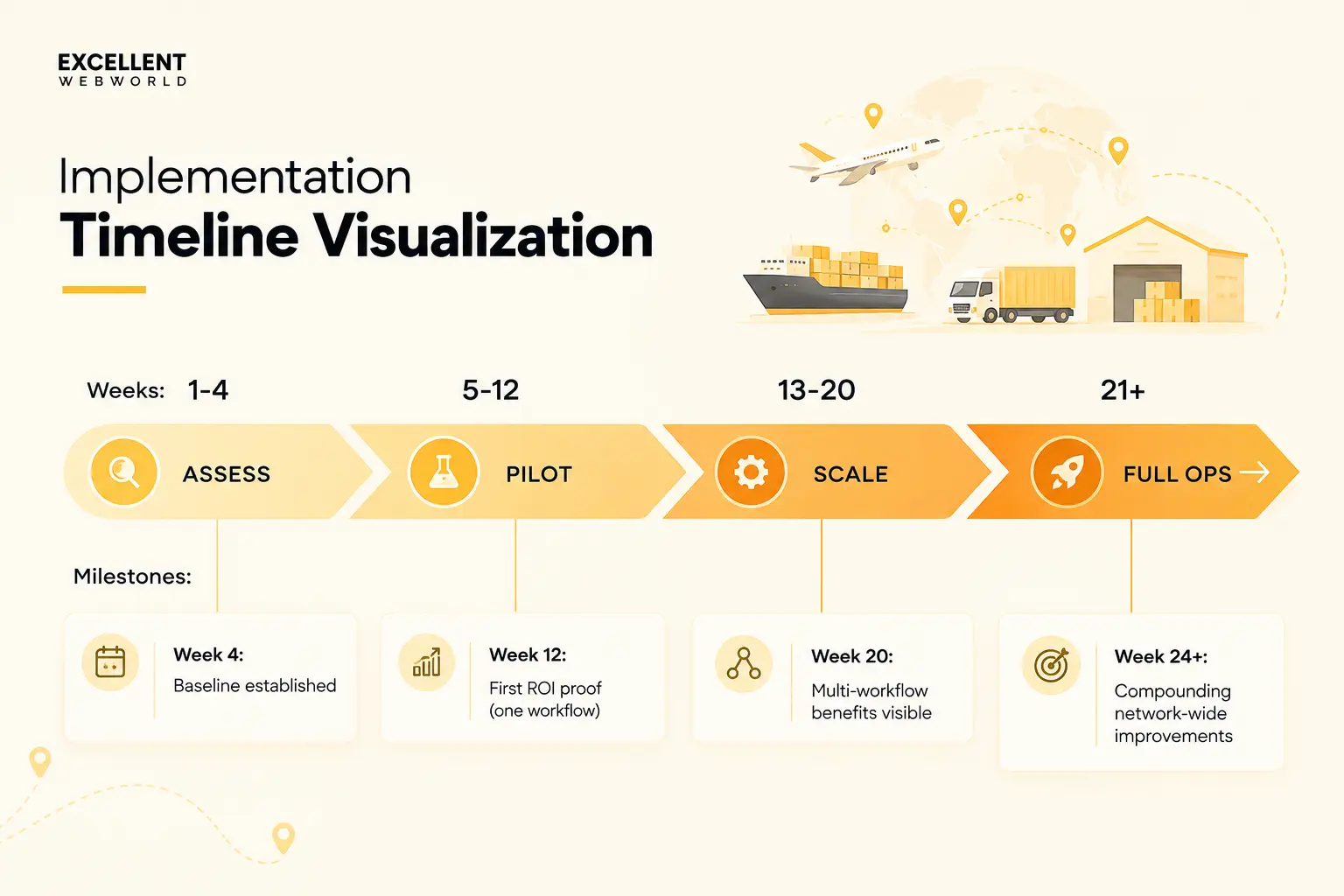
Phase 1: Evaluate Data, System, and AI Readiness
Inventory your ERP, TMS, WMS, and carrier APIs. Assess data quality and identify the single workflow causing the most friction. Define baseline metrics before deployment.
Outcome: Clear scope, realistic pilot plan.
Mistake: trying to integrate all systems at once. Best practice: ruthless focus on ONE accessible workflow.
Phase 2: Pilot & Validate One High-Impact Workflow
Deploy an agent to one priority workflow, such as route optimization, demand forecasting, or exception handling. Run live data through the agent, establish governance guardrails, capture performance against the baseline, and train the team. Understanding the fundamentals of how to build AI agents helps internal stakeholders grasp decision-making logic, improving adoption and governance alignment faster than documentation alone.
Outcome: Measurable ROI proof on a single workflow. Expected: 15-25% improvement depending on workflow.
Mistake: Scope creep. Best practice: ruthless focus, measure outcomes, then expand.
Phase 3: Refine, Integrate & Expand
Deploy a second workflow and connect both agents to begin orchestration. Expand governance controls and train additional operations roles as agent coverage grows.
Outcome: Multi-workflow orchestration starts. ROI compounds. What’s expected is 25-30% across deployed workflows.
Phase 4: Full Operational AI Agent Deployment
Run 4 to 6 workflows with mature multi-agent orchestration. Embed continuous improvement cycles and give leadership access to operational dashboards.
Outcome: Sustained 25-35% operational improvement, compounding learning.
How Excellent Webworld Architects & Engineers AI Agents for Supply Chain & Logistics
Excellent Webworld builds custom AI agents designed around each organization's unique data, workflows, and decision layers. Rather than forcing operations to adapt to rigid vendor platforms, our agents integrate directly with your existing ERP, TMS, and WMS systems.
As a logistics software development company with deep supply chain expertise, we've spent the last four years refining how agents adapt to real operational constraints. This is what we deliver with our hybrid approach:
- Speed-to-value: 4-6 weeks to first production workflow
- Flexibility: Agents evolve with your business
- Integration: Direct connection to your systems, no platform migration
- Governance: Enterprise-grade audit trails, compliance logging, escalation pathways built-in
- Measurable ROI: Realistic 25-30% operational improvements
Whether your highest friction is route optimization, exception management, demand forecasting, or multi-facility analytics, our AI agent development services focus on deploying agents that solve YOUR problems.
Frequently Asked Questions

Article By

