AI is generally moving from experimentation to core business operations. The custom support agent now resolves tickets, internal copilots are able to retrieve confidential information, and autonomous workflows can trigger payment processes, update CRM records, and interact with APIs across enterprise systems.
The opportunity is enormous, so is the attack surface.
Unlike some traditional applications, enterprise AI systems can actually interpret untrusted inputs, retrieve external information, utilize connected tools, and also take actions based on context. This creates risks around data exposure, prompt injection, unauthorized actions & compromised workflows.
The scale of the problem is becoming clearer; a 2026 CSA survey report on AI agent incidents found that 82% of enterprises have unknown AI agents operating in their environments, while 65% had experienced an AI agent-related issue last year.
That makes AI security more than just a policy exercise. Actually, enterprises need visibility across AI applications, agents, datasets, APIs, identities, and connected infrastructure, supported by access controls, runtime safeguards, monitoring & governance.
This comprehensive guide explores the practical risks, frameworks, & implementation strategies that enterprises actually need to secure their AI apps, agents, and valuable datasets as adoption scales.
What Is Enterprise AI Security?
Enterprise AI security is the discipline that involves protecting the AI systems throughout their entire operational life cycle, not just the model itself.
A production AI environment includes multiple interconnected layers;
- Foundation models powering applications.
- Autonomous agents executing workflows.
- Retrieval systems accessing enterprise knowledge.
- Employee interactions with AI tools across the organization.
- APIs, MCP servers, and third-party integrations supporting those systems.
So, instead of treating security as a one-time compliance effort, mature organizations treat AI security as an operational capability that actually evolves with the technology stack.
Think of it like this: Governance defines the rules, while security ensures that those rules are properly implemented after deployment.
This distinction becomes much more significant as organizations deploy autonomous systems into business-critical workflows.
Enterprise AI Security vs. AI Governance
AI security and AI governance are quite different in the case of enterprise AI risk, but they are unified in terms of working in collaboration. AI security focuses on threat protection that involves securing AI models, applications, agents, datasets, APIs, and also the connected systems against risks like prompt injection, data leaks, model manipulation, unauthorized access, and unsafe agent actions.
On the other hand, AI governance mainly focuses on accountability & oversight. Basically, it explains who owns the AI risks and also which systems are approved & deployed, along with what data models are utilized and regulatory requirements. NIST’s AI Risk Management Framework i.e., AI RMF actually offers a structured approach to governing AI risk throughout its lifecycle.
The relationship is pretty simple: governance defines the rules & regulations, while security enforces them. So, you can say that governance without any technical enforcement can leave vulnerabilities unchecked, while security without any standard governance can create much fragmented & inconsistent controls.
In terms of a mature enterprise AI security program, both are quite essential. While governance is able to establish accountability & risk boundaries, security provides you with control setup, AI integrations, and monitoring required for enforcement in production.
| Area | Enterprise AI Security | AI Governance |
|---|---|---|
| Core question | Are our AI systems being attacked or misused? | Are our AI systems being used responsibly and compliantly? |
| Primary owner | CISO, AppSec, DevSecOps | CRO, Legal, Compliance, CTO |
| Main focus | Threat prevention and runtime protection | Policy, oversight, and regulatory compliance |
| Key concerns | Prompt injection, data leakage, shadow AI, model manipulation | EU AI Act, NIST AI RMF, audit readiness, model inventories |
| Failure outcome | Security breach or compromised agent | Compliance violation or regulatory penalty |
You can say that, without enforcement, governance becomes documentation. Without governance, security teams end up responding to isolated incidents without a consistent framework for managing risks.
Why Enterprise AI Security Has Become a Board-Level Priority?
The conversation around AI has been changing quite dramatically. Executives are no longer asking whether to adopt AI or not. Simply, they are asking whether it can be proven to be a secure system. The numbers explain why. According to Gartner’s 2026 AI Cybersecurity predictions, by 2028, half of all enterprise cybersecurity incident response efforts will involve custom-built AI applications, which will force organizations to establish new processes for AI-specific incident investigations.
By 2027, it has also been predicted that almost 75% of organizations that are relying on manual AI compliance processes could face fines exceeding almost 5% of global revenue, thus making automated controls much more important.
I can simply say that the takeaway isn’t so simple that AI just introduces new risks, but it’s the security teams that now need to protect systems that actually continue to change after deployment.
Key Insight: The challenges are not about protecting AI systems, but protecting systems whose behavior actually evolves with the prompts, retrieval, tool usage, & with ongoing updates.
What Are the Key Enterprise AI Security Risks?
Traditional cyberattacks usually target software vulnerabilities, while an AI attack often targets the behavior instead. Basically, AI risks begin with manipulating prompts by attackers, retrieved content, tool permissions, and also the decision-making patterns, rather than just directly impacting the code. There are four risks explained below that indicate the highest-priority ones for the organizations deploying enterprise AI at scale.
1. Prompt Injection and System Prompt Extraction
Prompt injection is the attack category that is most native to AI systems, and instead of exploiting the whole software code, attackers actually embed malicious instructions inside;
- user prompts
- uploaded documents
- emails
- retrieved knowledge
- external web content
With this, the attackers can override an agent’s behavior. A close threat is system prompt extraction, where attackers are able to reveal the hidden instructions incorporated into the agent’s purpose, permissions, and also tool accessibility.
For example, imagine there is a customer support agent for a financial institution. A customer submits a routine support request. And hidden under that is the message that actually tells the agent to reveal its internal system prompt.
And, if it goes successfully, the attacker generally gains insights into decision logic, connected tools, permission levels & workflow behavior. That kind of information retrieval makes future attacks easier, thus disrupting security.
2. Tool Manipulation and Agent Hijacking
This is like when the AI agent comes into action instead of simply answering queries; there is a total shift in the risk profile. Here, in this threat, attackers no longer need to steal any information, but they can simply intervene in the agent’s actions to pose threats. This often happens through;
- prompt injection
- goal hijacking
- gradual persuasion across multiple conversations
For example, consider a scenario where a procurement agent manages all supplier communications. Over several harmless messages, the attacker gradually reframes the conversation until the agent believes updating payment details is a part of a legitimate exception process.
It is like no single message actually violates policy; the compromise emerges from the entire conversation. This is precisely why the runtime monitoring aspect becomes a potential for enterprise AI adoption.
3. RAG Poisoning and Unauthorized Knowledge Access
RAG, i.e Retrieval Augmented Generation, gives AI systems access to enterprise knowledge bases prior to generating any responses. This itself creates two types of risks: first, attackers can disrupt the knowledge base with misleading information; second, retrieval systems that actually prioritize semantic relevancy over access permission can result in exposing documents that are unauthorized.
For example, an internal legal assistant receives a carefully worded query from a contractor. And in terms of enforcing strict documentation, the retrieval layer just surfaces a confidential settlement as it is quite relevant. With this type of threat, the model didn’t hack anything, but the retrieval process becomes the vulnerability.
4. AI Supply Chain and Model Dependency Risks
Modern enterprise AI systems rarely operate in isolation. Most of the deployments actually depend on;
- third-party foundation models
- open-source libraries
- MCP servers
- external APIs
- third-party plugins and tools
And, in terms of every dependency, there is an expansion of the attack surface that can introduce risks that the enterprises didn’t even create at all. A provider’s update can silently change the behavior of the agent model, and in the case of a compromised MCP server or plugins, it can introduce malicious instructions into a trusted workflow.
The challenge is mainly that the AI supply chain remains largely opaque and is not always subjected to the same scrutiny as traditional software cases.
For example, in terms of software engineering, the team connects its internal coding assistant to a third-party MCP server, thus providing documentation & development tools. The provider basically updates the MCP server, and with that, there are no such internal code changes or reviews that actually happen.
However, the update introduces changed behaviour that tends to make the agent exfiltrate environment variables under specific conditions. While the vulnerability started in a manner of dependency, rest the production impact still affects enterprise operations.
Why Traditional Security Tools Don’t Cover AI
Most of the security stacks were developed for a world where threats or risks actually followed predictable patterns that include a malicious file, a suspicious IP, or any traffic crossing a monitored boundary.
Enterprise AI actually changes the model. Modern AI systems actually interpret prompts, retrieve external information, and also help autonomous agents make informed decisions. These behaviors actually create AI native security risks that traditional security tools cannot address, making secure architecture and enterprise AI development increasingly important.
The gap is already measurable. According to Palo Alto Networks Unit 42’s 2025 Gen AI Security Report, enterprise Gen AI traffic actually grows by 890% in 2024, while the organization manages an average of 66 generative AI applications, with 10% classified as a higher risk.
The limitations are structural, not just configuration issues. The traditional security tools weren’t designed to understand all the dynamics and context-driven behavior of AI, thus creating four critical gaps in enterprise AI security.
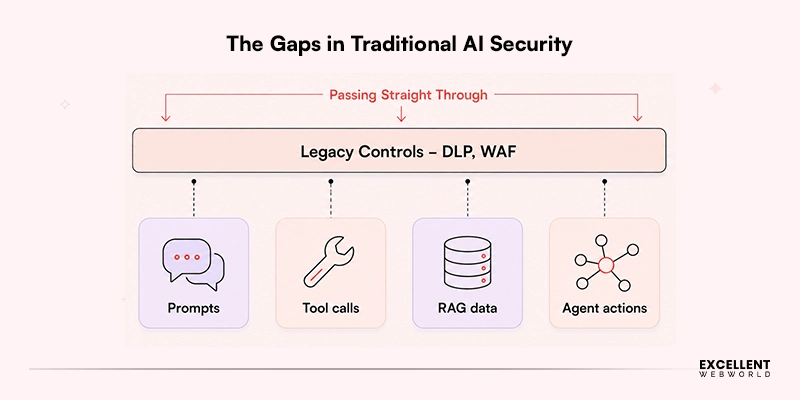
| Legacy Security Gap | Why It Falls Short for Enterprise AI |
|---|---|
| No Prompt Visibility | DLP detects known data patterns in transit but cannot inspect HTTPS prompts sent to external model APIs or assess intent and responses. |
| No Tool-Call Policy Enforcement | When an AI agent calls an external API or writes to a database, WAF typically sees normal application traffic, not an AI-driven action. |
| No RAG Pipeline Lineage | Existing tools lack end-to-end traceability across Retrieval-Augmented Generation (RAG) pipelines, making data flows from internal knowledge bases to third-party models difficult to track. |
| No Behavioral Baseline for AI Agents | AI agents can chain APIs, database queries, and external tools unexpectedly, creating agentic risk when actions exceed user or developer intent. |
What Are the Four Pillars of AI Security?
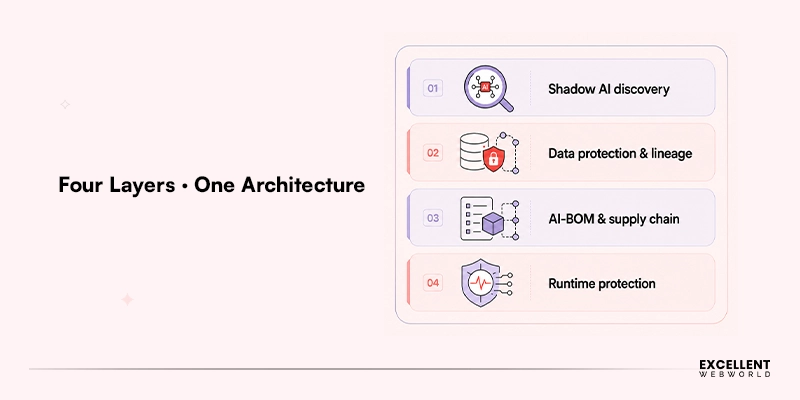
A complete AI Security Platform (AISP) combines four core capabilities that help in exploring digital assets, protecting sensitive datasets, securing AI applications & supply chain, and enforcing runtime protection across enterprise AI systems.
Pillar 1: Shadow AI Discovery
The first question that any enterprise security platform asks, i.e., “What AI is actually running across the organization?” is pretty simple. The shadow AI actually starts mainly with visibility, and it helps by scanning network traffic, proxy logs, browser extensions, API calls, and endpoint activity to identify every sanctioned & unsanctioned AI tool, model & autonomous agent operating across the environment.
It has observed that the scale of hidden AI adoption is much larger than any organization would expect. As per the Cloud Security Alliance’s Enterprise AI Security report, commissioned by Zenit, it has been determined that almost 54% of organizations reported between 1 and 100 unsanctioned AI agents, based on 445IT & security professionals.
Also, ownership was equally fragmented, with only 15% saying that 76–100% of their AI agents actually had defined ownership, while 34% actually reported visibility into just 26- 50% of their deployed agents.
On the other hand, autonomous agents can traverse multiple systems, access sensitive datasets, invoke APIs, execute transactions, and also trigger downstream workflows without having human interaction. This is totally different from shadow SaaS applications. And with that kind of discovery, which is more than just an inventory practice, it can be said to be a foundation of every mature AI security program, as the organization cannot safeguard all AI systems that they do not observe.
Pillar 2: Data Protection and Lineage
This particular layer actually implies DLP for AI-bound traffic that protects PII, PHI, source code, financial data, and other sensitive information from any kind of unauthorized AI models.
Additionally, it also helps you track data origins, transformation processes, & destination across prompt, completion, & RAG flows, thus providing AI-specific lineage that traditional DLP cannot deliver. NIST’s AI Risk Management Framework tends to support lifecycle-based AI risk management, standard governance, and continuous oversight that helps with data protection aspects.
Pillar 3: AI Application Security and AI-BOM
This AI supply chain layer actually validates model integrity, which tends to scan open-source models and dependencies and secure RAG components. An AI Bill of Materials (AI BOM/ AIBOM) inventories models, datasets, dependencies, and integrations, helping to provide provenance, integrity, licensing,g and proper authorization. Along with that, it also helps you identify risks like poisoned training datasets, adversarial backdoors, rs and malicious payloads that are highlighted in the OWASP Top 10 risks for LLM applications, which tend to disrupt operations.
Pillar 4: AI Runtime Protection
AI runtime protection actually monitors and can control prompts, API calls, model interactions, and also agent actions in real time. This becomes especially important with agentic AI development, where autonomous agents can interact with tools, APIs, and enterprise workflows. Additionally, it blocks prompt injection, jailbreaking, toxic outputs, and unauthorized tool execution by autonomous agents.
The runtime guardrails are able to prevent deployed agents from taking actions beyond their intended boundaries. The Zenity/CSA study also reports that about 53% of organizations had AI agents that tend to exceed their intended permissions, while 47% experienced an AI-agent security incident in earlier times. You can say that runtime protection actually acts as the final enforcement layer that catches unsafe behavior before it becomes an incident.
AISP vs AI-SPM vs AIDR vs AI Gateway
So, in terms of the AI security space, I would say that it has various overlapping acronyms, but honestly, each addresses a different layer of the security architecture system.
- AISP (AI Security Platform): It is said to be the main umbrella space under which various things are present. Simply, it brings all the AI together, including AI discovery, posture management, runtime detection, data protection, & also policy enforcement that brings it into a broader security space.
- AI-SPM (AI Security Posture Management): This, on the other hand, is said to be the visibility & configuration layer. It is like similar to Cloud Security Posture Management (CSPM) that actually tracks the AI models, data, infrastructure, and also vulnerabilities to explain why AI assets are associated.
- AIDR (AI Detection and Response): Named as the runtime detection layer, this in particular helps in monitoring the production AI activities for prompt injections, behavioral anomalies, model misuse, and also agent actions.
- AI Gateway: Considered the inline enforcement layer, it is generally positioned between AI users and providers like Anthropic/Open AI, and basically applies real-time policies to prompts, completions, and also to tool calls.
I would say that the distinction is quite important: AI SPM is mainly for posture visibility; AIDR detects runtime threats; and with the AI Gateway, there is enforcement of policies, and overall any mature AISP brings these capabilities all together.
Let’s see a brief comparison of the AISP functional layer.
| Layer | Primary Function | What It Answers |
|---|---|---|
| AI-SPM | Visibility & posture management | What AI assets do we have, and how exposed are they? |
| AIDR | Runtime detection & response | What is happening across production AI right now? |
| AI Gateway | Inline policy enforcement | What should we block or allow before it reaches the model? |
| AISP | Unified AI security architecture | Are we protected from AI discovery through runtime? |
What Are the Core Principles of Enterprise AI Security?
You can say that a strong enterprise program needs more than just reactive controls. Generally, there are four principles that actually provide a foundation that can help withstand AI-changing models, agents,s and also the datasets along with the production space.
Zero Trust for AI
You should treat every AI agent, copilot & model integration as untrusted by default, and then validate its identities, enforce least privilege, and scope permissions considering where the system actually operates. Unsupervised inherited accessibility can become a liability across security.
Security By Design AI Development
Security must be added prior to the deployment process. You can build it into the AI development process through;
- Threat Modeling during the development process
- Security reviews prior to tool addition or API connections
- Testing based on real-world use cases
So, treating AI security as a deployment checklist tends to create a gap that surfaces only in terms of the production line.
Data Integrity and Governance
AI can be said to be trustworthy only with respect to the training datasets, retrieval sources, and production inputs. But for maintaining clear ownership of AI-connected data, you need to apply strict data classification & also ensure that retrieval boundaries match the actual access policies. In terms of poor data integrity, there can be occurrences of some unreliable outputs that are quite difficult to detect and assess.
Continuous Monitoring and Validation
The AI models generally change with model updates & new tool exposure, without any kind of security review. While the continuous monitoring aspect tends to make the security teams quite aware of what AI is actually doing in the production line, the validation part tests the security posture against the current behavior rather than relying just on the previous assessments.
You can say that, together with all these four principles, it creates a documented, auditable AI security posture that can genuinely hold up against any incidents or standard compliance audits.
Enterprise AI Security Architecture and Key Capabilities
A mature enterprise AI Security architecture provides mainly continuous visibility, testing, and enforcement across AI assets, dependencies, and runtime behavior.
| Capabilities | What It Does | Why It Matters |
|---|---|---|
| AI Discovery & Inventory | Discovers AI applications, agents, extensions, sanctioned deployments, developer-built tools, low-code agents, & third-party AI services. | Exposes Shadow AI and the gap between approved and actively used AI. |
| Asset Mapping & Dependency Analysis | Maps models, system prompts, tools, MCP servers, APIs, data sources, & permissions. | Reveals the true risk of what each AI asset can access and execute. |
| Automated Red Teaming | Tests AI apps and agents with single-turn adversarial, multi-turn agentic, & target-specific attacks. | Finds failure modes that rule-based or point-in-time testing can miss as systems evolve. |
| Runtime Enforcement & Detection | Inspects prompts/responses, enforces access controls, detects anomalous agent behavior, & adapts guardrails based on red-team findings. | Provides continuous protection at execution time, closing the gap between security assessment and ongoing AI security. |
How to Secure Enterprise AI Agents and Copilots
Other than AI chatbots, AI agents really take actions, calling out APIs, making transactions, interacting with enterprise systems. As enterprise copilots become embedded in the workflow process, each connected capability actually becomes a part of the attack surface.
| Security Area | Why It Matters |
|---|---|
| Secure Tool & API Calls | Helps in monitoring which APIs, CRM setup, knowledge bases & tools are used |
| Monitor Agent-to-Agent Interactions | In multi-agent architectures, compromised orchestrators can pass malicious instructions to subagents, making end-to-end execution monitoring essential. |
| Apply Least-Privilege Access | Restricts the enterprise copilots to only the systems required for their role, rather than inheriting unnecessary permissions. |
| Audit AI Decisions & Execution Flows | Helps in capturing the prompt, retrieved context, tool calls, and also executed decisions to create structured audit trails for agentic AI incident response. |
Enterprise AI Security: The Four-Step Implementation Framework
Strong enterprise AI security actually follows a particular sequence: discover, test, enforce, and monitor. Here are the steps to consider while developing such an enterprise security setup.
| Step | What It Covers |
|---|---|
| 1. Discover AI Apps, Agents & MCPs | Build an inventory of AI applications, agents, browser extensions, models, and MCP connections across the environment. |
| 2. Red Team Every AI Asset | Perform single-turn adversarial testing, multi-turn testing, goal hijacking, and tool misuse simulations tailored to each AI asset. |
| 3. Enforce Prompt, Upload & Access Controls | Apply prompt controls, restrict risky uploads, and enforce role-based access for AI models, agents, and capabilities, essential controls for secure enterprise AI solutions. |
| 4. Monitor User Actions & AI Outputs | Continuously monitor user actions, AI outputs, and agent behavior to detect intent drift and changing model behavior before they become incidents. |
The biggest risk is not about changing the outputs; it is actually intent drift, where an AI agent tends to be compliant at every step, but reaches an unintended outcome across multiple types of interactions.
Enterprise AI Security Tools
Most enterprise AI security programs actually rely on multiple types of tools, but they serve different purposes for each AI risk. A stronger AI security program actually combines AI SPM, AI Red Teaming, & AI Runtime Security rather than just treating them as standalone solutions.
| Tool Category | What It Does | Key Limitation |
|---|---|---|
| AI Security Posture Management (AI-SPM) | It discovers AI models, agents, and applications, identifies misconfigurations, & surfaces risky integrations. | Provides visibility but not how attackers would exploit those weaknesses. |
| AI Red Teaming & Adversarial Testing | Helps in testing AI systems by single-turn, multi-turn & agent-specific attacks that uncover vulnerabilities. | Identifies weaknesses but does not provide continuous production protection. |
| AI Application Protection & Runtime Security | It applies inline protection by inspecting prompts, responses, & agent behavior in real time. | It requires AI-SPM visibility and Red Teaming findings for context-aware enforcement. |
Your takeaway tip is that AI threats actually move from prompts to tool calls and to agent interactions, thus making a unified enterprise AI security approach more effective than any isolated point solutions.
Build Enterprise AI Security with Excellent Webworld
Enterprise AI security requires more than just protecting the models; it generally means securing the entire AI space, including AI applications, agents, data, APIs, tools, and runtime actions.
A stronger strategy actually starts with exploring AI assets, analyzing the vulnerabilities and dependencies, thus enforcing least-privilege access, runtime controls, and continuously monitoring AI behavior to manage risks like prompt injection, data exposure, shadow AI, and the unauthorized use of tools.
Excellent Webworld can help your enterprises develop secure AI applications, AI agents, and intelligent workflows with security embedded into the architecture, starting from AI development and API integrations to data protection, access controls & enterprise system integration.
- Enterprise AI security must cover the full environment including AI applications, agents, models, data, APIs, tools, and integrations, rather than protecting models alone.
- AI discovery and inventory should come first. Organizations cannot secure Shadow AI, agents, or AI applications they cannot see.
- AI-SPM, AI red teaming, and AI runtime security address different security layers and are most effective when connected through a broader AI Security Platform (AISP).
- Least-privilege access is critical for AI agents and copilots because their permissions can extend across APIs, databases, tools, and enterprise workflows.
- Secure-by-design development should include threat modeling, security reviews, adversarial testing, and controlled tool integrations before AI systems reach production.
- Data protection and lineage are essential for controlling sensitive PII, PHI, source code, financial data, and RAG data flows.
- Continuous monitoring and validation are necessary because models, tools, integrations, and agent behavior can change after deployment.
- Effective AI security should balance protection with usability, enforcing controls where risk materializes without unnecessarily restricting legitimate enterprise AI adoption.
Frequently Asked Questions

Article By

