Summary:
Most fintech AI pilots stall because the gap between a working demo and a live system is rarely about the model. This blog explains how Forward Deployed Engineering embeds engineers inside your fintech operations, so leaders can see how it speeds up fraud detection, KYC, and lending while managing its cost and security risks.
Most fintech teams have proved that AI can work in their ecosystem, but very few have it running in their live environments. MIT’s NADNA research proves this hypothesis, as only 5% of customer enterprise AI tools reach production, even after spending $30-$40 billion. The same applies to AI in fintech, where you pay the cost in terms of stalled roadmaps & idle budgets.
However, that gap between pilot and production is rarely due to models. According to MIT, it’s a “learning gap,” meaning your tools are never trained to adapt to real business environments. In financial services, the case gets even more complicated as AI agents need to connect with core banking, identity, risk, and audit systems, which outside teams may rarely get right.
That’s what FDE in financial services is built to solve. MIT’s data points prove this fact – pilots built with experts sitting inside your business operations reached deployment 67% of the time, compared to about 33% with pilots built by your internal teams or teams sitting far away from your production environments.
Forward Deployed Engineering falls into the 67% bracket with engineers working alongside your business workflows. In this blog, you’ll learn about why Forward Deployed Engineering for fintech is a necessity, its key use cases, and how to implement it securely and at scale.
What is Forward Deployed Engineering in Fintech?
Forward Deployed Engineering (FDE) in fintech is about embedding senior engineers inside your fintech operations, so they learn from your core systems, compliance rules, and business workflows firsthand.
As Forward Deployed Engineers in fintech work close to business operations, they can build against real constraints and ship production systems instead of being involved in handling requirements across vendor layers, which slows down releases.
How Forward Deployed Engineering Works in Fintech
Here’s how forward-deployed engineering works in any typical fintech environment:
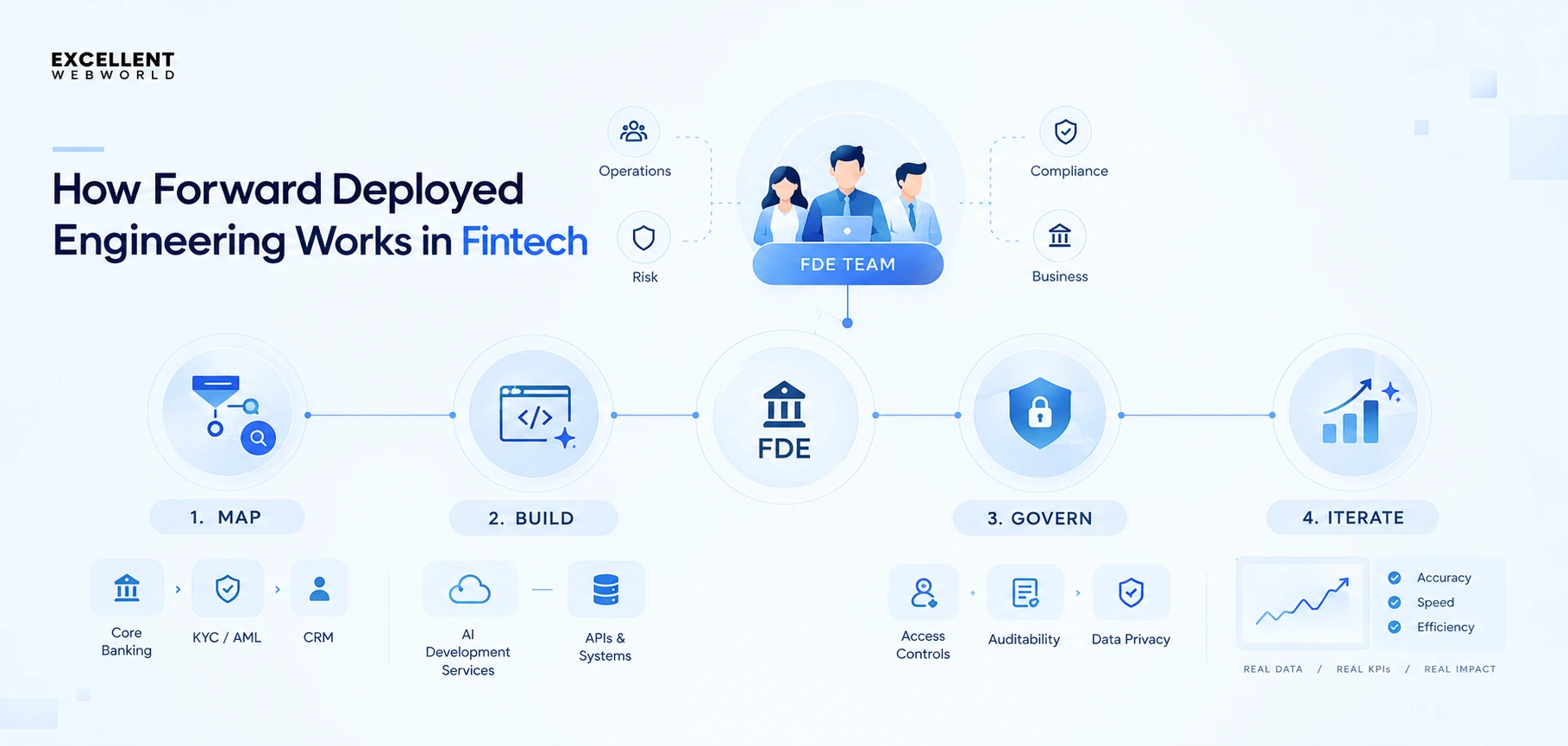
- Embed: FDE team joins your operations, risk, and compliance teams and works against real workflows so business context reaches the code in a few days instead of getting lost across various tickets and status calls.
- Map: Engineers trace how data and decisions move through core banking, KYC/AML & CRM workflows so integration risks get surfaced early instead of wasting your time & money at the final stage.
- Build: Engineers build solutions through next-gen AI development services directly into live workflows and connect them to your existing APIs, so pilots reach production instead of getting stalled in demo environments.
- Govern: Engineering teams build access controls, auditability, and data privacy controls into every release from the beginning so compliance reviews never become the reason for a delayed product launch.
- Iterate: Engineers fine-tune AI models for financial decision-making on real-time production data against well-defined KPIs, so leadership can see measurable results instead of dealing with just another roadmap.
Why Fintech Companies Are Adopting Forward Deployed Engineering
Most fintech leaders I have talked with don’t have any talent shortage. They have a context gap between the business problem and what the code is supposed to solve. Forward Deployed Engineering for financial services aims to solve this issue, and the table below shows the eight major reasons that are pushing teams toward FDE for fintech companies.
| Why Teams Switch | The Pain Point You’re Living With | How FDE Solves It |
|---|---|---|
| Stalled AI Pilots | Your GenAI pilots work well in a sandbox, but no one is taking ownership to push them into live workflows. | Engineers take ownership from pilot to production and integrate them into real workflows and approvals. |
| Tangled Core Systems | AI requires data, APIs, and identity access across core banking, payments & CRM. | FDE teams map these dependencies upfront and build integrations against your actual system. |
| Missing Business Context | Outside teams don’t have any idea of your underwriting logic, regulatory obligations, or exception handling. | Engineers learn your business processes firsthand so what they build aligns tightly with your operations. |
| Handoff Delays | Requirement gathering, development, testing, and deployment teams sit with different groups of people, so business context gets lost during handoffs. | Engineers work directly with your business team, removing the layer between problem and code. |
| Legacy Drag | Core systems can’t grow or expand, so every change requires careful sequencing and testing. | Engineers plan changes around your live system and modernize in phases without disrupting your live business operations. |
| Compliance As An Afterthought | KYC/AML and audit requirements are thought of only at the end, when legal and compliance teams raise red flags. | Fintech Forward Deployed Engineers work with legal and compliance teams and build the required control from the first sprint. |
| Agentic AI Demand | Agentic AI in financial services only works when agents run inside real operations, payments, and operations workflows. | Engineers deploy agents into live workflows with guardrails so manual work reduces significantly. |
| Pressure To Deliver Faster | Leadership wants measurable outcomes, not another innovation lab or consulting roadmap. | Engineers ship workable releases in short cycles, thereby keeping you ahead of the latest fintech trends. |
Key Use Cases of FDE in Fintech
The hard part of fintech AI is not the model; it’s the first handoff of the solution with core banking, risk and compliance systems, where clean demos meet decades of integration debt. Teams that treat engineering as a part of their business operations are able to close that gap. Here are some of the key FDE use cases in financial services that help you achieve that goal:
| Use Case | What’s At Stake For C-Level Executives | What FDE Delivers |
|---|---|---|
| Banking & Digital Payments | Slow product launches and rising costs as legacy systems stretch integration into a multi-quarter project. | Forward Deployed Engineering for banking ships new payment features inside your live environment, thereby reducing time-to-market without putting uptime at risk. |
| Fraud Detection & Risk Management | Direct fraud losses, wasted analyst capacity, and loss of good customers due to false positives. | AI financial fraud detection runs on your live transaction data and risk rules, which helps you reduce losses without impacting approval rates. |
| KYC & AML Automation | Audit findings, regulatory exposure, and onboarding delays that cost you customers even before they make a transaction. | AI agents for KYC and AML ship with audit trails built in, thereby providing you with a faster onboarding workflow and a strong, defensible position against regulators. |
| Lending & Credit Decisioning | Loss of revenue with slow approval processes and fragmented data, which sends qualified borrowers to competitors. | AI agents for loan approval operate inside your policy engine and bureau integrations, thereby improving decision-making speed while keeping credit risk in check. |
| Wealth Management & Trading | AUM growth and advisor productivity are held back by siloed data and broken internal tools. | AI implementation in financial services pays off with FDE as engineers build analytics systems and copilots around real workflows, compliance limits, and latency needs. |
How Forward Deployed Engineers Work With Fintech Teams
Here’s how Forward Deployed Engineers work with fintech teams in a step-by-step manner:
| Step | How It Works |
|---|---|
| Understanding Business & Technical Requirements | In fintech software engineering, context is everything. Engineers embed with your operations, risk, and compliance teams to map real workflows and regulatory requirements. They help you fix any broken steps so RPA in finance automates the clean processes and doesn’t waste time with messy ones. |
| Integrating AI & Financial Systems | Engineers help you prioritize fintech API use cases such as payments and account data and then add AI agents into your core banking, identity, and risk systems. FDE teams also map legacy dependencies upfront so the launch date doesn’t have to be shifted on regular intervals. |
| Building & Testing Solutions in Real Environments | Engineers build and test on live data and real edge cases, not sandbox environments. As you know, AI engineering for fintech only holds up when any surprises surface within a few weeks and not after going live. |
| Monitoring & Continuously Improving Deployments | Engineers stay on after launch, tracking model drift, accuracy, and cost against board-level metrics. For example, the AI agent development company that builds the agent for your fintech needs stays accountable for all these things and does not leave your project post-launch. |
Benefits and Challenges of FDE for Fintech Businesses
While FDE pushes engineers inside your operations to speed up delivery, it also raises alarming questions related to access, cost, and control. So, you need to know both the benefits and challenges of FDE for fintech to get a balanced point of view.
Benefits of Forward Deployed Engineering for Fintech
- Faster deployment: As there are no handoffs or back-and-forth between vendors, pilots reach production in weeks and leadership sees results while the business case is still fresh.
- Better product-market alignment: Engineers can see operations firsthand, so they ship products that match business needs very well.
- Reduced integration gaps: Engineers work inside core banking, risk, and CRM systems so integration problems surface at the earliest and not two weeks before launch.
- Improved AI adoption: Agents are built according to real workflows so operations and business analysts can actually use them instantly rather than working around them.
- Cleaner data foundations: Embedded data engineering services can fix fragmented data pipelines that affect AI models, thereby improving accuracy due to better inputs.
- Fewer vendors: One accountable team replaces a chain of handoffs, which means fewer status calls and no finger-pointing when something goes wrong.
- Measurable outcomes: Every release is tied with a particular metric such as fraud loss or approval time, which you can easily defend in a boardroom meeting.
Challenges of Forward Deployed Engineering for Fintech
- Security exposure: Embedded engineers require production access, which increases your risk surface and demands strict monitoring and access control from day one.
- Compliance burden: Every change requires privacy controls, regulatory sign-off, and privacy controls, so you need compliance in the engineering loop and not at the end.
- Scalability limits: Custom builds can stall without proper cloud services and solutions, as a solution that works for one fixed workflow may buckle at enterprise volume.
- Higher upfront cost: Senior embedded engineers cost you more than normal developers, so to get good ROI you need to focus more on speed and outcomes here.
- Knowledge concentration: Critical context can end up with few people without proper documentation and knowledge transfer.
- Legacy friction: Aging core systems can slow even the best FDE team, as broken systems have limitations related to safety despite modernization.
- Governance tension: Shared ownership can blur lines, so you need a clearly defined and accountable owner for every system and decision.
How to Implement Forward Deployed Engineering in Your Fintech Strategy
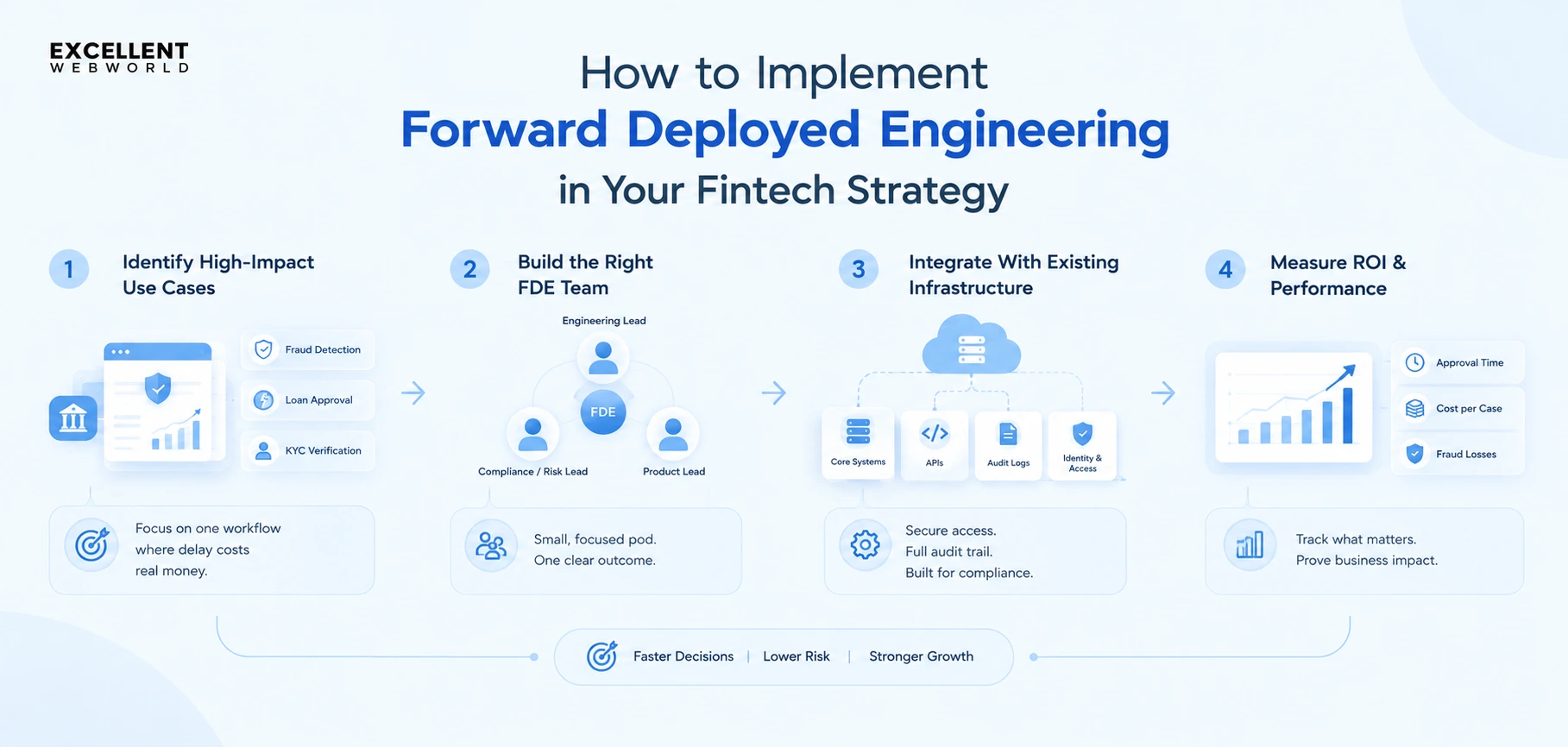
Here’s how you can implement Forward Deployed Engineering in your fintech strategy in a step-by-step manner:
| Step | What to Do | Why It Matters |
|---|---|---|
| Identify High-Impact Use Cases | Select one workflow where delay costs you real money. For example, AI agents in banking help you reduce fraud loss, speed up loan approvals, and KYC reviews. | A visible win in one quarter funds everything thereafter. |
| Build the Right FDE Team | Pair senior engineers with a risk or compliance owner and a product lead. Keep the pod small and accountable for one particular outcome. | Decisions happen in the boardroom, not across a vendor chain. |
| Integrate With Existing Infrastructure | Starts with APIs and read-only access to core systems. An experienced agentic AI development company helps you handle audit trails, identity, and rollback. | Modernize without risking uptime or failing a compliance review. |
| Measure ROI & Performance | Set your KPIs before launch. Track approval time, cost per case, and fraud losses. | Leadership sees measurable business outcomes. |
How Excellent WebWorld Can Help With Forward Deployed Fintech Solutions
Your next AI win won’t come from a pilot. It will come from pushing these demos into live production environments. That’s where Forward Deployed Engineering has a definitive role, as it places engineers inside your operations, so complex business requirements get converted into scalable, production-ready systems without months lost to handoffs.
We at Excellent Webworld, a top-rated fintech app development company, bring this model to banks, lenders, and payment providers. Our engineers work alongside your risk, operations, and compliance teams to understand your workflows. We also help you integrate AI agents and digital products with your payments, core banking, and KYC/AML systems. Lastly, we build security and audit controls from the beginning and ensure timely launch of your product.
So, what’s one stalled initiative you’d want to push into production this quarter? Book a 30-minute discovery session with our industry experts, and we’ll provide you with a custom FDE roadmap with clearly defined KPIs.
Frequently Asked Questions

Article By


Paresh Sagar is the CEO of Excellent Webworld. He firmly believes in using technology to solve challenges. His dedication and attention to detail make him an expert in helping startups in different industries digitalize their businesses globally.