React vs React Native—For business owners, this decision matters more than it seems. Choosing between these technologies directly impacts user experience, performance, and reach. Whether you’re building the next startup or scaling an existing business, one critical question can shape your way to success: How do you build your app efficiently without compromising quality?
That’s why choosing the right technology matters. Selecting the best one from React Native vs React can become your strategic move. It directly impacts your budget, time-to-market, and customer experience. Both are great tech by the same ecosystem, but developed for very contrasting business outcomes.
To avoid wrong calls that cost time, money, and momentum, learning the difference between React and React Native is crucial. Let’s break down all the key differences in detail with ideal use cases so you can make an appropriate choice for your project.
What is React (ReactJS)?
React is a JavaScript library, not a full framework, which is used for developing UIs. It was built by Meta in 2013. React uses a Virtual DOM to minimize costly real DOM operations. When your data updates, it only re-renders what actually changed; this way, the overall process becomes fast.
It offers key features including JSX syntax, component reusability, data flow in one direction, and Hooks to manage state and side effects. Leveraging React benefits in terms of speed, reusability, and a huge ecosystem. The only limitation of using React is that it’s just the UI layer. For mobile app development, you will need additional libraries such as React Router and Redux to build a complete solution.
Popular companies such as Meta, Netflix, Airbnb, and Uber use React in parts of their production.
What is React Native?
React Native is an open-source framework. It is built by Meta to create native mobile apps for iOS and Android with the help of JavaScript and the React library. React Native is completely different from hybrid apps that run in a WebView. It renders real native UI components and gives a truly native look, feel, and performance to the apps.
Components are written in JavaScript using React. A JSON bridge between JS and native threads is used by an old architecture. The new architecture uses JSI (JavaScript Interface), which allows JS to talk directly with native C++ code. UI rendering and TurboModules load native features lazily, handled by Fabric. The benefits of React Native include cross-platform, live & hot reloading, huge community support. It also provides access to device APIs, optimal performance, cost-effectiveness, and a rich ecosystem of third-party libraries.
Popular apps built with the React Native framework include Discord, Shopify, and Bloomberg.
React vs React Native: Quick Differences Table
Here’s the table that gives you a quick overview of the core differences between React Native vs. React. Have a look:
| Aspect | ReactJS | React Native |
|---|---|---|
| Purpose | Develop web user interfaces | Develop mobile applications |
| Platform | Web (browser-based apps) | iOS & Android (native mobile apps) |
| Rendering | Uses Virtual DOM | Uses Native components |
| Styling | CSS, SCSS, Styled Components | Inline styles (JavaScript objects) |
| Components | HTML elements (div, span, etc.) | Native components (View, Text, etc.) |
| Navigation | React Router | React Navigation / Native Navigation |
| Performance | Fast (depends on browser) | Near-native performance |
| SEO | SEO-friendly (with SSR support) | Not applicable (mobile apps) |
| Learning Curve | Easier for web developers | Slightly steeper (mobile concepts) |
| Code Reusability | Limited to web apps | Some reuse across platforms |
| Development Tools | Browser DevTools | Android Studio, Xcode, CLI |
React vs React Native: What Are the Key Differences?
Actually, the core philosophy behind React vs React Native is the same. They have similar components, JSX, and a unidirectional data flow. But they are developed for completely different environments. So, for making the right decision as an entrepreneur, understanding where React Native and React differ is crucial. Here are the top 8 key differences between React and React Native:
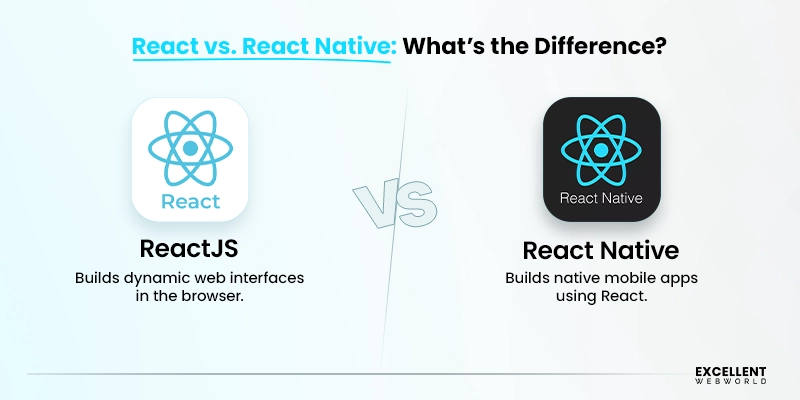
1. Platform & Target Environment
In the list of key differences between React vs React Native, we will start with the fundamental difference, which is where they run. React is a web library, so it runs in a browser and produces HTML elements that the browser renders.
On the other hand, React Native is a complete mobile framework that is made to compile native iOS and Android components. It’s not really even touching the browsers at all. An expert React Native development firm can help you understand the platform and target environments of your dream app.
Here’s what they target and what they give individually:
| Aspect | React | React Native |
|---|---|---|
| Targets | Mostly web browsers. | iOS and Android. |
| Outputs | HTML/CSS rendered by the browser. | Real native UI components. |
2. Rendering Engine
The way the UI is rendered is a core difference between React Native and ReactJS. React uses the DOM from the browser, along with a Virtual DOM. This is to update elements on the screen efficiently.
React Native does not depend on the DOM at all. Instead, it communicates with native APIs through a bridge and renders real native components. This is why React Native apps feel more similar to traditional mobile applications.
| Aspect | React | React Native |
|---|---|---|
| Renders to | Browser DOM via Virtual DOM | Native platform UI components |
| Renderer | ReactDOM | Fabric (new) / Bridge (old) |
| Update Mechanism | Reconciliation against Virtual DOM | JSI calls to the native thread |
| Output Elements | <div>, <span>, <p>, etc. | View, Text, Image, etc. |
| Styled With | CSS / CSS-in-JS | StyleSheet API (CSS-like, not CSS) |
3. Styling Approach
Styling is one of the most noticeable React and React Native differences in day-to-day development. React gives you the ability to leverage the full power of CSS. This includes cascading styles, media queries, pseudo-classes, animations via keyframes, and the entire ecosystem of CSS frameworks like Tailwind.
On the other hand, React Native takes a different approach. It uses a JavaScript-based StyleSheet API that looks like CSS but is not actually CSS. There’s no cascade, no inheritance, and no browser quirks to deal with. Key pointers to differentiate between React vs Native in terms of styling pointers.
- The React library leverages standard CSS, CSS Modules, Tailwind, styled-components, etc.
- React Native uses StyleSheet.create({}) – it’s a JS object with properties like CSS.
- No class or id selectors in React Native.
- Units such as px, em, and rem don’t exist. React Native uses unitless numbers, which are density-independent pixels.
- Platform-specific styles through Platform.OS checks.
4. Navigation
React: The web navigation is managed by React Router or Next.js router. URLs change, the browser history stack is updated, and back/forward buttons work natively. The heavy lifting is mostly handled by the browser. Hiring a ReactJS developer can make all the navigation smooth and user-friendly.
React Native: The mobile navigation is managed by React Navigation or Expo Router. Screens are pushed/popped on a stack. Tab bars, drawers, and gestures everything is managed in JS; there’s no browser URL bar to rely on.
5. Component Library
React and React Native share the same component module. But they expose very different primitive components, because they are developed for different surfaces.
| Purpose | React | React Native |
|---|---|---|
| Container | <div> | <View> |
| Text | <p>, <span>, <h1> | <Text> |
| Image | <img> | <Image> |
| Input | <input> | <TextInput> |
| Scrollable list | <ul> / <div> with overflow | <FlatList> / <ScrollView> |
| Button | <button> | <TouchableOpacity> / <Pressable> |
6. Performance
Performance characteristics of React vs React Native differ significantly based on the target platform and use case. You can hire an experienced React Native or ReactJS development company to get a better understanding of the most suitable tech for achieving the best performance for your business idea.
- React renders in the browser. The performance of React is heavily dependent on the bundle size, rendering strategy (CSR vs SSR), and how the Virtual DOM reconciles updates efficiently.
- React Native renders real native components. With React Native, the UI feels smooth and native to the platform. But the JS-heavy logic can cause frame drops if not carefully managed.
- React Native’s new architecture, which is JSI + Fabric, has significantly closed the performance gap vs fully native apps.
- For heavy graphics, neither will match a fully native Swift or Kotlin app. But for most business and consumer apps, the difference is negligible.
7. SEO Capability
Generally, SEO matters more for web products. And this is where React vs React Native are simply incomparable. They serve different mediums completely.
React: SEO is possible, but it demands extra work. A standard React SPA is client-side rendered, so search crawlers may not execute JavaScript. The solution to this is to use Next.js for server-side rendering (SSR) or static generation (SSG) for making pages crawlable out of the box.
React Native: Considering mobile apps, SEO does not apply to React Native. Mobile apps don’t appear in search engine results pages. App discoverability happens through app stores via ASO (App Store Optimization), not because of Google indexing.
8. Development & Tooling
Let’s understand the difference between React vs React Native development processes with key steps involved:
- Getting Started: React projects are commonly bootstrapped with Vite or Create React App. React Native projects use the React Native CLI or Expo. This abstracts away most platform-specific configuration. You need to hire React Native developers with a great portfolio to make development easy.
- Testing: Both ecosystems of React and React Native use Jest. React adds React Testing Library for component testing. On the other hand, React Native uses its own render utilities. End-to-end testing in RN relies on tools like Detox or Maestro.
- Debugging: React benefits from browser DevTools, which has a mature, visual, always-available panel. Whereas React Native debugging is more involved, dependent on Flipper, LogBox, or the Hermes debugger.
- Build & Deployment: React apps deploy as static files to any CDN or web server. And the React Native apps must go through the Apple App Store and Google Play Store review processes. OTA update tools such as EAS Update can bypass stores for JS-only changes.
- Developer Environment: React only needs a browser. But the case with React Native is different. It requires Android Studio for Android and Xcode for iOS, macOS only, heavier local setup.
What Are the Top Similarities Between React and React Native?
Despite being made for different platforms, React and React Native share more similarities than any entrepreneur could expect. Here’s what stays consistent across both:
- Both are entirely developed in JavaScript. There is no platform-specific language that needs to be learned.
- React and React Native are built around the idea of reusable, self-contained components. The mental model is completely the same on both platforms.
- Both use JSX syntax. Whether you’re returning a <div> in React or a <View> in React Native, the JSX pattern is exactly the same.
- Props pass data from parent to child components, and state manages dynamic, changing data within a component. Everything follows the same concept, same behavior, and same rules in React as well as React Native.
- All React Hooks, such as useState, useEffect, useContext, useRef, useMemo, and custom hooks, work exactly the same in React Native.
- Both follow the same one-way, unidirectional data flow.
- State management libraries like Redux, Zustand, and React Query are working similarly on both React and React Native.
- React and React Native have capabilities to share business logic with each other. API calls, authentication logic, data formatting, validation, and state management code can mostly be written once and reused across a React web app and a React Native mobile app.
When to Choose React? [Best Use Cases]
React is always the best choice whenever you need a fast, interactive, component-driven web UI. Below are the seven scenarios where React is the go-to choice for your business. Have a look:
| Use Case | Why React? | Real-World Example |
|---|---|---|
| SaaS Web Applications | The component model fits complex, stateful UIs. Best for dashboards, real-time collaboration, and multi-step workflows. | Notion |
| E-commerce Websites UI | Fast page loads, live cart updates, smooth filtering, and smooth checkout flows enhance the user experience. | Shopify Storefront |
| Content-Heavy Platforms (Blogs, News) | React + Next.js gives the best SEO-friendly SSR pages with rich interactive features like live feeds and paywalls. | The New York Times |
| Admin Dashboards & Internal Tools | Rich data tables, charts, filters, and real-time forms. There is no SEO pressure and pure UI complexity. | Retool |
| Progressive Web Apps (PWAs) | Component architecture pairs well with service workers for installable, offline-capable app-like experiences. | Starbucks |
| SEO-Critical Websites | React + Next.js SSR makes sure fully crawlable, fast-loading pages which are rich in structured data. | Airbnb |
| Enterprise Web Portals | A build-once, reuse-everywhere component model scales throughout large teams with consistent design systems. | Microsoft Azure Portal |
When to Choose React Native? [Best Use Cases]
Whenever you need a high-performance and clear UI for your mobile application, opting for React Native is best. Here are the most preferred use cases of React Native. Have a look:
| Use Case | Why React Native? | Real-World Example |
|---|---|---|
| Cross-platform mobile apps (iOS + Android) | One codebase compiles to real native components on both platforms. There is no need to maintain two separate codebases in Swift and Kotlin. | Shopify Mobile |
| Consumer mobile apps with hardware access (camera, GPS, push notifications) | React Native provides direct access to device APIs such as camera, GPS, Bluetooth, and push notifications through native modules and libraries like Expo. | Discord |
| MVP development | Expo + React Native allows small teams to ship a fully functional iOS and Android app in weeks, not months. This makes it ideal for validating ideas quickly. | Delivery Hero (early MVP) |
| Apps where 60–70% code reuse matters for budget | Shared business logic, API calls, state management, and UI components across iOS and Android drastically reduce development and app maintenance costs. | Wix Mobile |
| On-demand & fintech app development | React Native handles real-time data, live tracking, payment flows, and complex state well. This makes it a strong fit for ride-hailing, on-demand food delivery, and financial apps. | Bloomberg |
Final Thoughts: The Verdict of React vs React Native
React and React Native are both powerful tools developed on the same foundation. But they solve different problems. If you are looking for fast and scalable web applications, then React is your best choice. And if you want a cross-platform mobile experience without doubling your development effort, then React Native is the smart choice. The right choice between React vs React Native is simply dependent on your business requirements and where your users are: the browser or their phone.
But choosing the right technology is only half the battle; you also need the right team to make your business revenue-generating. At Excellent Webworld, a leading mobile app development company, we specialize in building high-performance web and mobile applications using both React and React Native. Whether you are launching an MVP, scaling an enterprise product, or exploring cross-platform mobile development, our experienced developers fulfill all your needs. Get in touch with us to turn your idea into reality.
Frequently Asked Questions
React is a JavaScript library for building web interfaces that run in a browser; on the other hand, React Native is a framework for building native mobile apps for iOS and Android.
From the perspective of the target approach, they are not similar. But yes, React and React Native are built on the same core principles: components, JSX, props, state, and hooks all work the same way.
It depends on what you are building. If you are developing a web application, React should be your first choice. And if you are developing a mobile app for iOS and Android, React Native is the better fit.
No, React Native is actively maintained by Meta and has a large, growing community. The introduction of the New Architecture, such as JSI, Fabric, and TurboModules, in recent years has significantly improved its performance and reliability.
Yes, with a library, React Native for Web allows you to run React Native components in a browser. It maps native components like View and Text to their HTML equivalents.

Article By


Paresh Sagar is the CEO of Excellent Webworld. He firmly believes in using technology to solve challenges. His dedication and attention to detail make him an expert in helping startups in different industries digitalize their businesses globally.