Among web developers, this unending battle of JavaScript vs TypeScript has always been prevalent in the industry. Both JavaScript and TypeScript are used for full-stack development – frontend & backend.
JavaScript, created by Brendan Eich at Netscape in 1995, is very comfortably used in developing web pages and web apps. For example, It’s also used for frameworks like frontend (TezJS, React) and backend (Node.Js & Deno). However, the actual problem arises when creating large and complex web apps. As applications grow larger, JavaScript’s dynamic nature can make code maintenance, debugging, scalability, and collaboration increasingly challenging. Hence, TypeScript was launched to address JavaScript’s limitations at scale, not just to “enhance” it and add static typing and tooling support for large-scale applications.
This blog will answer the following questions in your mind:
- Which language is better, TypeScript vs JavaScript?
- Should you migrate the web app built in JavaScript to TypeScript?
- Which language has more benefits – TypeScript or JavaScript?
What is TypeScript?

TypeScript is a free, open-source, high-level language for developing complex web pages or app elements. As a strict syntactical superset of JavaScript, the TypeScript language has gained rapid traction in the web development market. By the same token, TypeScript is used as client-side and server-side language technology in web browsers.
It’s one of the most popular languages and one of the fastest-growing.
Being its superset, TypeScript has gained an edge over JavaScript. It extends over the plain JavaScript code, improving the developer’s experience. The TypeScript playground also helps in building and managing large-scale JavaScript projects.
Is TypeScript the SAME as JavaScript?
No, TypeScript is not the same as JavaScript. TypeScript is a Microsoft-developed, statically typed superset of JavaScript. It allows developers to catch bugs or errors at the earliest stage and facilitates them to build large-scale web applications.
On the other hand, JavaScript is a general-purpose scripting language that you can use for building web applications, where you can run client-side in a browser and server-side in runtimes like Node.js. All these capabilities enable you to create dynamic and interactive web pages.
A simple example of a TypeScript snippet will help you understand the difference between TypeScript and JavaScript.
In JavaScript, if you pass the wrong data type, there will be no error at compile time:
function greet(name) { return "Hello, " + name; } // greet(42) runs with no warning
In TypeScript, if you pass the same function with a type annotation, the function will catch the error at compile time:
function greet(name: string) { return "Hello, " + name; } // greet(42) → compile error
These TypeScript vs JavaScript examples will help you understand why TypeScript is a preferred choice for complex applications, where catching the errors early matters a lot.
Here are the three components of TypeScript:

What is JavaScript?
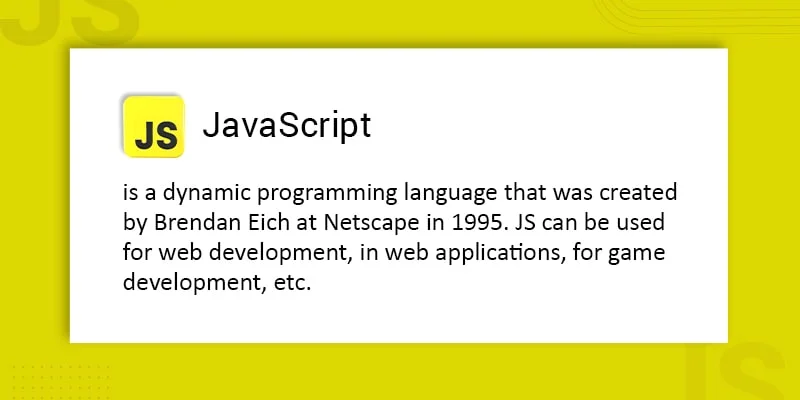
If you look at the history of JavaScript (JS), you’ll find it as one of the most prominent languages on the World Wide Web. It is used to create and design dynamic web pages. And it is a full scripting language or programming language that allows the developer to implement various elements on the web page or website.
It is considered one of the top frontend technologies and is beginner-user-friendly. It is relatively easy to learn other languages besides this one. Coders with no or little coding experience can also learn JavaScript.
When you see a menu dropping down on your web browser (tab or screen), extra elements added to a page, changing colors on a page, a text editor, etc., you see the effects and functions of JavaScript coding.
Features of TypeScript
- TypeScript is just JavaScript – It starts with JS and ends with JS. TypeScript picks the basic building blocks from JS. Hence, a coder must necessarily know only JS to use TypeScript. Additionally, every .js file can be renamed to .ts and compiled with other TypeScript files.
- Supports multiple other JS libraries – A compiled TypeScript can be consumed from any JS code. A TypeScript-generated JS can reuse existing JS frameworks, libraries, and tools.
- TypeScript code is portable – It can run on all environments, browser tab, devices, operating systems, etc.
- Static Type Checking – TypeScript helps you to catch any type of error at compile time, before you run the code in the production environment, thereby ensuring a safe and robust build.
Features of JavaScript Code
- Dynamic Typing – JavaScript is a dynamically typed language in which the variable types are determined at runtime. This allows for greater flexibility in coding but can also lead to errors if not managed properly.
- Event-driven Programming – JavaScript responds to various events such as mouse clicks, key presses, and page loads. This is why it is an apt choice to build interactive web apps.
- Garbage Collection – This is a unique feature of JavaScript. It automatically frees up memory that is no longer being used, preventing memory leaks and ensuring the smooth running of the application.
- Asynchronous Programming – In JavaScript, a programmer can execute the code without blocking the main thread.
- Widely Used & Known – Windows, macOS, Linux, Android, iOS, smart TVs, etc., all use JavaScript as a client-side programming language. This accounts for about 98.8% of all websites on the web.
How TypeScript Fills the Gaps of JavaScript?
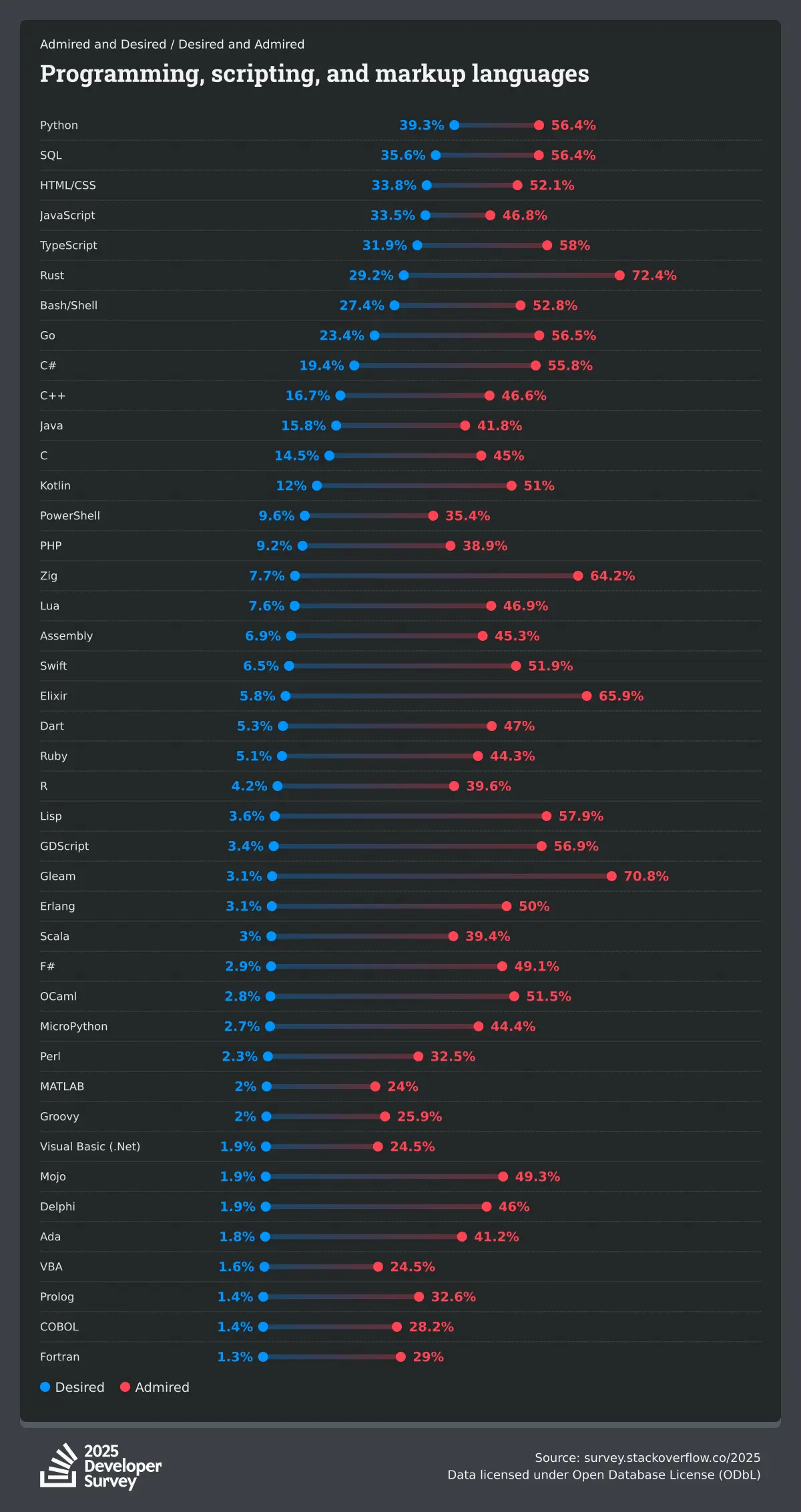
According to the Stack Overflow Developer Survey 2025, JavaScript (68.8%) and TypeScript (48.8%) are the 1st and 6th most popular programming, scripting, and markup languages, respectively.
The entire existence of TypeScript lies in addressing the core deficiencies of the JavaScript language. For these reasons, it is a popular language. Moreover, TypeScript has a solid edge over JavaScript on many levels. So, what accounts for its popularity or what sets it apart from its existing competition?
- TypeScript supports JavaScript libraries.
- It uses Data Binding methods, whereas JavaScript has no such concept.
- TS also allows developers to use all the JavaScript libraries and elements easily.
- An autocomplete functional editor in TypeScript enables developers to discover spelling errors and issues when creating classes.
- Frameworks like Angular, Next.js, Remix, Astro, SvelteKit, and NestJS support TypeScript with first-class integration. This increases its chances of future stability and reliability for users.
- TypeScript shows the type errors at compile time on the web server rather than run time. No such facility is available in JavaScript. This is where TypeScript stands out!
Differences Between TypeScript and JavaScript
This example of tabular format differences will help you discover how TypeScript differs from JavaScript?
| Basis of Distinction | TypeScript | JavaScript |
|---|---|---|
| Concept | Object-oriented programming language | Scripting language |
| Developed by? | Microsoft in 2012 | Netscape Navigator in 1995 |
| Language Features | TypeScript includes additional features, like interfaces, variables, classes, and enums, unavailable in JavaScript | JavaScript has a simpler syntax and does not have as many built-in language features |
| Superset-Subset | Superset of JavaScript | Subset of TypeScript |
| How is it typed? | A statically-typed programming language | Loosely typed language |
| Supports? | Supports both static and dynamic typing | Supports only dynamic typing |
| Learning Curve | Stiff learning curve needs prior coding knowledge | Easy to learn without programming experience |
| Tooling | TypeScript provides better tooling support, including better code editors and debugging tools. | JavaScript tooling has improved in recent years but still does not have the same level of support as TypeScript. |
| Compilation | TypeScript compiles down to JavaScript before it can be executed in the browser or runtime | Does not need compilation |
| Adoption | TypeScript is growing in popularity and is increasingly used for large-scale projects | JavaScript is still the most widely-used programming language for the web and is used for projects of all sizes |
Now that you know the difference between TypeScript and JavaScript, let us quickly explore the benefits of both at length.
Advantages of TypeScript over JavaScript
Here are the use cases when TypeScript wins over JavaScript:
- TypeScript Compilation – TypeScript’s compiler helps you catch syntax errors before your code runs. Modern JavaScript engines use JIT (Just-In-Time) compilation than doing interpretation. However, they don’t provide pre-execution type checking as TypeScript does. That’s why TypeScript is a better option during development.
- Microsoft Owns – Since the tech giant Microsoft owns it, continuous development and maintenance exist.
- Flexible – Not only runs on JavaScript engine but all browsers. It can be easily called from an existing JavaScript code.
- Good Syntax – The syntax of TypeScript is closer to the backend frameworks like Scala and Java.
Advantages of JavaScript Over TypeScript
Here are the use cases when JavaScript wins over TypeScript:
- Simplicity – JavaScript has fewer rules and concepts to master; hence, it is an easy-to-learn language compared to TypeScript.
- Wider Adoption & Support – JavaScript has been in the industry longer. This means that there are more resources, libraries, frameworks, etc. Adding more to this, the developers can get quick support from the community.
- Runtime Speed! Vroooom! – JavaScript is faster than TypeScript during runtime because TypeScript adds overhead to the code, thus slowing the speed down.
- Compatible – JavaScript is compatible with all browsers and platforms.
- No Build Step Required – You can run JavaScript without compilation, thereby helping you to speed up development for prototypes and lightweight apps.
Disadvantages of TypeScript
- The learning curve is steeper than in JavaScript, especially for developers new to typed languages.
- Requires compilation, which can increase complexity in the build pipeline.
- Type definitions for some third-party libraries can be incomplete or outdated.
- May add too much complexity for quick prototypes or small scripts.
Disadvantages of JavaScript
- With no built-in static type checking, there’s a chance of errors at runtime.
- Without type contracts between modules, it’s difficult to collaborate on large projects.
- Refactoring a large JavaScript codebase can be risky without type info.
- Dynamic typing can lead to unpredictable behavior.
Which Language Should You Use for Designing Web Pages – TypeScript or JavaScript?
The choice between JavaScript and TypeScript depends on your specific needs and preferences. Here are some factors to consider:
- If you are building a small project or a prototype, JavaScript may be the best choice as it is easier to learn, and also JavaScript requires less setup.
- If you are working with an existing JavaScript codebase, you can gradually introduce TypeScript to make your code more reliable and maintainable. (Migration)
- If you are building a large and complex project, TypeScript can make your code more reliable and maintainable, saving time and effort in the long run.
- If you are working with a team, TypeScript can help reduce communication errors and make collaborating easier on a codebase.
Ending the Battle: TypeScript vs JavaScript
Whichever you choose between JavaScript vs TypeScript for your web page or next project, it is completely your choice. At the end of the day, your business objectives and technical expertise will help you decide which is a better choice for you. And if your decision goes beyond TypeScript and JavaScript, a comparison between Python and JavaScript can help you evaluate which language best fits your project’s backend and full-stack needs.
Confused about which to pick, TypeScript vs JavaScript, for your project? Join hands with Excellent Webworld, the best website development company, to nail your project and take it to the desired heights.

FAQs
First, TypeScript is an object-oriented language for web pages, whereas JavaScript is an event-driven programming language. Second, TypeScript is used to build large/complex web applications, whereas JavaScript is used to build interactive pages.
TypeScript is often preferred for large-scale apps because it offers static typing, better tooling, improved maintainability, and easier collaboration. However, JavaScript remains a great choice for smaller projects, rapid prototyping, and situations where simplicity and flexibility are more important. The right choice depends on the project’s size, complexity, and development requirements.
Javascript is a dynamic programming language for using data, updating live content, controlling multimedia functions, animated images, etc.
TypeScript is an extended version of JavaScript. It provides more comfort to developers, improving their experience. It involves static typing that ensures error detection during code execution.
Yes, JavaScript is easier to debug and compile as it executes directly in the web browser. Even in learning JavaScript is like level 1, and TypeScript is like level 2.
Top 8 Global companies using JavaScript are:
- Microsoft
- PayPal
- Uber
- Walmart
We see this question frequently – the answer is that you cannot learn TypeScript without learning JavaScript!! Despite the differences between TypeScript and JavaScript, TypeScript shares the syntax and runtime behavior with Javascript. Hence, anything you learn about JS is helping you learn about TS simultaneously.
TypeScript is a highly typed programming language based on JavaScript that offers improved tools to scale.

Article By


Paresh Sagar is the CEO of Excellent Webworld. He firmly believes in using technology to solve challenges. His dedication and attention to detail make him an expert in helping startups in different industries digitalize their businesses globally.