A simple frontend setup that is easy to scale and maintain sounds easy to you, right? No, it requires more effort than you think.
The mistake teams always encounter is that they start with one framework. After a while, they hit roadblocks with performance issues or delays in the development cycles. Even at times, teams find it hard to balance flexibility and structure with the product expansion.
This is the reason behind developers and product teams searching for what Vue.js is used for before they make any kind of decision.
Vue.js shows constant growth when we talk about its adoption in the production environment. The BuiltWith reports say Vue.js has been used on 11.7 million+ websites. And the currently active websites among those are 4.5 million. Such a scale of use indicates its reliability for small as well as large applications.
Let’s run through this article, know briefly about this JavaScript framework, and gain a complete guide to boosting your business by developing an app.
What is Vue.js?
In simplest terms, Vue.js is an open-source front-end JavaScript framework with a gentle learning curve. It came into existence in February 2014.
Evan You develop Vue.js. What’s even more impressive is how the Vue.js idea came into existence. Evan was a Google employee, as he mainly worked on the AngularJS project. One day, Evan thought of creating a lightweight framework. He somehow wanted to extract the excellent part of AngularJS, and as a result, Vue.js was manifested.
In a nutshell, using Vue.js, one can build an impressive front-end UI. One can start with simple, and as you march forward, you can use tools to build complex features. In the current year, Vue.js has matured around Vue 3. This version introduces the Composition API and built-in support for TypeScript, along with a faster reactivity system than Vue 2.
Vue 3.5 is the latest stable release. It aims to improve reactivity performance with an experimental approach known as Vapor Mode that minimizes Virtual DOM usage. Have more questions about what Vue.js is? It will be clearer to you if you understand the characteristics of this simplest framework.
Know What Vue.js is Via its Characteristics
Well, to get an understanding of what Vue.js is used for, you should get a brief overview of the characteristics it possesses. Here we have listed it down for your understanding.
1) Virtual DOM
Besides the simplicity and scalability, virtual DOM adds to the reasons for its growing popularity. When you pass specific changes in the real DOM, the whole page reloads. Thankfully, Virtual DOM passes only necessary changes to the real DOM. With Vue 3.6, the focus is on Vapor Mode. An approach that removes reliance on the Virtual DOM by converting templates into imperative DOM operations.
So, now developers can experiment with different designs and work at their best. Moreover, creative websites can be built to impress your users.
2) Composition API
Intoduction to Composition API by Vue 3 is an architectural shift. It makes it easier for developers to structure logic based on features instead of separating it into data, methods and properties.
When used with TypeScript, it provides efficient type inference without unnecessary complexity. As per the Vue’s official documentation, new projects should adopt the Composition API with Single-File Components in 2026.
3) Animation
With a third-party animated libraries option, one can make an impressive and more interactive user interface. Vue provides <Transition> and <TransitionGroup> components. These components manges enter/leave animations in a declarative way. Also, removing the requirement for complex CSS jiggling. The latest Vue Router 5 integrates the View Transition API to deliver native page transitions.
4) Data Binding
The data binding characteristics easily set HTML values; one can modify the style with the data binding element. The reactivity system in Vue 3 is based on ES6 Proxies. This is what ensuresensures better tracking of nested data and array updates without requiring additional workarounds.
5) Component-Based Architecture
Vue’s component system forms the core of any scalable application. It includes its own template, logic, and styles. Everything is defined within a Single-File Component. As a result, code becomes easier to reuse, test, and scale. Libraries including Vuetify, Quasar, and PrimeVue provide ready-to-use UI components, reducing development time.
6) Easy to Use
The simplicity of using this JavaScript framework is its USB, which is why Vue.js has become so popular in such a short span of time. It is simple yet effective, making it the perfect framework for using an MVP app to a fully-functional app. Nowadays, Vite has replaced Vue CLI as the preffered build tool. It leads to allowing rapid server setup and efficient hot module replacement (HMR) during development.
After the characteristics, it is important to know the usage of this JavaScript framework and then know the different benefits of Vue.js.
What is Vue.js used for?
Mainly, when we talk about Vue.js, it’s used to build web interfaces and one-page applications. Surprisingly, VueJS can be used for desktop and mobile app development with an Electron framework.
Vue.js is like a tool that makes it easier to add features and enhance parts of a project or the whole foundation of one’s web app. The Vue.js library designs make it easier to add interactivity to web applications. It makes things more organized and maintainable.
The sole reason for the high demand for these frameworks is their flexible nature. Don’t worry if you are building a high complexity app, as one can use the Vue.js framework depending on the requirements of the project. So, you can start simple and then keep adding complex features to it. Let’s help you know what Vue.js is used for diverse real projects:
1. Progressive Web Apps (PWAs)
Integration with Workbox and service workers is clean when building PWAs. With Background Sync and Periodic Sync APIs, Vue applications can store updates offline and process them when the connection is available.
2. Single-Page Applications (SPAs)
One of Vue’s core strengths is building SPAs, where applications load once and update dynamically without full page reloads. Client-side routing in Vue applications is handled through Vue Router.
3. Desktop and Mobile Applications
With Electron, Vue enables the development of desktop apps that run across multiple platforms. For mobile app development, Ionic Vue and NativeScript Vue provide options for building hybrid and native-like applications.
4. Server-Side Rendered (SSR) Applications
Nuxt 4 is widely used as the standard framework for server-side rendering in Vue. Nuxt 4 is built on Vue 3, Nitro, and Vite. So it supports SSR, static generation, and client-side rendering within a single framework. This is the approach that works well for eCommerce platforms and content platforms, specifically the ones that depend on performance and visibility.
5. Micro-Frontend Architectures
Vue 3 supports module federation via Webpack Module Federation or Vite plugins to allow teams to build and deploy independent micro applications. In large engineering organizations where multiple teams own different parts of the same frontend product, this is increasingly common.
6. Enterprise Dashboards and Admin Panels
Vuetify and Quasar, Vue’s component ecosystem, helps in developing data-intensive interfaces and dashboard development. Companies like GitLab uses Vue in an extensive way for their internal tooling and web interfaces.
Now, the question stands: is the popularity of Vue.js rising among all the other frameworks? If yes, then why is it the most preferred choice these days? Why is there a sudden 40% rise in its demand? Let’s find out in the next section!
Now that you know what Vue.js is, let’s understand what are the reasons that made it popular.
Comparison of Vue.js vs. React vs. Angular in 2026
The comparison landscape has shifted meaningfully since Vue first appeared. Here’s where things actually stand:
| Dimension | Vue.js 3 | React 18+ | Angular 17+ |
|---|---|---|---|
| Learning Curve | Low (fastest to onboard) | Medium (JSX, hooks depth) | High (full opinionated framework) |
| SSR / Meta-Framework | Nuxt 4 | Next.js | Analog.js (newer, smaller) |
| Performance | Excellent (3.6 improved with Vapor Mode) | Excellent with concurrent features | Good with heavier bundle baseline |
| Ecosystem Size | Large, curated | Largest (npm downloads) | Large, but enterprise-heavy |
| TypeScript Support | First-class in Vue 3 | Good, but requires setup | First-class (TS-native) |
| Best For | SPAs, dashboards, SaaS | Anything; largest ecosystem | Large enterprise, Google-backed |
| State Management | Pinia (official, lightweight) | Redux / Zustand / Jotai | NgRx / Signals (Angular 17+) |
| Backed By | Community + sponsors | Meta |
Vue.js vs. Angular
As we mentioned earlier, Vue.js has sucked up all the good things of Angular. Also, more good things are added to it and thus made it inherently better than Angular.
So without any doubt, when we compare Vue.js with Angular.js, Vue.js has more followers, as, in a way, it is a better version of Angular.js.
Vue.js vs. React
But again, when you compare Vue.js with React.js, the latter is quite popular. Unfortunately, there are fewer downloads of VueJS when compared to React.js. But again, most developers believe that Vue is much easier to use.
Moreover, most of the clients now demand VueJS compared to React Native. For sure, the demand for Vue.js has started booming in the market. Therefore, Vue will continue to grow to surpass the demand for React.js.
What You Need to Know About The Vue.js Ecosystem in 2026
If you think Vue 3 is in isolation, just stop. The real power of Vue comes from its integrated ecosystem. Let’s have a quick look at the tools that are required for a Vue project.
1. Vite
The Vue ecosystem now classifies Vue CLI as a legacy solution. Every single Vue project is advised to use Vit as the build tool. Even on large codebases, Vite offers near-instant dev server starts and HMR that feels immediate. The introduction of Vite+ points to a Rust-based future focused on improving build speed and performance.
2. Pinia
Vue now recommends Pinia instead of Vuex for state management. Each store in Pinia is independent, making state management more structured and easier to manage. In 2025, Pinia ended Vue 2 compatibility to align with Vue 3’s Composition API. if you are dealing with shared state, Pinia offers a more suitable approach.
3. Vue Router 5
Vue Router 5 supports the native View Transition API, allowing smooth page transitions without additional libraries. Route-level data fetching is now managed through a built-in Data Loading API. Improvements in lazy loading can reduce initial load times by up to 40%.
4. Nuxt 4
Released in mid-2025, Nuxt 4 is what you use when Vue projects need SSR, SSG, or full-stack capabilities. The framework is powered by Vue 3, Vite, and Nitro. The framework brings structured architecture, integrated data fetching, and stronger TypeScript support. Following its acquisition by Vercel, Nuxt Labs made its ecosystem tools widely available.
Also, when we talk about ReactJS vs. AngularJS vs. VueJS, one needs to understand the pros and cons of each framework and then decide which one best suits their project requirements. After knowing ‘What is Vue.js?’, it’s time to learn some benefits of using this framework and its various uses.
Benefits of Using Vue.js for Your Business
Firstly, the main advantage of Vue.js is its size-18-21Kb. Secondly, the speed of the framework. Though it is small in size, it offers high speed. Lastly, its clean code tends to make it the most preferred choice among clients.
Vue.js is a progressive framework. So, it can be used for projects as per the requirements. The framework offers a lightweight library to add some interactivity to a web application. Here are some more reasons why one uses Vue.js for their app development.
Performance Efficiency
Vue comes up with strong performance in a compact bundle when you are comparing ot to the equivalent frameworks.According to 2025 benchmarks, Pinia outperformed Vuex with faster state updates and lower memory consumption in complex setups. Even the developers gets accessibility to add new features and funcationalities per the demand of the clients with less strain.
Highly Flexible
Well, the nature of Vue.js is highly flexible. So, when we talk about flexibility, we mean to say that it can be used as a library in a project, or one can build a project using all the framework’s features.
Long-Term Benefits
Once your application is deployed, multiple updates are on the way. Interestingly, Vue.js has made it much easier to make updates compared to other frameworks. With the Composition API, Vue 3 enables better code reuse using composables that manage stateful logic, making large applications easier to maintain. Moreover, it shows good compatibility with the backend too. As per developers, VueJS works amazingly with Laravel in the backend.
Strong and Growing Community
The Vue.js ecosystem is active, growing, and driven by its developer community. GitHub rankings place Vue among the most popular JavaScript projects based on stars. If you look at the recent data, it shows 80% of developers prefer to continue using Vue, reflecting growing satisfaction. Leading organizations like Alibaba, GitLab, Nintendo, IBM, Expedia, and Adobe rely on Vue.
Size- Efficient
If you are worried about tweaking the application, Vue.js won’t fail you. Compared to the equivalent frameworks, though VueJS is small in size, it provides better performance. Hence, developers can add new features per the client’s demand with less strain.
Extremely Popular
As time passes, Vue.js is becoming extremely popular. Currently, the demand for React.js is high in the market, but soon, we will observe a paradigm shift from React.js to Vue.js.
If you are thinking of choosing VueJS for your next web development project, then here are some things you should know about Vue.js.

Hidden Truths about What Vue.js is Used for?
Though Vue.js has been around for several years, it’s still considered a new kid. The one drawback of VueJS is that a big company doesn’t back it up.
Comparatively, other frameworks are backed up by Facebook, and thus, this sole reason makes clients not go for Vue.js.
But looking at the growing popularity of VueJS, soon, any big company will start backing up Vue. JS framework.
Well, many of the clients come to us and ask about which one is better in Node.js Vs. Vue? We want to clarify this misconception that Node.js is primarily used for the backend, and VueJS is a front-end framework. Similarly, one can even use Node.js with React for web development.
Yes, we can undoubtedly debate about Next.js vs. Vue. Well, Next.js came into existence in 2016, two years after the launch of VueJS. Next.js is also an open-source web development framework of React.js.
As Next.js is new in the market, it needs some time to grow. People are shifting from React.js to Vue.js as they have started building confidence in Vue.js. Next.js is still growing in the market.
Therefore, the latter wins the race when we talk about Next.js vs. VueJS, as many big companies have started using the Vue.js framework. Let’s have a look at the list of companies here.
Some of the companies using VueJS frameworks are Expedia, IBM, GitLab, Nintendo, Alibaba, and many more. These companies are pleased with the simplicity that the Vue.js framework offers.
Common Questions Asked About Vue.js
Vue.js, recognized in the market, comes with confusion among people. Here are the queries that we are addressing for you to get everything clear and sorted about Vue.
Q1. Is Vue.js backed by a big company?
Most of the people have this query in their minds. Vue.js is community-funded and maintained, not like React (Meta) or Angular (Google). In 2025, Vue’s ecosystem partners, like Vercel and major cloud providers, will provide substantial backing.
Q2. What is the difference between Node.js and Vue.js?
Both are not competitors, but they are complementary. Talking about Node.js, it runs on the server side. And Vue.js runs in the browser. One on backend and one on frontend. You can and often should use both together: Vue for the UI, Node.js for the API, and server logic.
>Q3. What is the difference between Next.js and Vue.js?
Next.js and Vue.js are frequently compared. If you want an honest answer, here it is: Next.js dominates SSR for React developers, while Nuxt 4 is the equivalent for Vue. Both are production-grade. If your team already knows React Native, Next.js wins. If your team is Vue, Nuxt is the natural SSR choice.
Is Vue.js Suitable for Large-Scale Enterprise Projects?
You know this answer very well by just looking at GitLab. It’s entire frontend is built in Vue. even Alibaba runs major consumer facing applications on Vue. Not just this, Adobe, Nintendo, and IBM have also deployed Vue across production systems.
The Composition API in Vue 3 focuses on solving challenges faced with large-scale development through better code reuse and clearer structure. Vue becomes more suitable for large-scale and enterprise applications when paired with Nuxt 4 and Pinia.
Its obvious that choosing between Vue, React, or another framework depends on the specific goals and technical needs of the project. You can anything partner with a software development company like Excellent Webworld who are experts at JavaScript development. We have built scalable frontends in industries spanning healthcare, fintech, and SaaS for clients ranging from startups to Fortune 500 companies.
How To Hire a Vue.js Developer for Your Business?
Without any doubt, today, many big websites are using VueJS. Even if you are not aware of what Vue.js is used for? Then, judging by the popularity, we can say that it’s safe to use VueJS for your next project.
Working with Excellent Webworld can help take your project to the next level, as it is the best mobile app development company. Furthermore, our developers are well-trained and have experience working with Vue.js. So, you can trust these development experts for your next project.
FAQs
Well, VueJS is proving to be an excellent open-source front-end library. It aids in building web interfaces and single-page applications. In the current year, the framework is used for SSR applications via Nuxt 4. Also, its favourable for Progressive Web Apps (PWAs), enterprise dashboards, and micro-frontend architectures. Many big companies are thinking about developing a website with VueJS.
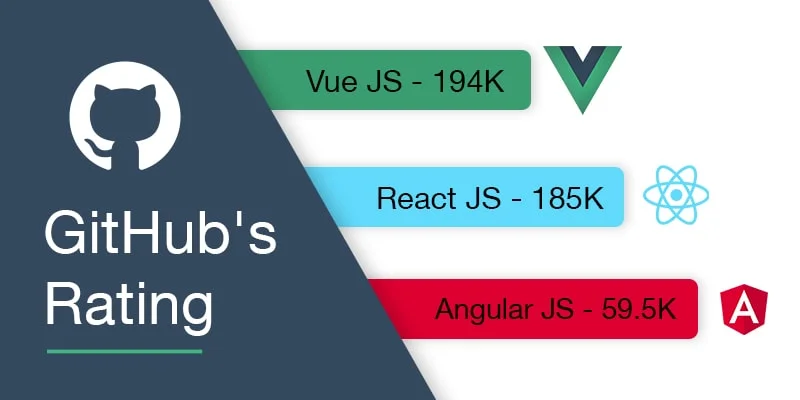
As per the GitHub ratings, there are more stars for VueJS compared to React. Though React holds a strong reputation, the popularity of VueJS is increasing rapidly. This depends on various factors, like your team and use cases as well. On the left side, Vue has fewer npm downloads than React. On the right side, it consistently scores higher in developer satisfaction surveys. Vue is simpler with a unified stack. React is broader and more in demand. Both fit different cases.
Yes, indeed, Vue.js is exceptionally lightweight and flexible for web development. A new Vue 3 project can be up and running quickly with Vite. And, the Composition API helps manage complex features without increasing development overhead. VueJS can also meet the advanced needs of the website. Also, there are ample benefits of building a website with VueJS.
No, VVue.jsis a part of JavaScript. Vue is a modern JavaScript framework that provides functional facilities like progressive enhancement.
VueJS is an open-source front-end JavaScript framework. It was developed by Evan You in the year 2014. With VueJS, one can build websites and single-page applications.
It depends on the regions and experiences of the developer. However, the approximate cost to hire a Vue.js developer in the USA ranges from $80 to $200/hour for senior talent. Whereas if you target cost-effective regions like India, the cost ranges around $15 to $40/hour. If you don’t want to waste time, contact us. Excellent Webworld offers dedicated Vue.js developers with Vue 3 and Composition API expertise.
There are several ways in which one can hire an app developer. For instance, one can connect with freelancers, developer communities, and companies. However, if confused about where to find VueJS experts, the overseas companies like Excellent Webworld providing the best and experienced Vue.js developers, are the best among these options.
Yes, the recently launched Vue.js 3 is a sturdy platform that can quickly develop an MVP or a fully-functional app. Moreover, Vue.js web development is used by the giant global OTT platform like Netflix.

Article By


Paresh Sagar is the CEO of Excellent Webworld. He firmly believes in using technology to solve challenges. His dedication and attention to detail make him an expert in helping startups in different industries digitalize their businesses globally.