User experience is the number one priority for any business that offers a website or an app platform to its customers. Developers are fighting over which front end technology is the best without knowing that the users don’t care which front-end technologies you use, all they want is the best user experience.
In 2026, you need to give more importance to the front end than ever before. The reason behind that is that Google’s Core Web Vitals are now major ranking signals, enterprise buyers are looking at the loading time of your website before signing the contract, and AI-generated interfaces are raising the UX bar. In this scenario, picking the wrong frontend technologies can cost you months of rework.
However complex the app’s working, what users see, and experience has to be seamless. And this principle is what made the majority of the global startups into an international enterprise in just a few years – Netflix, Facebook, Instagram, etc.
All the latest websites and apps are powerful yet simple and have a brilliant user interface. However, with the increasing scope in technology and the demands of customers, there is a constant need to upgrade the quality in terms of usability and functionality using the latest and best front end technologies and frameworks.
It’s time for new and exciting web development and Front end development software. So, today in this article, we’ll be talking about the best Front end frameworks, tools, and technologies of 2026.
But before going all technical with front end development, let’s have a front end, 101 class, for the non-technical readers.
What Is Frontend Web Development?
The front-end development is a balance of and layouts that empowers the web product’s visuals, app design elements, and user interactions (site or app).
In most simple terms, if a web design depicts how the website looks, the front-end development is what implements that design. This collaboration of professionals in the web development team ensures a smooth user experience.
For instance, consider your website as a car. The backend will include the features that make your car run (the engine, transmission, exhaust, etc.). On the other hand, the front end will consist of features that make your car look cool, like a racing stripe, sleek leather interior, etc.
All the elements on the web page that you can directly interact with, i.e., see, touch, or hear, are frontend elements. A front-end developer works at the intersection of design and engineering. They aim to translate visual mockups into high-performing, functional interfaces using HTML, CSS, JavaScript, and modern frameworks.
Why Frontend Technology Choice Matters More in 2026
If you build a high-quality frontend for your website, you can increase conversion rates, lower bounce rates, and strengthen brand trust. Your website is the face of your brand; therefore, it must be visually appealing, functional, and fast.
Key Statistic:
According to Google, 53% of mobile users abandon your website if it takes more than 3 seconds to load. That’s why you need to ensure your loading time stays as minimal as possible.
For that purpose, you need to make the right frontend tech choices, as they affect your Core Web Vitals, which in turn affect organic rankings.
In 2026, enterprises are evaluating frontend technology stack by looking at the AI-readiness, i.e., do the frameworks you’re using support AI-generated UI components, edge rendering, server components, and real-time data streams? These are not “nice to have” but “must have” features.
What Are The Benefits Of Modern Frontend Web Technologies?
Here are the key benefits of using modern frontend web technologies:
| Benefit | What It Means In Practice |
|---|---|
| Enhanced Code Quality | Modern-day frontend software development frameworks enforce coding standards, reduce inconsistencies, and catch errors early. |
| Hot Reloading | The changes made to your web applications are reflected instantly in the browser without losing app state, enabling faster iteration cycles. |
| Accelerated Development | With reusable modules, CLI scaffolding, and pre-built components, you can reduce time-to-delivery. |
| Reduced Code Duplication | Component-based architecture helps you to encapsulate logic, style, and view so you can write once and reuse everywhere |
| AI Integration Ready | Modern frontend frameworks support server components and streaming, thereby enabling seamless integration of AI features. |
List of 10 Most Popular Frontend Technologies in 2026
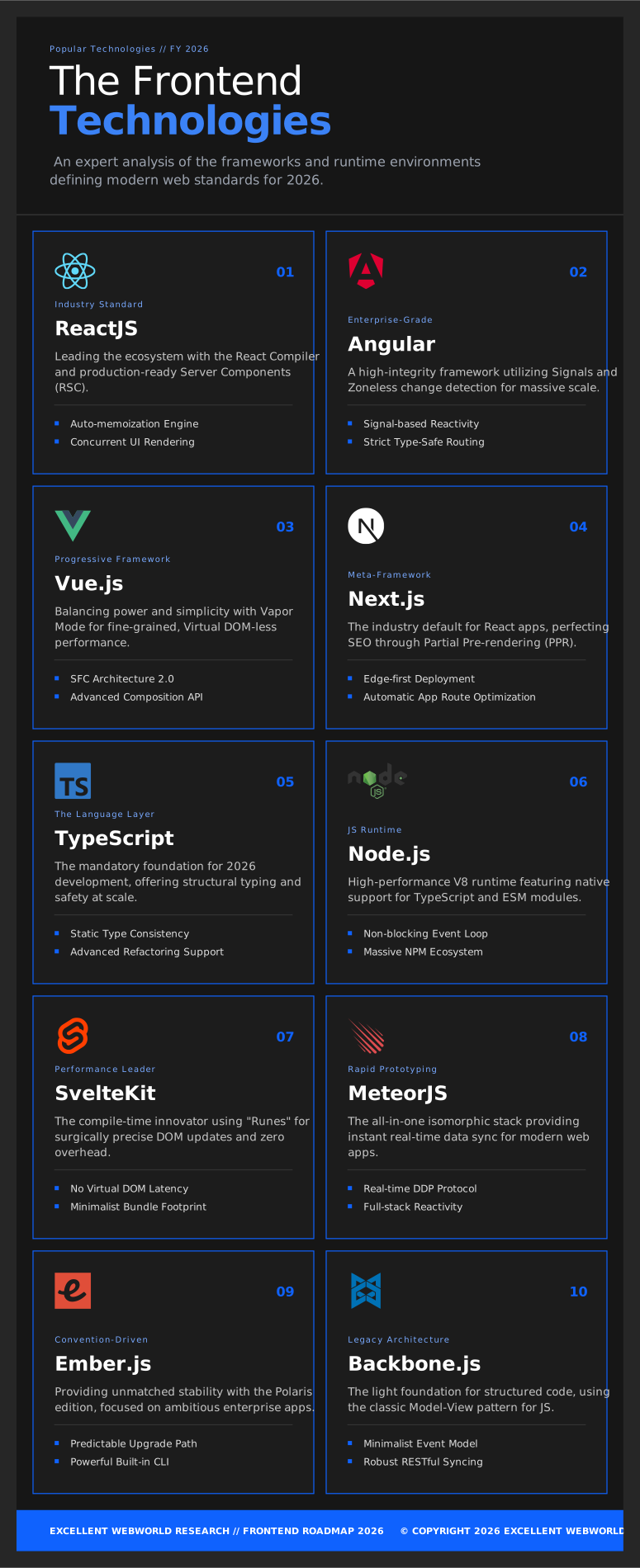
We curated this list based on the Stack Overflow Developer Survey 2025 usage data, npm downloads trends, real-world project viability, and GitHub stars.
Modern stacks prioritize AI, server-side efficiency, and edge computing. This roadmap covers the high-performance tools redefining today’s user experience.
HTML5 and CSS3 endure, but 2020 staples like Flash and AngularJS are now legacy. We retained this infographic to highlight six years of progress in web standards.

Here are the frontend technologies that matter the most in 2026 and beyond:
1. ReactJS — The Industry Standard
If you talk about the most prominent JavaScript libraries for frontend mobile app development and website development, then ReactJS is one of the first names that comes to mind. Maintained by Meta (formerly Facebook), it allows you to build reusable UI components.
React 19, released in 2024, is the latest version of ReactJS and includes a React Compiler that automatically optimizes re-renders. It means you don’t need to use manual useMemo and useCallback, which improves the developer experience for large-scale applications. In addition, React’s Server Components architecture makes it a top choice for developing AI-powered web applications.
Key features:
ReactJS Use Cases and Industry Adoption
2. Angular — Enterprise-Grade Architecture
Created in 2009 as AngularJS and fully rewritten as Angular 2+ or Angular 18 as of 2026, it is one of the most widely used frontend frameworks. Angular is Google’s batteries-included frontend framework, which means it comes with almost all the tools, libraries, and functionality required to build a complete web application. The framework is opinionated, TypeScript-first, and built for teams focused on long-lived, complex applications.
Key features:
Angular Enterprise Use Cases and Market Presence
3. Vue.js — The Progressive Framework
According to the Stack Overflow Developer Survey 2025, Vue.js is the 8th most popular web framework, with a 17.6% adoption rate among developers. Teams that want a gentle learning curve and strong scalability can use Vue.js. With the rise of Vue 3, its Pinia state manager, and Composition API, its performance is very close to React’s for mid-market applications.
Key features:
Vue.js Project Suitability and Top Adopters
4. Next.js — The Meta-Framework for Production React
Next.js by Vercel has become the de facto standard for shipping React-based applications in production. The latest version of Next.js, i.e., Next.js 15, was released in 2025. It provides features such as React Compiler integration, improved server actions, and partial prerendering, making it an ideal choice for SEO-critical, performance-first web apps.
Key features:
Next.js Production Use Cases and Global Implementation
5. TypeScript — The Language Layer
If you compare TypeScript vs JavaScript, you will find out that TypeScript is not just a framework, but a typed superset of JavaScript that compiles to plain JavaScript. With 48.8% adoption among developers, TypeScript has become non-negotiable for enterprise frontend development. Angular is TypeScript-native, while Vue, React, and Next.js provide support for TypeScript.
Key Features:
TypeScript Implementation and Enterprise Support
6. Node.js — JavaScript Beyond the Browser
Built on Google’s V8 engine, Node.js is a powerful JavaScript runtime that continues to dominate the Stack Overflow Developer Survey with an adoption rate of 48.7%. With the help of Node.js, you can use JavaScript on the server-side, thereby enabling full-stack JavaScript development. You can also build real-time applications like I/O-intensive platforms, video streaming, and single-page applications with the help of Node.js.
Key features:
Node.js Environment Utility and Leading Adopters
7. Svelte/SvelteKit — The Compile-Time Performance Leader
Svelte is one of the most unique frontend frameworks, taking a different approach to frontend development. Instead of shipping a runtime framework to the browser, Svelte compiles components into optimized vanilla JavaScript at build time. As a result, there is a smaller bundle size, faster loading times, and amazing Core Web Vitals scores. Svelte 5, released in 2024, introduced runes to help ensure predictable reactivity.
Key features:
Svelte Performance Use Cases and Developer Adoption
8. MeteorJS — Full-Stack Rapid Prototyping
MeteorJS is one of the most popular JavaScript frameworks that you can use for rapid prototyping and running isomorphic JavaScript applications. With the introduction of Next.js, MeteorJS has not been the first choice for production deployment. However, for the teams that need out-of-the-box real-time data reactivity and cross-platform code generation for Android, iOS, and web, MeteorJS is the best bet.
Key features:
MeteorJS Prototyping Strengths and Industry Users
9. Ember.js — Convention-Driven Development
Developed in 2011, Ember.js is a free and open-source JavaScript framework for client-side development that can help you build high-end web applications. The USP of Ember.js is that it provides an end-to-end solution for application flow and data management. Lastly, it remains a strong choice for teams who value conventions over configuration.
Key features:
Ember.js Scalability and Long-Term Maintenance Use Cases
10. Backbone.js — Lightweight Legacy Architecture
Backbone.js is one of the most lightweight JavaScript libraries available in the market that you can use to build client-side applications. While Vue, React, and Angular have superseded Backbone.js in terms of performance, you can use Backbone for legacy enterprise applications. If you have an old application running on Backbone.js, you can use it. However, for any greenfield development, we don’t recommend using it in 2026.
Key features:
Backbone.js Legacy Support and Application Scope
Frontend Framework Comparison Table (2026)
Here is a side-by-side comparison of the top frontend frameworks:
| Framework | Type | Language | Best For | Learning Curve | Developer Adoption |
|---|---|---|---|---|---|
| React | Library | JavaScript/TypeScript | SPAs, AI apps, enterprise | Medium | 46.9% |
| Angular | Framework | TypeScript | Large enterprise apps | Steep | 19.8% |
| Vue.js | Framework | JavaScript/TypeScript | Mid-market, progressive apps | Low-Medium | 18.4% |
| Next.js | Meta-framework | JavaScript/TypeScript | SEO-critical, SaaS, e-commerce | Medium | 21.5% |
| Svelte | Compiler | JavaScript/TypeScript | Performance-critical UIs | Low | 6.9% |
| Node.js | Runtime | JavaScript | Full-stack JS, real-time apps | Medium | 49.1% |
| TypeScript | Language/Superset | TypeScript | Type-safe, large codebases | Medium | 48.8% |
| MeteorJS | Full-stack Framework | JavaScript/TypeScript | Real-time apps, rapid prototyping | Low-Medium | <1% |
| Ember.js | Framework | JavaScript/TypeScript | Ambitious, long-term web apps | Steep | <1% |
| Backbone.js | Library | JavaScript | Lightweight SPAs, legacy apps | Low | <1% |
How to Choose the Right Frontend Framework for Your Project
There can’t be a single best frontend framework. The correct choice depends on many factors, including team expertise, maintenance requirements, and project needs. Here’s how you can choose the correct framework:
| If your situation is… | Choose this |
|---|---|
| Building a large enterprise SPA with many developers | Angular — enforced architecture prevents inconsistency at scale |
| SEO-critical site or SaaS product | Next.js (React) — SSR + RSC + optimized image/font handling |
| The team is new to modern JS frameworks | Vue.js — gentlest learning curve with strong Nuxt.js ecosystem |
| Performance is the primary metric (LCP, TTI) | Svelte/SvelteKit — compile-time optimization, no runtime overhead |
| Rapid MVP or prototype with real-time data | MeteorJS or Next.js with Supabase |
| AI-integrated product requiring streaming responses | Next.js with React Server Components + Vercel AI SDK |
Which Frontend Frameworks Do EWW Developers Recommend?
Over the last 15 years or so, we have delivered 900+ projects to 650+ clientele. So, based on that experience, we can say that you should stick to:
Choose The Perfect Frontend Development Technologies
If you’re still running your frontend on older or outdated tech stack, 2026 should be your year for modernization. The gap between modern-day frontend frameworks’ performance (Core Web Vitals, AI readiness, and edge rendering) and legacy frameworks is widening, creating a competitive disadvantage for you.
So, if you’re looking for website development solutions, opt for modern frontend development services. We at EWW have delivered 900+ projects across 35+ industries like healthcare, fintech, manufacturing, and enterprise software. Whether you want to develop an enterprise SaaS application, a regulated app, or legacy modernization, we have seen it all.
Ready to build with the best frontend technologies for your use case? Get in touch with EWW’s expert frontend development team.

Article By


Paresh Sagar is the CEO of Excellent Webworld. He firmly believes in using technology to solve challenges. His dedication and attention to detail make him an expert in helping startups in different industries digitalize their businesses globally.